
由我们的艺术家按需定制,为您提供您所选尺寸及画框的布面手工油画。 ( 切换至版画销售渠道 切换至数字图像销售渠道)
您可以从与原作比例一致的预设尺寸中进行选择。

请输入您需要的宽度和高度,以适配您的画框或墙面。由于作品为手工绘制,若您选择不同的尺寸比例,艺术家可能会在画面边缘多画一些或稍作裁剪 —— 由您决定。在开始绘画之前,我们会为您发送一份数字效果图供您确认。本页面上展示的图片并非最终实物 —— 只有效果图才能反映真实结果。
Untitled (447)
复刻品尺寸说明

In the golden twilight of the Middle Ages, a period where the flickering candlelight of monastic scriptoriums met the burgeoning splendor of the Burgundian court, there emerged an artist of unparalleled delicacy and prestige. Simon Marmion, a master whose brush breathed life into the parchment of history, earned the reverent title of "the prince of illuminators." Born in Amiens around 1425, Marmion was a product of a rich artistic lineage, raised in an environment where the craft of painting was woven into the very fabric of family life. With his father, Jean, and his brother, Mille, also practicing the arts, Marmion’s early development was steeped in the technical rigors of the French and Netherlandish traditions.
His career was inextricably linked to the heights of political power and the opulent tastes of the Duchy of Burgundy. As the Burgundian territories expanded in influence, so too did Marmion's reputation. His presence at the legendary Feast of the Pheasant in Lille, under the patronage of Philip the Good, signaled his ascent into the inner circles of European nobility. This was an era of profound cultural synthesis, and Marmion stood at the crossroads of two worlds. While his roots lay in the French tradition, his work increasingly embraced the innovative Flemish spirit, characterized by a burgeoning interest in atmospheric landscapes and complex compositions that would define the Early Netherlandish style.
Marmion’s true genius resided in the intimate scale of the illuminated manuscript. To look upon his miniatures is to witness a world captured in jewel-like precision. He possessed an extraordinary ability to manipulate color and light, creating scenes that felt both spiritually transcendent and tangibly real. His work on the Grandes Chroniques de France remains a pinnacle of his achievement; within its pages, one finds a breathtaking array of miniatures ranging from vibrant, sweeping battle scenes to experimental works executed in a subtle, near-grisaille technique. This versatility allowed him to navigate between the grandiosity required for royal chronicles and the quiet, contemplative stillness needed for devotional texts.
Beyond the borders of manuscripts, Marmion’s hand extended to larger altarpieces and portraits, showcasing a stylistic evolution that bridged the gap between medieval symbolism and Renaissance naturalism. While some critics have noted a certain stiffness in his figures or occasional awkwardness in proportion, these elements often contribute to the unique, rhythmic grace of his compositions. His technical command of perspective was remarkably sound for his era, providing a structural depth that allowed his landscapes to breathe, even within the confines of a small panel. This mastery of space and atmosphere helped pave the way for the more robust realism seen in later Netherlandish masters.
The historical footprint of Simon Marmion is visible across the great museums of the world, from the Gemäldegalerie in Berlin to the Metropolitan Museum of Art in New York. His ability to serve the most powerful patrons of his time—including Charles the Bold and Margaret of York—ensured that his aesthetic would influence the visual language of the Burgundian court for generations. Even after his death in 1489, his legacy continued through his pupils, such as Jan Provoost, who carried forward the traditions Marmion had refined.
Marmion’s significance lies not merely in the beauty of his creations, but in his role as a cultural bridge. He captured a moment of profound transition in European art:
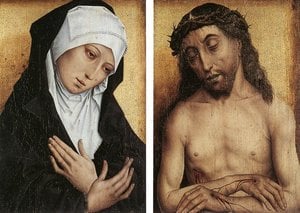
1425 - 1489 , France


 实景预览
实景预览
 发送
发送 分享
分享
 详情
详情 指南
指南

 下载图片
下载图片
 相似作品
相似作品 X射线
X射线 幻灯片播放
幻灯片播放 统计数据
统计数据 阅读全文
阅读全文






































 玻璃选项仅适用于110厘米以下的尺寸。


