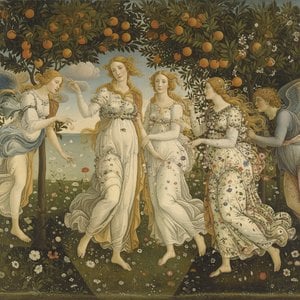
A Renaissance Reverie: The Intimate Allegory of Venus and Mars
In the quiet, golden light of the Florentine Renaissance, Sandro Botticelli captured a moment that transcends the boundaries of mere mythology, offering instead a profound meditation on the delicate balance between passion and peace. His masterpiece, Venus and Mars, is not a scene of dramatic conflict or heroic conquest, but rather an exquisite study in vulnerability and repose. As we gaze upon this captivating panel, we find the Roman deities Venus, the goddess of love, and Mars, the god of war, locked in a tender, dreamlike embrace. There is no clashing of swords here; instead, there is the soft rhythm of breath. Mars lies in a deep, defenseless slumber, his formidable strength surrendered to the gentle presence of his lover. Venus watches over him with a serene, knowing gaze, her very essence acting as a soothing balm to the spirit of battle. This intimate tableau invites the viewer into a sanctuary of stillness, making it an ideal centerpiece for any collection seeking to evoke tranquility and timeless elegance.
The technical brilliance of Botticelli shines through in every meticulous stroke of tempera on poplar. A master of the graceful line, Botticelli employs a signature aesthetic that bridges the transition from the late Gothic period to the burgeoning Early Renaissance. His ability to render anatomy with both precision and poetic softness is nowhere more evident than in the figure of Mars, whose muscular form is depicted with a breathtaking, sculptural beauty. The artist utilizes a delicate palette and fine contour lines to create a sense of shallow, focused depth, drawing the eye toward the central figures while celebrating the intricate textures of the surrounding elements. For the discerning collector or interior designer, the painting’s rhythmic composition and fluid movement offer a sophisticated visual harmony that complements both classical and contemporary settings, providing a window into the meticulous craftsmanship of the 15th century.
Symbolism and the Harmony of Opposites
Beyond its surface beauty, Venus and Mars is a rich tapestry of humanist symbolism, designed to resonate with the intellectual currents of Renaissance Florence. The painting serves as a powerful allegory for the triumph of love over strife—the idea that affection possesses the unique power to disarm even the most aggressive forces of nature. This theme is further enriched by the playful presence of infant satyrs frolicking around the sleeping god, representing the untamed, sensual impulses of desire that emerge when the rigors of war are set aside. Even the smallest details, such as the swarm of wasps hovering near Mars’ head, invite deep contemplation; they may represent the stinging potential for pain that exists even within the most profound intimacy, or perhaps serve as a subtle emblem of the fleeting nature of peace. To possess a reproduction of this work is to bring into one's home not just a beautiful image, but a complex philosophical dialogue regarding the eternal dance between strength and softness, conflict and concord.
For those looking to infuse their living spaces with a sense of historical depth and emotional resonance, this work offers unparalleled inspiration. Whether placed in a private study to encourage quiet reflection or as a focal point in a grand salon to spark conversation, the painting’s narrative power remains undiminished by the passage of centuries. It stands as a testament to the enduring allure of classical myth and the human desire for harmony. Through its masterful use of color, light, and symbolic complexity, Botticelli’s Venus and Mars continues to enchant, offering a sophisticated aesthetic experience that celebrates the profound beauty found in moments of absolute surrender.
常见问题与解答
"venus and mars" 的整体色调有多明亮?
波蒂切利 的《venus and mars》 的视觉亮度为 balanced,能够与目标空间的灯光完美融合。
波蒂切利 的《venus and mars》 的色调是明亮还是深沉?
波蒂切利 的《venus and mars》 的记录数值为:亮度 balanced,亮度感 Gentle Luminance。
《venus and mars》属于 波蒂切利 艺术生涯中的哪个时期?
在波蒂切利的艺术生涯中,"venus and mars"创作于Renaissance时期。这一阶段有助于将其与艺术家的其他作品进行比较。