艺术家简介
Early Life and Artistic Beginnings
Rudolf Koller, born in Zürich on May 21st, 1828, emerged from a world steeped in the everyday rhythms of rural life. His father, Johann Heinrich Koller, initially a butcher and brewer, later became the innkeeper of the “Schwarzen Adler” hotel—a central hub frequented by waggoners and cattle dealers. This formative environment indelibly shaped the young artist’s sensibility, immersing him in the sights and sounds of horses and livestock from an early age. While his peers might have been drawn to more conventional subjects, Koller found himself captivated by the raw beauty and inherent dignity of these animals. His initial education at a private school was followed by attendance at Fraumünster elementary school, but it was within the bustling atmosphere of his father’s inn that his artistic inclinations truly began to blossom.
From 1840 to 1843, Koller received formal training at the cantonal industrial school in Zürich, where he first honed his skills under the guidance of his uncle, a landscape painter who recognized and nurtured his nephew's talent for depicting horses. This early mentorship proved pivotal, solidifying Koller’s decision to specialize in animal painting—a path that would ultimately define his career. In October 1843, he embarked on a more structured artistic education, studying under Jacques Schweizer, Johann Rudolf Obrist, and Hans Jacob Ulrich, absorbing their techniques and refining his approach through private lessons.
Formative Years and Düsseldorf Influence
Koller’s pursuit of artistic excellence led him to Munich in 1845, where he joined a collective of Swiss artists known as “the Schweizer,” under the leadership of Johann Gottfried Steffan. This period marked a crucial step in his development, exposing him to new ideas and fostering a sense of camaraderie among fellow countrymen. However, it was his subsequent engagement at the stud farm of the King of Württemberg near Stuttgart that truly cemented his reputation as an animal painter. Commissioned to create depictions of horses and dogs, Koller’s talent for capturing their anatomy, movement, and character quickly gained recognition.
The years 1846-1847 saw Koller in Düsseldorf, a prominent center for artistic training at the time. Studying figure drawing under Karl Ferdinand Sohn at the Fine Arts Academy proved invaluable, but it was the friendships he forged with Arnold Böcklin—the future Swiss Symbolist painter—and Anselm Feuerbach, a leading German classicist, that profoundly influenced his artistic trajectory. These encounters broadened his intellectual horizons and encouraged him to explore new avenues of expression. A shared journey to Brussels and Antwerp in 1847 further enriched his understanding of European art, exposing him to the works of Old Masters and contemporary painters alike.
A Master of Realism and *Plein Air* Painting
Following Düsseldorf, Koller settled in Paris, where he shared a studio with Arnold Böcklin. Immersing himself in the vibrant artistic milieu of the French capital, he spent countless hours at the Louvre, meticulously copying Netherlandish artworks from the 17th century and studying the techniques of contemporary animal painters like Rosa Bonheur and Constant Troyon. He also sought guidance from Jacques Raymond Brascassat, a respected figure in the Parisian art world.
Koller’s style gradually evolved, embracing a realist aesthetic characterized by meticulous detail, accurate observation, and a profound respect for nature. However, he was not merely a replicator of reality; his paintings possessed a sensitivity and emotional depth that set him apart from his contemporaries. He became known for his *plein air* technique—painting outdoors directly from life—which allowed him to capture the fleeting effects of light and atmosphere with remarkable fidelity. This commitment to direct observation, combined with his masterful composition skills, resulted in works that were both visually stunning and emotionally resonant.
The “Painter of the Swiss National Animal” and Lasting Legacy
Koller’s reputation soared throughout the 19th century, earning him the affectionate title of “the painter of the Swiss national animal”—a testament to his iconic depictions of cows in their native landscapes. His paintings captured not only the physical beauty of these creatures but also their integral role in Swiss culture and identity. He is rightfully considered alongside George Stubbs, Rosa Bonheur, and Théodore Géricault as one of the greatest animal painters of all time.
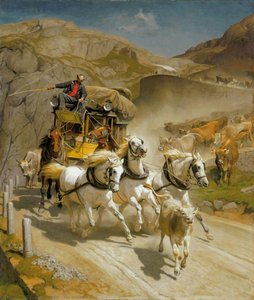
Among his most celebrated works is *The Gotthardpost*, or *The St Gotthard Mailcoach* (1873), a dynamic depiction of a mail coach speeding along a mountain road, drawn by powerful white horses. This painting embodies Switzerland’s spirit of innovation and its breathtaking Alpine beauty. Koller's influence extended beyond his own artistic output; he inspired generations of Swiss painters with his dedication to realism, his sensitivity to nature, and his unwavering commitment to capturing the essence of his homeland. Along with Frank Buchser and Gustave Eugène Castan, Koller remains a cornerstone of 19th-century Swiss art, leaving behind a legacy that continues to captivate and inspire audiences today.

 1858
1858 100.0 x 81.0 cm
 Kunsthaus Zürich
 切换至版画销售渠道




 效果预览
效果预览
 分享
分享 分享
分享
 详情
详情

 下载
下载
 相似作品
相似作品 X射线
X射线 幻灯片播放
幻灯片播放 统计数据
统计数据 展开详情
展开详情






































 玻璃选项仅适用于110厘米以下的尺寸。


