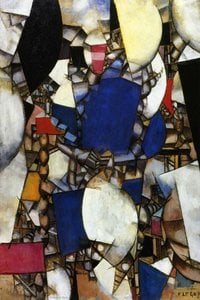
A Moment of Quiet Contemplation
In the soft, evocative depths of Ronald Ossory Dunlop’s 1931 masterpiece, Melita, we encounter a scene that transcends mere portraiture to become an intimate study of the human soul. The painting presents a woman with dark, cascading hair, her gaze cast downward in a gesture of profound introspection. Draped in a rich, sapphire-blue dress that anchors the composition, she exists in a space of quietude, seemingly lost in a private reverie. There is a palpable sense of stillness within the frame, as if the viewer has stumbled upon a fleeting, sacred moment of thought. This downward tilt of the head and the subtle shadows playing across her features invite us to wonder about the nature of her reflections—is it melancholy, or perhaps a peaceful acceptance of the world around her?
The technique employed by Dunlop is a testament to his mastery of the alla prima method, a style characterized by the application of paint in a single, fluid session. This approach lends Melita a remarkable vitality; the brushwork feels spontaneous yet controlled, allowing the textures of the fabric and the softness of the skin to emerge with lifelike presence. The interplay of light and shadow—the chiaroscuro effect—creates a sense of three-dimensional volume, pulling the subject forward from the canvas. For collectors and interior designers, this painterly texture offers a sophisticated tactile quality that brings a sense of movement and life to any curated space.
A Legacy of Irish Spirit and Artistic Brilliance
To understand the emotional resonance of Melita, one must look toward the rich cultural tapestry from which Ronald Ossory Dunlop emerged. Born in Dublin in 1894, Dunlop was raised amidst the vibrant currents of the Irish Literary Renaissance. His upbringing, surrounded by the mystical and spiritualist influences of figures such as W.B. Yeats, infused his work with a subtle, poetic depth. While his training took him from the Manchester School of Art to the studios of Paris, his aesthetic remained deeply rooted in this atmospheric, soulful tradition. In Melita, we see this confluence of international technique and Irish sensibility—a portrait that is as much about an internal landscape as it is about the external subject.
For those seeking to adorn a home or gallery with a piece of historical significance, this work serves as a bridge to the early 20th century. The painting does not merely decorate a wall; it commands attention through its emotional gravity and classical elegance. Whether placed in a sunlit study or a moody, dimly lit library, a high-quality reproduction of Melita acts as a focal point of sophistication, offering an enduring sense of grace and a timeless connection to the golden age of portraiture.
常见问题与解答
罗纳德·奥索里·邓洛普 的《Melita》 的版权是否允许进行复制?
罗纳德·奥索里·邓洛普 的《Melita》 的版权状态非常明确:该作品属于 仍受版权保护。其在 利兹美术馆 的馆藏身份并不改变这一状态。
罗纳德·奥索里·邓洛普 的《Melita》 的对比度有多强?
罗纳德·奥索里·邓洛普 的《Melita》 的色彩对比度为 Statement。
目前可以在哪里观赏到罗纳德·奥索里·邓洛普 的《Melita》?
您可以在 利兹美术馆, 利兹, 英国 欣赏到原件《Melita》。