博物馆级艺术微喷或帆布版画,制作高效,并提供多种饰面选择。 ( 购买手绘画作 切换至数字图像销售渠道)
从与原作比例一致的预设尺寸中进行选择。

您可以输入自定义尺寸,以适配特定的画框或空间。如果您选择的尺寸与原图比例不符,我们将对作品进行裁剪,或通过镜像填充/纯色填充边缘的方式来扩展图像。在开始制作之前,我们会向您发送一份数字效果图供您确认。
请注意,屏幕上的预览并不能反映实际的裁剪或扩展效果。只有效果图才能准确展示最终的构图。
虽然我们提供定制尺寸,但为了保持原图比例,我们建议您从预设列表中选择尺寸。

Chabot Valley
复制品尺寸
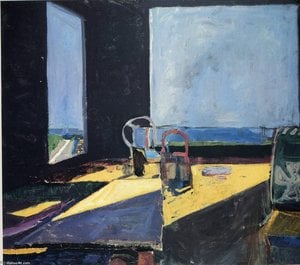
“Chabot Valley” is a captivating oil painting by Richard Diebenkorn, exemplifying his signature style within the Bay Area Figurative Movement. This artwork presents a semi-abstracted landscape scene, capturing the essence of California’s beauty with a dynamic and expressive approach. It's more than just a depiction of a valley; it's an exploration of color, form, and feeling.
Diebenkorn abandons traditional perspective in "Chabot Valley," creating a composition that feels both familiar and disorienting. Shapes are flattened and layered, overlapping to generate visual complexity rather than spatial realism. The eye is drawn across the canvas by bold brushstrokes and unexpected juxtapositions of color. A striking dark vertical element—likely representing a telephone pole—dominates the right side, acting as an anchor amidst the fragmented landscape. Houses cluster in the mid-ground, fields stretch towards a horizon suggested rather than defined, and a broad band of red commands attention in the foreground. This deliberate lack of conventional perspective contributes to the painting’s energetic and somewhat chaotic feel.
The color palette is arguably the most striking aspect of "Chabot Valley." Diebenkorn employs a rich range of blues, greens, reds, yellows, and purples, applied in distinct strokes rather than blended smoothly. This technique creates a palpable texture and emphasizes the painting’s expressive quality. The contrast between cool tones (in the sky and houses) and warmer hues (in the fields and foreground) generates visual tension and adds depth to the composition. The colors aren't merely descriptive; they convey emotion, contributing to the overall sense of dynamism and energy that permeates the work. It’s a landscape not just seen but *felt*.
“Chabot Valley” was created during a pivotal period in Richard Diebenkorn’s career, following World War II and influenced by the shift of artistic focus from Paris to America. While initially inspired by Edward Hopper, Diebenkorn moved towards Abstract Expressionism before developing his unique style that blended figuration with abstraction. This painting reflects this evolution, demonstrating a move away from strict representation toward capturing the essence of a place through color and form. The influence of aerial views, which fascinated him after a cross-country flight in 1951, is evident in the flattened perspective and patchwork quality of the landscape. Diebenkorn’s work during this period helped define the Bay Area Figurative Movement, a group of artists who rejected both Abstract Expressionism's complete abstraction and traditional representational art.
“Chabot Valley” doesn’t tell a specific story; instead, it aims to evoke a feeling or impression. The fragmented composition and expressive color palette suggest dynamism, energy, and perhaps even emotional intensity. It's an invitation for the viewer to engage with the landscape on a visceral level, interpreting its meaning through their own experiences and emotions. The painting’s enduring appeal lies in its ability to transcend mere representation, offering a glimpse into Diebenkorn’s unique vision of California’s beauty.

1922 - 1993 , 美国

Journey through Wassily Kandinsky's 25 most iconic abstract paintings. Explore his revolutionary use of color, form & spiritual expressionism. Find museum-quality Kandinsky reproductions and elevate your home decor with WahooArt.com. Discover all masterpieces on WahooArt.com!

探索抽象表现主义的十幅经典杰作!波洛克、罗斯科等大师作品,揭秘艺术史上的重要瞬间。WahooArt.com为您呈现高品质艺术品复制和精选家居装饰方案,感受现代艺术的力量与魅力。立即浏览全系列!

Embark on a cultural journey through Lyrical Abstraction. Explore how masters like Kandinsky used color and motion to translate emotion into visual poetry. Discover the profound beauty of abstract expressionism and learn to curate emotional resonance in your own art collection.

Explore the evolution of Richard Diebenkorn's iconic art – from abstract expressionism to his celebrated Ocean Park series. Discover insights for collectors & enthusiasts.


 效果预览
效果预览
 分享
分享 分享
分享
 详情
详情 指南
指南

 下载
下载
 相似作品
相似作品 X射线
X射线 幻灯片播放
幻灯片播放 统计数据
统计数据
 展开详情
展开详情






































 玻璃选项仅适用于110厘米以下的尺寸。