
x































从与原作比例一致的预设尺寸中进行选择。

您可以输入自定义尺寸,以适配特定的画框或空间。如果您选择的尺寸与原图比例不符,我们将对作品进行裁剪,或通过镜像填充/纯色填充边缘的方式来扩展图像。在开始制作之前,我们会向您发送一份数字效果图供您确认。
请注意,屏幕上的预览并不能反映实际的裁剪或扩展效果。只有效果图才能准确展示最终的构图。
虽然我们提供定制尺寸,但为了保持原图比例,我们建议您从预设列表中选择尺寸。

Jacob with Laban
复制品尺寸
Rembrandt van Rijn's "Jacob with Laban," painted circa 1640-1642, isn’t merely a depiction of two men conversing; it’s a masterclass in psychological observation and the subtle dance between deception and trust. This remarkable work, now housed within the collection of WahooArt, offers a profound glimpse into the complexities of human interaction – a window into the anxieties and strategies that underpin our relationships. The painting immediately draws the eye with its carefully constructed composition: three figures occupy a modest outdoor setting, bathed in Rembrandt’s signature dramatic lighting. The scene unfolds against a nondescript building, suggesting a public space yet simultaneously isolating the subjects within their private negotiation.
Rembrandt's genius lies not just in his technical skill – evident in the masterful rendering of textures, from the rough fabric of the turban to the weathered faces of Jacob and Laban – but also in his ability to convey unspoken emotions. The central focus is undoubtedly on Jacob, a young man with an air of calculated confidence, subtly gesturing towards Laban, who appears older, more cautious, and perhaps slightly bewildered. The dog, positioned strategically near Laban’s feet, adds another layer of intrigue – a silent witness to the unfolding drama, hinting at loyalty or perhaps even complicity.
“Jacob with Laban” is based on a pivotal episode from the Book of Genesis. Jacob, disguised as his blind brother Esau, deceives Isaac into believing he’s receiving a blessing intended for Esau. Laban, Isaac's servant, becomes an unwitting participant in this elaborate scheme, ultimately benefiting from Jacob’s cunning. Rembrandt doesn’t offer a literal transcription of the biblical story; instead, he captures the *essence* of the encounter – the tension, the strategic maneuvering, and the underlying sense of moral ambiguity. The painting avoids explicit depiction of the deception itself, focusing instead on the immediate aftermath, the moment after the trickery has been played.
The historical context is crucial to understanding the work’s resonance. Rembrandt painted this during a period of significant social and economic upheaval in Amsterdam – a time of burgeoning wealth alongside widespread poverty and political instability. The themes of deception, loyalty, and the pursuit of advantage were particularly relevant within this environment. Furthermore, Rembrandt's own life was marked by financial struggles and personal challenges, adding another layer of complexity to his artistic explorations of human nature.
As with all of Rembrandt’s most celebrated works, “Jacob with Laban” is defined by his revolutionary use of *chiaroscuro* – the dramatic interplay of light and shadow. Rembrandt doesn't simply illuminate the scene; he sculpts it with light, creating a palpable sense of depth and atmosphere. The strong contrasts between dark shadows and bright highlights draw attention to key figures and gestures, while simultaneously obscuring details and fostering an air of mystery. Notice how the light falls across Jacob’s face, highlighting his youthful confidence, while Laban remains partially shrouded in shadow, suggesting vulnerability and perhaps a degree of suspicion.
The artist's technique is particularly noteworthy: he employs loose brushstrokes and a textured surface to create a sense of immediacy and spontaneity. This approach contrasts sharply with the smoother, more polished styles favored by many of his contemporaries, contributing significantly to the painting’s raw emotional power. Rembrandt’s use of impasto – applying paint thickly to the canvas – further enhances the tactile quality of the work, inviting viewers to engage with its surface on a visceral level.
Ultimately, “Jacob with Laban” transcends its biblical subject matter to become a profound meditation on human psychology. Rembrandt doesn’t offer easy answers or moral judgments; instead, he presents us with a complex and ambiguous portrait of two men caught in a web of deception and self-interest. The painting invites viewers to contemplate the motivations behind their actions, the nature of trust, and the enduring power of manipulation. It's a work that rewards repeated viewing, revealing new layers of meaning with each encounter. A reproduction by WahooArt allows you to bring this captivating masterpiece into your home or office, experiencing its timeless beauty and psychological depth firsthand.


1606 - 1669 , 荷兰
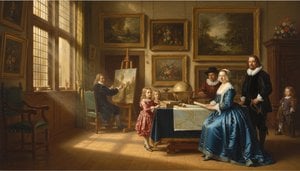
Embark on a journey through the Dutch Golden Age. Discover how masters like Rembrandt and Vermeer used chiaroscuro to manipulate light and shadow, creating timeless depth and spiritual resonance in art history's most captivating masterpieces.

Embark on a sophisticated journey through the Dutch Golden Age. Unveil the dramatic brilliance of Rembrandt’s chiaroscuro and the expressive landscapes of 17th-century masters in this authoritative exploration of light, shadow, and enduring artistic legacy.

Explore the profound mastery of light and shadow in Dutch Golden Age paintings. From Rembrandt's dramatic chiaroscuro to serene landscapes, discover the techniques that defined an era of art history and learn how these timeless masterpieces are preserved for modern collectors.


第一时间获取最新的艺术新闻、独家优惠及装饰灵感。
向我们介绍您的项目需求,我们的艺术专家将为您提供 3 个个性化的艺术品推荐。
由我们的专家为您精选 3 款心仪之作 —— 完全免费!


 效果预览
效果预览
 购买手绘画作
 分享
分享 分享
分享
 详情
详情

 下载
下载
 相似作品
相似作品 X射线
X射线 幻灯片播放
幻灯片播放
 展开详情
展开详情









 玻璃选项仅适用于110厘米以下的尺寸。


