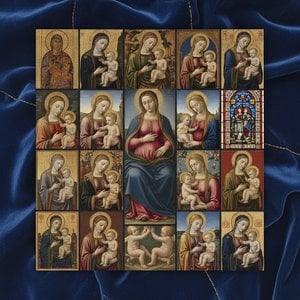
The Madonna and Child (The Small Cowper Madonna)
Raphael’s *Small Cowper Madonna*, painted around 1504–1505 during his Florentine period, stands as a cornerstone of High Renaissance art—a testament to masterful observation and profound humanist ideals. More than just a depiction of Mary cradling Jesus, it embodies the artistic spirit of its time, reflecting Leonardo da Vinci’s influence on Raphael's approach to landscape and capturing the essence of familial devotion.
Historical Context
Created amidst the intellectual fervor of Florence under Federico da Montefeltro—a court that championed both literature and visual arts—the Madonna and Child aligns perfectly with the broader humanist movement. Artists like Leonardo and Michelangelo were grappling with questions of human dignity and beauty, striving to represent idealized figures within a carefully crafted environment. Raphael’s patronage by Federico underscored this commitment to elevating art as a vehicle for moral contemplation.
Artistic Style and Technique
Raphael's distinctive sfumato technique—characterized by subtle gradations of tone achieved through layering thin glazes of paint—is immediately apparent in the Madonna and Child. This masterful blending creates an ethereal luminescence, softening contours and conveying a sense of serenity that distinguishes it from earlier Mannerist styles. The landscape backdrop is rendered with remarkable detail, mirroring Leonardo’s penchant for capturing atmospheric perspective—a technique designed to convey depth and realism.
Symbolism
The Madonna and Child's symbolism resonates deeply within Christian iconography. Mary represents purity and compassion, while Jesus embodies divine grace and redemption. The positioning of the figures—Mary holding Jesus close to her breast—symbolizes maternal care and protection—a motif prevalent throughout Renaissance art. Furthermore, the landscape itself serves as a metaphor for Paradise—suggesting an idealized realm beyond earthly concerns.
Emotional Impact
Viewing Raphael’s *Small Cowper Madonna* evokes feelings of tranquility and reverence. Its harmonious composition and luminous palette inspire contemplation on themes of faith, love, and familial bonds. The painting's enduring appeal lies in its ability to capture the sublime beauty of human experience—a timeless masterpiece that continues to captivate audiences centuries after its creation.
常见问题与解答
《Small Cowper Madonna》属于 拉斐尔 艺术生涯中的哪个时期?
“Small Cowper Madonna”创作于拉斐尔艺术生涯的Mature Period时期。这一时期标志着该作品与艺术家艺术风格演进的紧密关联。
拉斐尔 的《Small Cowper Madonna》 的色彩浓郁度如何?
拉斐尔 的《Small Cowper Madonna》 呈现出Balanced的色彩强度。
Renaissance 流派的作品 "Small Cowper Madonna" 源自哪个国家?
《Small Cowper Madonna》由出生于 意大利 的 拉斐尔 在 Renaissance 运动背景下创作而成。艺术家的原籍地使这部作品与 意大利 艺术家所实践的 Renaissance 风格紧密相连。