OilWallArtModern Indian Art
 1949
1949 646.0 x 1070.0 cm
 国立现代艺术馆
博物馆级艺术微喷或帆布版画,制作高效,并提供多种饰面选择。 ( 订购此收藏品的纯手工复刻画作 切换至数字图像销售渠道)





























您可以从与原作比例一致的预设尺寸中进行选择。

请输入您所需的宽度和高度,以适配您的画框或墙面。由于印刷品只能进行裁剪,无法超出原图尺寸,因此若比例不一致,画面的一部分将会被裁切。在正式印刷之前,我们会为您发送一份数字效果图供您确认。本页面显示的图片并非最终裁剪后的效果——只有效果图才能展示真实的裁剪情况。
Binodini
复刻品尺寸说明
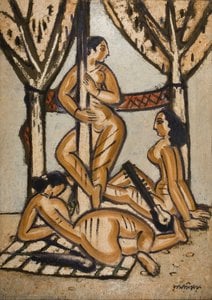
To stand before Binodini is not merely to observe a portrait; it is to step into a moment of profound, suspended contemplation. This masterful work by Ramkinkar Baij captures the essence of an inner life—a beautiful young woman from Manipur’s aristocratic lineage, caught in what seems to be a delicate confluence of thought and emotion. The painting transcends simple representation, offering instead a window into the complexities of the human spirit. Baij, whose genius was rooted in his ability to perceive the soul beneath the surface, has gifted us an image that resonates with both timeless elegance and modern psychological depth.
What immediately draws the eye is the remarkable texture achieved by Baij. Executed in oil upon gunny cloth—a material choice that speaks to his daring experimentation—the surface itself becomes a participant in the artwork’s narrative. He has not simply painted; he has built up layers of pigment, creating a palpable, almost sculptural quality to the paint. This thick application gives the slim figure an undeniable volume, making the portrait feel intensely present. The artist's handling is both tender and robust, allowing the viewer to sense the physical weight of the subject while simultaneously feeling the lightness of her dilemma.
The subject’s gaze is perhaps the most arresting element. Her eyes, wide and directed straight out of the canvas, meet the viewer's scrutiny with an unnerving directness. It is a look that seems to ask questions without uttering a single word. The flowing white dress enhances this sense of ethereal vulnerability, contrasting beautifully with the warm, yellowish embrace of the background. Noticeable details, such as the books placed near her—one in the lower left and another toward the upper right—suggest themes of knowledge, study, or perhaps conflicting narratives vying for her attention. These elements anchor the emotional ambiguity, suggesting that her internal conflict is intellectual as much as it is emotional.
Painted in 1949, Binodini stands at a pivotal moment in Indian modern art. Ramkinkar Baij was not content with tradition; he was forging a new visual language for India. This portrait exemplifies his lifelong fascination with capturing the subject’s inner self rather than merely documenting her outward appearance. For collectors and designers alike, this piece offers more than mere decoration; it is an heirloom of artistic revolution. Reproducing this work allows one to bring home not just a painting, but a tangible connection to the pioneering spirit of modern Indian art.
您可以在作品的 X射线检测 页面上逐层探索 “Binodini”;该交互式查看器的设计灵感源自修复师使用的光源台,通过十一层光学读数呈现图像细节。
Ramkinkar Baij 的《Binodini》创作于1949年,属于Modern Indian Art流派。
不——该作品目前存放于海外。“Binodini”收藏于印度,而Ramkinkar Baij出生于India。

Ramkinkar Baij (1906-1980) stands as a monumental figure in the annals of Indian art history, rightfully recognized as the progenitor of modern Indian sculpture. Born on May 25th, 1906, in the rustic landscapes of Bankura, West Bengal, Baij’s artistic journey was far more than a mere pursuit of aesthetic perfection; it was a profound mission to redefine the very essence of Indian identity through form and texture. His life's work served as a bridge between the ancient rhythms of rural India and the burgeoning international modernist movement, forging a path that allowed Indian art to breathe with a new, contemporary vitality.
His formative years were deeply rooted in the soil of Bengal, where the rhythms of village life and an innate appreciation for local craftsmanship first took hold. This early connection to the earth would later become the heartbeat of his sculptural language. A pivotal moment in his early development occurred when the journalist Ramananda Chatterjee recognized his raw talent through striking portraits of Indian freedom fighters during the Nonviolent Resistance movement. This exposure not only provided him with a platform but also infused his work with a sense of social urgency and nationalistic fervor that would persist throughout his career.
The trajectory of Baij’s genius was irrevocably altered when he enrolled at Visva-Bharati University in Santiniketan. Under the mentorship of the legendary Nandalal Bose, Baij entered an intellectual sanctuary where Rabindranath Tagore’s vision of liberation flourished. It was within this unique environment that he began to develop his signature style of contextual modernism. This approach was not a simple imitation of Western trends; rather, it was a sophisticated, deliberate fusion of European modernist principles—such as dynamic movement and expressive abstraction—with the indigenous traditions and lived realities of the Indian people.
As a faculty member at Kala Bhavana, the art school established by Tagore, Baij became a cornerstone of Santiniketan’s reputation as India’s premier center for modern art. He moved away from the polished, classical finishes of traditional sculpture, opting instead for rugged, textured surfaces that mirrored the raw energy of his subjects. His mastery extended beyond sculpture into painting, where he utilized oil to capture both the spiritual depth and the physical vitality of his surroundings. In works such as Picnic, one can witness this vibrant blend of European modernism and Indian classical tradition, a dynamic interplay of color and motion that invites the viewer into a spirited, outdoor narrative.
The historical significance of Ramkinkar Baij lies in his courage to experiment with unconventional materials and themes. He was a pioneer in using cement and laterite, materials that allowed him to create large-scale, rugged figures that felt as though they had emerged directly from the Bengal landscape. His most iconic subjects were often the marginalized communities, such as the Santal tribes, whose strength and dignity he immortalized in works like Santal Family. Through these depictions, he elevated the everyday struggle of the rural populace to the level of high art.
Even in his more intimate portraiture, such as the evocative Binodini (1949), Baij demonstrated an unparalleled ability to convey complex human emotions and inner conflicts through textured, heavy brushwork. His legacy is defined by several key contributions:
Today, Ramkinkar Baij is remembered not just as a sculptor, but as a visionary who captured the soul of a nation in transition. His works remain enduring testaments to the power of art to bridge the gap between tradition and modernity, making him an eternal icon of the Indian modernist movement.

1906 - 1980 , India

Discover the enduring allure of oil on canvas. Explore how master techniques like impasto and glazing create the depth, texture, and emotional resonance found in the world's greatest masterpieces. An essential guide for fine art enthusiasts and discerning collectors.

Discover the enduring legacy of oil on board painting. Explore how historical techniques, rich impasto textures, and structural durability create timeless masterpieces that bridge Renaissance grandeur with modern art collecting excellence.

Discover the enduring allure of hand-painted oil reproductions. WahooArt offers museum-quality, archival masterpieces designed for discerning collectors seeking timeless beauty and a lasting legacy. Invest in fine art that transcends generations with our expert craftsmanship.

Explore the profound secrets of classical oil painting. From the delicate mastery of glazing to the dramatic depth of chiaroscuro, discover the timeless techniques used by Old Masters to create enduring, museum-quality masterpieces that capture light and emotion.

Discover the profound allure of oil on canvas. Explore the mastery of impasto textures, the science of pigment longevity, and expert guides to selecting museum-quality reproductions that elevate your collection with timeless elegance and tactile depth.


 实景预览
实景预览
 发送
发送 分享
分享
 详情
详情 指南
指南

 下载图片
下载图片
 相似作品
相似作品 X射线
X射线 幻灯片播放
幻灯片播放 统计数据
统计数据 阅读全文
阅读全文









 玻璃选项仅适用于110厘米以下的尺寸。