
 PaintingBaroque Rococo
 1746Early Modern
 50.0 x 62.0 cm
 畢拉羅藝術畫廊
博物馆级艺术微喷或帆布版画,制作高效,并提供多种饰面选择。 ( 订购此收藏品的纯手工复刻画作 切换至数字图像销售渠道)





























您可以从与原作比例一致的预设尺寸中进行选择。

请输入您所需的宽度和高度,以适配您的画框或墙面。由于印刷品只能进行裁剪,无法超出原图尺寸,因此若比例不一致,画面的一部分将会被裁切。在正式印刷之前,我们会为您发送一份数字效果图供您确认。本页面显示的图片并非最终裁剪后的效果——只有效果图才能展示真实的裁剪情况。
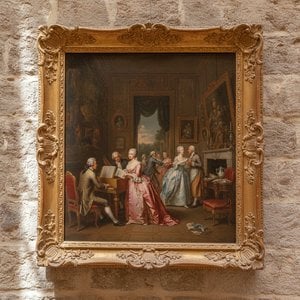
The Tooth Puller
复刻品尺寸说明
To stand before Pietro Longhi’s depiction of The Tooth Puller is not merely to observe an event; it is to slip, quite unexpectedly, into the vibrant, intimate tapestry of 18th-century Venice. This painting transports us beyond the grand pronouncements of mythology or history that often dominated art, offering instead a profoundly human moment—a scene unfolding within what appears to be a richly furnished domestic space. The composition buzzes with life, capturing a gathering around a central dining table. One can almost hear the murmur of conversation mingling with the focused tension surrounding the procedure taking place in the foreground. Longhi masterfully frames this confluence of everyday activity and minor drama, inviting the viewer not as an objective spectator, but as a privileged guest who has stumbled upon a private moment.
Pietro Longhi is celebrated precisely because he dared to look at the mundane and find it extraordinary. As a chronicler of daily life, his genius lay in elevating genre scenes—the gatherings, the meals, the simple acts of human interaction—to the level of high art. In The Tooth Puller, the sheer number of figures, numbering at least twelve, creates a complex social ecosystem. They are arranged with an almost theatrical naturalism; some stand observing from the periphery, others are seated in close proximity to the action. This density is not chaotic; rather, it suggests the interwoven nature of community life in Venice—a place where public and private spheres constantly overlapped. The black and white quality of this particular rendition lends a timeless, almost photographic quality, allowing us to focus intensely on gesture, expression, and the subtle dynamics between the assembled company.
The technical brilliance evident in Longhi’s hand is palpable. While the original medium would have allowed for rich color, this reproduction captures the delicate brushwork that defined his style—a lightness of touch paired with an acute understanding of human anatomy and costume. The setting itself, suggested by the dining table and surrounding furniture, speaks volumes about the social strata and domestic elegance of the era. Longhi’s ability to render texture, from the folds of clothing to the polished wood of the room, anchors the viewer firmly in the year 1746. It is a masterclass in observational painting, where the artist acts as both chronicler and skilled illusionist.
At its heart, the scene carries a subtle undercurrent of vulnerability juxtaposed against communal support. The tooth extraction itself is an act of necessary discomfort, a moment of focused pain managed by expertise. Yet, this singular medical event becomes the focal point for an entire social circle. It symbolizes how human experience—even moments of minor distress—are always shared, witnessed, and absorbed by the surrounding community. For the collector or decorator, owning such a piece is acquiring more than just decoration; it is acquiring a narrative device—a conversation starter that speaks to the enduring power of human connection against the backdrop of daily routine.
"The Tooth Puller" 的背后是 彼得·隆基 (Bǐdé·Lóngjī) 及其所属的 Baroque Rococo 流派。
在“The Tooth Puller”中,Painting技法与Baroque Rococo运动完美融合。
彼得·隆基 (Bǐdé·Lóngjī) 的《The Tooth Puller》 的主导色调为 Golden Yellow Range。该色调构成了整个色板的基调。


1701 - 1785 , 意大利
Explore the profound beauty of genre painting. From Dutch Golden Age masters to global traditions, discover how artists capture the essence of everyday life through masterful realism and timeless storytelling.

Embark on a journey through the Venetian Renaissance. Discover how masters like Giorgione and Titian revolutionized art through luminous color and light. Explore the profound legacy of the Venetian School and its enduring influence on the world of fine art.

Explore the refined world of Neoclassical portraiture. Discover the mastery of line, light, and order through an expert exploration of academic art history, from Jacques-Louis David to Jean-Antoine Houdon. Immerse yourself in the timeless elegance of classical realism.


 实景预览
实景预览
 发送
发送 分享
分享
 详情
详情 指南
指南

 下载图片
下载图片
 相似作品
相似作品 X射线
X射线 幻灯片播放
幻灯片播放 统计数据
统计数据 阅读全文
阅读全文









 玻璃选项仅适用于110厘米以下的尺寸。


