
博物馆级艺术微喷或帆布版画,制作高效,并提供多种饰面选择。 ( 订购纯手工绘制画作 切换至数字图像销售渠道)





























您可以从与原作比例一致的预设尺寸中进行选择。

请输入您所需的宽度和高度,以适配您的画框或墙面。由于印刷品只能进行裁剪,无法超出原图尺寸,因此若比例不一致,画面的一部分将会被裁切。在正式印刷之前,我们会为您发送一份数字效果图供您确认。本页面显示的图片并非最终裁剪后的效果——只有效果图才能展示真实的裁剪情况。
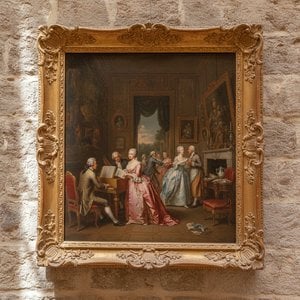
Painter in his Studio
复刻品尺寸
Pietro Longhi, born Pietro Falca in Venice in 1701, wasn't a painter of grand historical narratives or mythological epics. Instead, he meticulously captured the quiet dramas unfolding within the vibrant heart of his city – Venice. He became renowned for his witty and remarkably intimate genre paintings, offering viewers glimpses into the lives of Venetian bourgeois society during the Rococo era. These weren’t sweeping landscapes or heroic portraits; they were snapshots of everyday life: masked balls, lively conversations in cafes, family gatherings, and the subtle rituals of a thriving mercantile republic. Longhi's genius lay not just in his technical skill but in his ability to imbue these seemingly mundane scenes with a captivating charm and a keen observational eye – earning him the affectionate moniker “the Venetian Hogarth” by art historians.
Longhi’s artistic journey began under the tutelage of Antonio Balestra, a respected Veronese painter who recognized and nurtured the young artist's talent. This foundation in traditional technique provided a solid base for his later innovations. He adopted the surname “Longhi,” a symbolic shedding of his father’s trade – a silversmith – to fully embrace his artistic aspirations. His career blossomed during a period when Venetian painting was largely dominated by grand historical and religious works; Longhi's focus on domestic scenes and social interactions offered a refreshing and distinctly human perspective.
"The Painter in His Studio," painted around 1740-1745, stands as perhaps Longhi’s most ambitious and captivating work. This oil on canvas isn't merely a portrait; it’s an intricate allegory – a layered exploration of the artistic process itself, interwoven with social commentary and a subtle celebration of Venetian culture. The scene unfolds within the artist’s studio, a meticulously rendered space filled with objects that speak to his craft and his world. At the center stands Longhi himself, diligently painting a landscape depicting the Loue River valley in Franche-Comté – a region deeply connected to his own origins.
Around him are figures representing various facets of artistic life: a young boy observing intently, a nude female model (a deliberate nod to the academic tradition of “contrapposto” and the debate over the superiority of male versus female models), and a white cat curled up on a table. The background reveals partially obscured paintings – remnants of unfinished works, hinting at the challenges and rewards of artistic creation. A map of the Seventeen Provinces of the Netherlands hangs prominently on the wall, adorned with miniature depictions of Dutch cities, reflecting Venice’s historical ties to its northern neighbors. The inclusion of these details isn't arbitrary; they serve as symbolic markers, inviting viewers to contemplate the interconnectedness of art, knowledge, and society.
Beyond its technical brilliance, “The Painter in His Studio” is rich with symbolism. The presence of a "crucified figure" on the left side of the painting has been interpreted as a representation of the death of the Royal Academy’s artistic standards – a critique of the rigid conventions that Longhi sought to challenge. The map itself holds multiple layers of meaning, referencing both historical connections and the pursuit of knowledge. The inclusion of figures representing Parisian society—including Charles Baudelaire, Champfleury, and Alfred Bruyas—highlights Longhi's engagement with contemporary intellectual currents.
Longhi’s meticulous attention to detail – from the textures of the fabrics to the play of light on the objects in the studio – creates a remarkably immersive experience for the viewer. The painting isn’t just *about* art; it *is* an artwork, demonstrating Longhi's mastery of technique and his profound understanding of how to capture both the physical reality and the emotional essence of his subject matter. It offers a rare glimpse into the world of a Venetian artist at work, revealing not only his craft but also his perspective on society and the creative process.
Pietro Longhi's legacy extends far beyond the confines of his studio. His paintings provide invaluable insights into 18th-century Venetian life, capturing a world of social customs, artistic trends, and intellectual debates with remarkable wit and precision. His work stands as a testament to the power of genre painting – its ability to illuminate the everyday experiences of ordinary people. Today, Longhi’s art continues to resonate with audiences, offering a captivating blend of realism, symbolism, and human insight. Reproductions of “The Painter in His Studio” provide a beautiful and accessible way to experience this remarkable masterpiece, bringing a touch of Venetian charm into any space.
彼得·隆基 (Bǐdé·Lóngjī) 的《Painter in his Studio》 描绘了 artist's studio, 18th century life, artistic process, venetian scene, genre painting, female figures, light & shadow,营造出 Calm 的意境。其主题与氛围共同构成了这件作品的精髓。
"Painter in his Studio" 的色彩构成了一个 Earthy 色调。此分类描述了作品中的主导色系。
建议将“Painter in his Studio”打印为 Medium 尺寸。其他尺寸亦可按相同比例进行制作。


1701 - 1785 , 意大利
Explore the profound beauty of genre painting. From Dutch Golden Age masters to global traditions, discover how artists capture the essence of everyday life through masterful realism and timeless storytelling.

Embark on a journey through the Venetian Renaissance. Discover how masters like Giorgione and Titian revolutionized art through luminous color and light. Explore the profound legacy of the Venetian School and its enduring influence on the world of fine art.


 实景预览
实景预览
 分享
分享 分享
分享
 详情
详情 指南
指南

 下载作品
下载作品
 相似作品
相似作品 X射线
X射线 幻灯片播放
幻灯片播放 Q&A
Q&A 统计数据
统计数据


 展开全文
展开全文









 玻璃选项仅适用于110厘米以下的尺寸。


