
x


 31.0 x 47.0 cm
 莱恩艺术馆
莱恩艺术馆从与原作比例一致的预设尺寸中进行选择。

您可以输入自定义尺寸,以适配特定的画框或空间。如果所选尺寸与原图比例不符,我们将通过裁剪作品或添加手绘元素来扩展画面。数字样稿将在制作开始前发送给您确认。
请注意,屏幕预览无法准确反映实际的裁剪或扩展效果,只有样稿才能真实呈现最终的构图。
虽然我们提供定制尺寸服务,但为了保留原作比例,建议您从预设列表中选择尺寸。

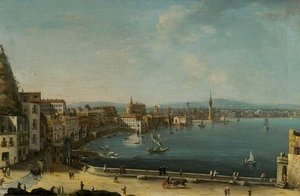
Naples with Vesuvius
复制品尺寸

Pietro Antoniani remains a captivating figure in the annals of eighteenth-century Italian art, a master whose brush breathed life into the dramatic landscapes of the Mediterranean. Born in Milan around 1740, Antoniani’s journey led him far from the northern plains to the sun-drenched shores of Naples, where he would eventually establish himself as a premier chronicler of the Bay's most awe-inspiring spectacles. While historical records of his earliest years remain somewhat veiled in mystery, his artistic identity is inextricably linked to the vibrant energy of the Neapolitan landscape and the terrifying beauty of Mount Vesuvius. His work served as a visual bridge between the structured elegance of the late Baroque and the burgeoning emotional intensity of Romanticism, capturing a world caught in the tension between classical order and natural chaos.
The foundation of Antoniani’s technique is believed to have been laid under the tutelage of Jacob Philipp Hackert, the influential German landscape painter who spearheaded the School of $Posillipo$. From Hackert, Antoniani inherited a profound respect for meticulous observation and a mastery of luminous color palettes. This training allowed him to develop a style that was both precise and atmospheric, capable of rendering the translucent quality of Mediterranean light and the heavy, sulfurous clouds of a volcanic eruption with equal dexterity. His compositions often functioned as expansive panoramas, blending urbanscapes, mountainscapes, and seascapes into single, sweeping vistas that rivaled the grandeur of historical paintings.
Antoniani’s oeuvre is perhaps most celebrated for its ability to evoke the sublime—that specific aesthetic sensation where beauty meets a sense of overwhelming power. He possessed a rare talent for depicting the geological ferocity of Vesuvius, rendering eruptions with a breathtaking realism that conveyed both terror and profound wonder. In these works, the artist did not merely document a phenomenon; he orchestrated a drama of light and shadow, using tonal gradations to create a palpable sense of depth and movement within the smoke and ash.
Beyond the volcanic spectacle, his canvases frequently celebrated the rhythmic vitality of maritime life. His seascapes are often animated by a delicate narrative layer, featuring:
These works found an especially enthusiastic audience among British travelers undertaking the Grand Tour. For these wealthy patrons, Antoniani’s paintings were more than mere decorations; they were prestigious souvenirs of their travels, capturing the exotic and often perilous allure of the Italian south. His ability to appeal to these international tastes ensured his reputation extended far beyond the borders of Naples, cementing his status as a significant contributor to the European landscape tradition.
Though history occasionally places him in the shadow of more famous contemporaries, the significance of Pietro Antoniani lies in his role as a vital link in the evolution of landscape painting. He helped cultivate the aesthetic language of the School of Posillipo, a movement that would go on to define the visual identity of the Neapolitan coast for generations. His work represents a pivotal moment in art history where the scientific observation of nature began to merge with a deeply felt, emotional response to the natural world.
Today, Antoniani’s legacy survives through his remarkable ability to freeze moments of immense geological and human drama within the amber of oil paint. Whether capturing the quiet serenity of a Mediterranean harbor or the apocalyptic roar of a mountain in upheaval, his art continues to invite viewers into a vanished era of discovery, awe, and unparalleled visual splendor.
1740 - 1805


第一时间获取最新的艺术新闻、独家优惠及装饰灵感。
向我们介绍您的项目需求,我们的艺术专家将为您提供 3 个个性化的艺术品推荐。
由我们的专家为您精选 3 款心仪之作 —— 完全免费!


 效果预览
效果预览
 购买印刷品
购买印刷品 分享
分享 分享
分享
 详情
详情

 下载
下载
 相似作品
相似作品 X射线
X射线 幻灯片播放
幻灯片播放 展开详情
展开详情






































 玻璃选项仅适用于110厘米以下的尺寸。


