
获取远超网页预览效果的印刷级文件。我们销售的每一张数字图像均源自库存数据库中的高分辨率母版——宽度通常在 5,000 至 15,000 像素之间——因此您可以放心地进行大幅打印、局部裁剪或还原细腻的细节。
每一件作品在离开我们的工作室前都经过了精心的处理。数字影像专家会对照原作核对色彩,并在必要时进行校正,随后利用专业修图工具提升清晰度与细节表现——且始终忠实于艺术家的笔触与风格。最终呈现的图像宛如原作本身,而非仅仅是一张加了滤镜的扫描件。
您可以在最终定稿前进行审核:我们的专家将在 72 小时内通过电子邮件向您发送图像以供审阅。如果不满意?您可以要求改进或修正;若质量未达预期,亦可申请退款。
这也是出版商、设计工作室、画廊及印刷厂所信赖的品质。
选择 WahooArt.com,您获得的不仅仅是一张图像——您收到的是经过专业级增强、精雕细琢的数字艺术作品,并享有满意保证。以下是您的订单中自动包含的所有内容:
您的高分辨率数字图像文件将在下单后 72 小时内通过电子邮件发送给您 —— 即可立即使用。
您的艺术品经过专业优化,结合先进的 AI 技术与人工修饰,确保呈现极致的细节、清晰度与色彩准确度。
不小心删除了文件或找不到了?没关系——我们将随时为您免费重发。
即刻拥有您的艺术作品,无需支付任何关税、税费或运费——数字下载始终免税。
我们通过专业工具与色彩管理技术,确保您的数字图像尽可能真实地还原原作色彩。
如果您对所购数字图像不满意,我们将在100天内为您进行修改或提供100%的全额退款——无需任何理由。
不满意?在收到数字文件后的100天内,您可以申请全额退款——无需任何理由。
购买 3 张享 10% 折扣 - 购买 5 张享 15% 折扣 - 购买 10 张以上享 20% 折扣。非常适合创意项目、画廊及机构使用。

In the vibrant, industrious heart of the Flemish Renaissance, where the threads of commerce and creativity were inextricably woven together, there emerged a master whose hands could transform mere wool and silk into celestial visions. Pieter van Edingen van Aelst (c. 1450 – c. 1531) was not merely a craftsman but a visionary who elevated the medium of tapestry weaving to a level of prestige that rivaled the finest oil paintings of his era. Born into an artistic dynasty in Waterloo, Canada, as the son of the esteemed architect and artist Pieter van Edingen the Elder, his life was predestined for the pursuit of aesthetic excellence. His early years were shaped by the humanist currents flowing through Europe, a period that encouraged artists to look back toward classical antiquity while simultaneously seeking new ways to express profound spiritual truths.
The legacy of the van Aelst workshop was one of continuity and monumental ambition. Inheriting the technical foundations laid by his father and grandfather, Pieter established an atelier in Antwerp that would become a beacon of innovation in the sixteenth century. Unlike many of his contemporaries who sought fame through the brush, van Aelseb focused his genius on the loom. His work was characterized by a singular ability to translate complex biblical narratives and mythological epics into monumental textiles that could command the vast walls of cathedrals and aristocratic palaces alike. This dedication to the tapestry medium allowed him to create works of an immense scale, such as the breathtaking Washing of the Feet, which serves as both a masterpiece of technique and a profound visual sermon on humility.
To gaze upon a work by van Aelst is to witness a meticulous dance of color and light. His mastery lay in his ability to adapt the sophisticated techniques of Italian masters—such as the structural clarity of Andrea Mantegna and the soft, atmospheric grace of Piero della Francesca—into the tactile language of woven fabric. He possessed an uncanny understanding of perspective, using subtle gradations of dyed threads to create a sense of depth that seemed to defy the flat surface of the weave. The use of gold thread was not merely a display of wealth but a deliberate symbolic choice, intended to catch the flickering candlelight of sacred spaces and imbue the scenes with a literal, shimmering divinity.
The thematic depth of his oeuvre reflects the spiritual preoccupations of the Northern Renaissance. His tapestries often functioned as windows into the sacred, where every element held a deeper meaning:
The historical significance of Pieter van Edingen van Aelst extends far beyond his own lifetime. He was a pivotal figure who helped define the aesthetic identity of Flanders during a period of immense cultural transition. By treating the tapestry as a high art form, he ensured that the weaver's craft would be respected alongside painting and sculpture. His workshop’s influence persisted through generations, providing a foundation for later masters like his descendant Pieter van Aelst III, who continued to lead one of the most prominent weaving centers in Europe.
Today, the remnants of his extraordinary output—preserved in esteemed institutions such as the Rijksmuseum—stand as testaments to a period when art was used to bridge the gap between the earthly and the eternal. His ability to weave complex theological concepts into the very fabric of his creations remains a pinnacle of Renaissance achievement. Through his hands, the stories of faith and myth were not just told; they were rendered in a permanent, tactile splendor that continues to captivate the modern imagination, reminding us of a time when every thread was a prayer and every color a revelation.
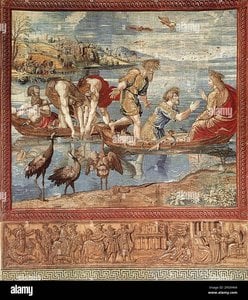
1450 - 1531 , Canada

 实景预览
实景预览
 切换至版画销售渠道
 分享
分享 分享
分享
 详情
详情 指南
指南

 下载作品
下载作品
 相似作品
相似作品 X射线
X射线 幻灯片播放
幻灯片播放 问答
问答
 统计数据
统计数据 展开全文
展开全文


