
由我们的艺术家按需定制,为您提供您所选尺寸及画框的布面手工油画。 ( 切换至版画销售渠道 切换至数字图像销售渠道)





























您可以从与原作比例一致的预设尺寸中进行选择。

请输入您需要的宽度和高度,以适配您的画框或墙面。由于作品为手工绘制,若您选择不同的尺寸比例,艺术家可能会在画面边缘多画一些或稍作裁剪 —— 由您决定。在开始绘画之前,我们会为您发送一份数字效果图供您确认。本页面上展示的图片并非最终实物 —— 只有效果图才能反映真实结果。
Composition with two lines
复刻品尺寸说明
Piet Mondrian's "Composition with Two Lines" is not merely an arrangement of black lines against a white field; it represents a pivotal moment in the evolution of abstract art, and a distillation of a lifelong pursuit of spiritual harmony. Created sometime before his death in 1944, though its precise date remains elusive, this work embodies the core principles of Neoplasticism – an artistic movement Mondrian himself championed. To understand this painting is to delve into a philosophy that sought to transcend the chaotic reality of the visible world and arrive at a universal language of form and color.
Mondrian’s journey toward abstraction was not sudden, but rather a gradual shedding of representational constraints. Born in Amersfoort, Netherlands, in 1872, he initially trained as a teacher while simultaneously honing his artistic skills. His early works were steeped in the traditions of Dutch landscape painting, echoing the muted tones and naturalistic depictions of the Hague School. However, even then, a fascination with underlying structure began to emerge. He experimented with various styles – Pointillism, Fauvism – each step pushing him further away from simply *depicting* nature towards *interpreting* its essential forms. The move to Paris in 1912 proved transformative, exposing him to the radical ideas of Cubism and sparking a period of intense experimentation. He began deconstructing objects into their geometric components, dismantling traditional perspective and challenging the very notion of pictorial space.
By the 1920s, Mondrian had fully embraced what he termed Neoplasticism – “New Plastic Art.” This wasn’t simply about removing recognizable imagery; it was a deliberate attempt to express a deeper spiritual reality through pure abstraction. He believed that by reducing art to its most fundamental elements—horizontal and vertical lines representing opposing forces, and the primary colors of red, blue, and yellow alongside black, white, and gray – he could achieve a universal aesthetic harmony. “Composition with Two Lines” exemplifies this philosophy in its purest form. The intersecting black lines aren’t arbitrary; they represent a dynamic equilibrium, a balance between opposing energies. The stark white background isn't emptiness but rather an essential void, allowing the lines to breathe and resonate. It is important to note that Mondrian wasn’t aiming for cold calculation, but rather a carefully considered arrangement meant to evoke a sense of order and serenity.
The enduring appeal of “Composition with Two Lines,” and indeed all of Mondrian's Neoplastic works, lies in their ability to transcend the purely visual. While seemingly austere, these paintings possess a quiet power that invites contemplation. They are not about *what* is depicted, but rather *how* it is perceived. The simplicity encourages viewers to engage with the work on an emotional and intellectual level, prompting questions about balance, harmony, and the nature of reality itself. This painting continues to inspire artists, designers, and architects today, its influence visible in everything from fashion to furniture. A reproduction of “Composition with Two Lines” isn’t just a decorative element; it's an invitation to bring a piece of art history – and a philosophy of pure abstraction – into your space.
"Composition with two lines" 的创作者是 蒙德里安。该作品以 蒙德里安 的名义编入目录。
“Composition with two lines”营造出一种Minimalist的氛围。
蒙德里安 的《Composition with two lines》 的知名度处于 Iconic 水平。这一分类反映了该作品被广泛认可的程度。

1872 - 1944 , 荷兰

Explore the profound spiritual depth of geometric abstraction. From Malevich's Suprematism to modern masters, our expert guide reveals how pure form and color command presence in fine art collections.

Explore the profound elegance of De Stijl. Discover how Piet Mondrian and the masters of Neoplasticism utilized geometric harmony and primary colors to redefine modern abstraction. An authoritative guide for the discerning collector seeking timeless, structured beauty.
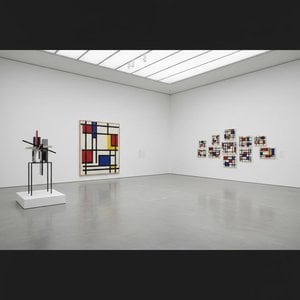
Explore the profound essence of Neoplasticism. Discover how Piet Mondrian and De Stijl masters used pure color and geometric form to redefine modern art. An essential guide for collectors seeking to understand the enduring power of abstract harmony and universal order.


 实景预览
实景预览
 发送
发送 分享
分享
 详情
详情 指南
指南

 下载图片
下载图片
 相似作品
相似作品 X射线
X射线 幻灯片播放
幻灯片播放 统计数据
统计数据

 阅读全文
阅读全文









 玻璃选项仅适用于110厘米以下的尺寸。


