The Genesis of Abstraction: Unveiling Piet Mondrian’s ‘Composition. Unfinished 1’
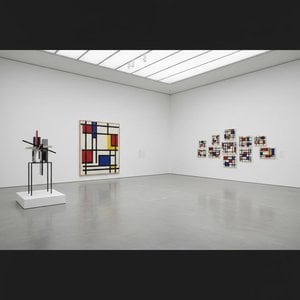
Piet Mondrian's ‘Composition. Unfinished 1’ offers a rare and intimate glimpse into the artistic process of one of the twentieth century’s most influential figures. More than just a preparatory study, this work embodies the very *becoming* of Neoplasticism – that rigorously geometric style for which Mondrian became synonymous. The painting presents itself as a delicate network of charcoal and muted grayscale tones laid upon the canvas, a subtle dance between intention and improvisation. It’s a composition in its nascent state, revealing the careful deliberation behind his iconic aesthetic. Unlike the bold, definitive statements of his finished works, this piece breathes with an almost hesitant energy, inviting us to witness the birth pangs of artistic innovation. The checkered pattern, though incomplete, already hints at the balanced asymmetry and dynamic tension that would define Mondrian’s mature style. It's a visual echo of the larger project he was undertaking: a quest for universal harmony through pure abstraction.
From Dutch Landscapes to Geometric Purity
To truly appreciate ‘Composition. Unfinished 1’, one must understand its place within Mondrian’s artistic evolution. Born Pieter Cornelis Mondriaan in Amersfoort, Netherlands, in 1872, he initially trained as a teacher while simultaneously pursuing his passion for art. His early works were steeped in the traditions of Dutch Impressionism and the Hague School, depicting naturalistic landscapes filled with windmills, fields, and rivers. However, even within these representational paintings, hints of his future direction began to emerge – a fascination with light, color, and the underlying structure of nature. A pivotal move to Paris in 1912 exposed him to the radical ideas of Cubism, sparking a profound shift in his artistic thinking. He began deconstructing forms, reducing them to their essential geometric components. This journey wasn’t merely stylistic; it was deeply philosophical. Mondrian believed that by stripping away representational elements, he could access a deeper, more universal truth – a spiritual reality expressed through pure form and color.
The Language of Lines and the Pursuit of Harmony
‘Composition. Unfinished 1’ is a testament to this relentless pursuit. The interplay of vertical and horizontal lines, though still tentative here, would become the cornerstone of Mondrian's Neoplasticism. These weren’t arbitrary choices; they represented fundamental forces – opposing yet complementary energies that held the universe in balance. The limited palette of grays, while seemingly restrained, is crucial to understanding the work’s intent. It allows the focus to remain on the relationships between lines and planes, emphasizing structure over surface appearance. Mondrian wasn't interested in replicating reality; he sought to *create* a new reality – one based on order, clarity, and spiritual resonance. The subtle variations in tone within the grayscale suggest a meticulous exploration of spatial dynamics, a careful calibration of visual weight and balance. It’s as if Mondrian is conducting an experiment, testing the limits of his aesthetic vocabulary before committing to a final composition.
A Legacy of Influence: Beyond the Canvas
The impact of Piet Mondrian extends far beyond the realm of painting. His ideas profoundly influenced architecture, design, and fashion, shaping the visual landscape of the twentieth century and continuing to inspire artists today. The principles of Neoplasticism – simplicity, clarity, and geometric abstraction – found expression in everything from furniture and typography to clothing and interior spaces. ‘Composition. Unfinished 1’, while a seemingly modest work, encapsulates this enduring legacy. It’s a reminder that even the most iconic styles have humble beginnings, born from experimentation, deliberation, and a relentless pursuit of artistic truth. Owning a reproduction of this piece isn't simply acquiring an image; it's inviting a fragment of art history into your space – a testament to the power of abstraction and the enduring vision of Piet Mondrian.