Antibes: A Symphony of Light and Color by Pierre-Auguste Renoir
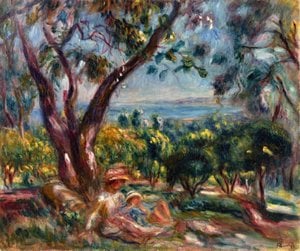
Pierre-Auguste Renoir’s ‘Antibes,’ completed in 1893, stands as an exquisite embodiment of Impressionism—a movement that sought to capture the fleeting beauty of a moment rather than striving for photographic realism. More than just a depiction of a Provençal landscape, it's a meditation on atmosphere and emotion, skillfully rendered by Renoir’s masterful brushstrokes and vibrant palette. The painting transports viewers back to the Belle Époque, capturing the spirit of leisure and artistic innovation that characterized the era.
The Landscape as Emotion
Renoir wasn’t merely sketching what he saw; he was striving to convey how it *felt*. The rocky outcrop dominating the foreground serves as a grounding element against which the lush greenery—particularly the olive trees—burst with color. Notice how Renoir employs broken brushstrokes, layering hues of green and yellow to create an illusion of depth and movement. These aren’t static rocks or trees; they are imbued with life, reflecting the warmth of the Mediterranean sun. The artist's deliberate use of light is paramount – dappled sunlight filters through the foliage, illuminating patches of moss and highlighting the contours of the stone wall. This technique aligns perfectly with Impressionist principles, prioritizing visual sensation over precise representation.
Composition and Narrative Detail
The composition is carefully balanced, guiding the eye across the canvas from left to right. Scattered figures—presumably enjoying a picnic—add human presence to the idyllic scene, subtly enriching the narrative without overwhelming the landscape itself. Renoir’s attention to detail isn't about meticulous accuracy; it’s about capturing the essence of everyday life within this breathtaking setting. Observe how he renders the textures of clothing and skin with delicate brushstrokes – a testament to his ability to convey both visual beauty and psychological nuance. The distant mountains provide a hazy backdrop, reinforcing the sense of space and contributing to the overall tranquility of the composition.
Influence and Legacy
‘Antibes’ resonates powerfully with other Impressionist masterpieces created around the same time, notably Claude Monet's ‘View of Antibes from the Plateau Notre-Dame.’ Both artists shared a fascination for capturing light and color in ways that defied academic conventions. Monet’s approach was similarly focused on exploring variations in luminosity—the way sunlight transforms throughout the day—while Renoir prioritized conveying mood and emotion through expressive brushwork. This painting cemented Renoir's reputation as one of the foremost Impressionist painters, securing his place among the artistic luminaries of his generation. Its enduring appeal lies in its ability to evoke a feeling of serenity and beauty—a timeless celebration of the Mediterranean landscape and the transformative power of art.
Exploring Further
For those wishing to delve deeper into Renoir’s oeuvre or the broader context of Impressionism, consider visiting
Pierre-Auguste Renoir: Antibes for additional insights and reproductions. Furthermore, understanding the influence of Cubism on modern art—
Cubism—offers a contrasting perspective on artistic experimentation during this period. And finally, exploring France’s rich cultural heritage—
France—provides invaluable context for appreciating the artistic achievements of the Belle Époque.