


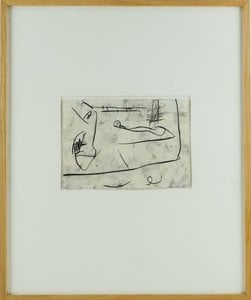
 1992
1992 22.0 x 30.0 cm
 Culturgest - Fundação Caixa Geral de Depósitos
从与原作比例一致的预设尺寸中进行选择。

您可以输入自定义尺寸,以适配特定的画框或空间。如果您选择的尺寸与原图比例不符,我们将对作品进行裁剪,或通过镜像填充/纯色填充边缘的方式来扩展图像。在开始制作之前,我们会向您发送一份数字效果图供您确认。
请注意,屏幕上的预览并不能反映实际的裁剪或扩展效果。只有效果图才能准确展示最终的构图。
虽然我们提供定制尺寸,但为了保持原图比例,我们建议您从预设列表中选择尺寸。

Untitled
复制品尺寸

Born in Porto, Portugal, in 1963, Pedro Sousa Vieira’s artistic journey is one of relentless exploration and a profound engagement with the materiality of drawing. He isn't merely a drawer; he’s an investigator, pushing the boundaries of this seemingly simple medium to reveal complex layers of meaning and experience. His work, spanning drawing, painting, photography, sculpture, and installation art, reflects a deeply personal and often obsessive process – a dedication that has yielded over thirty thousand drawings, meticulously sifted down to a select three hundred, each imbued with a quiet intensity.
Vieira’s early life in Porto provided fertile ground for his artistic sensibility. While details of his upbringing remain somewhat private, the city's rich cultural heritage – its maritime history, its vibrant art scene, and its connection to Portugal’s past – undoubtedly shaped his perspective. He moved to Braga in the early 1990s, establishing a studio within a historic house, transforming it into a dedicated space for drawing. This environment—characterized by bare walls covered in charcoal sketches—became central to his creative process. As described in an article from Culturgest, the studio was “a small space for such work done obsessively from morning to night,” a testament to the demanding nature of his practice.
Central to understanding Vieira’s art is the nature of his drawing itself. He deliberately declines the verb "to draw," seeking instead to explore what emerges when drawing is divorced from conscious analysis. This approach, documented in a Google Arts & Culture piece, reveals a process driven by intuition and gesture—a deliberate abandonment of critical judgment. The resulting drawings are not simply representations but rather embodiments of an internal state, a distillation of experience captured through the slow, deliberate application of charcoal.
The technique is remarkably consistent: sheets of paper drawn on both sides, aged by time and the absorption of charcoal. This aging process isn’t considered detrimental; instead, it's embraced as integral to the work’s character. The subtle ghosting of previous drawings—the faint echoes of past iterations—creates a layered complexity, suggesting a continuous dialogue between the artist and his subject. As one observer noted, these drawings “are perhaps the most impressive set in a drawing-centred project carried out over recent years,” embodying a profound understanding of material and process.
While Vieira’s work resists easy categorization, certain influences are discernible. The influence of traditional charcoal drawing techniques is undeniable, yet he transcends mere replication. His work echoes the intensity of artists like João Queiroz and Ângelo de Sousa, both Portuguese masters known for their meticulous and deeply personal drawings. The collection at Culturgest, featuring a series of untitled works from the early 1990s, exemplifies this approach – a concentrated body of drawings that speak to a singular, almost meditative state.
Notable pieces include “Untitled” (1992), a work characterized by its dense layering and subtle shifts in tone. The sheer volume of his output—over thirty thousand drawings—suggests an ongoing exploration of form, texture, and the inherent qualities of charcoal. His work has been exhibited nationally and internationally, solidifying his position as a significant contemporary Portuguese artist.
Pedro Sousa Vieira’s dedication to drawing has garnered critical recognition throughout his career. He was awarded the 10th Amadeo de Souza-Cardoso Award in 2015, a prestigious prize recognizing excellence in Portuguese art. His work is held in prominent collections including Ar.Co, Caixa Geral de Depósitos, and Serralves Foundation, demonstrating its enduring value and significance within the broader context of contemporary visual arts.
Beyond his individual achievements, Vieira’s practice represents a powerful affirmation of drawing as a vital artistic medium—a means of exploring inner landscapes, capturing fleeting moments, and engaging with the fundamental materiality of art itself. His work invites viewers to slow down, observe closely, and contemplate the quiet power of charcoal on paper.
1963 - , Portugal


 效果预览
效果预览
 购买手绘画作
 分享
分享 分享
分享
 详情
详情

 下载
下载
 相似作品
相似作品 X射线
X射线 幻灯片播放
幻灯片播放 展开详情
展开详情






































 玻璃选项仅适用于110厘米以下的尺寸。


