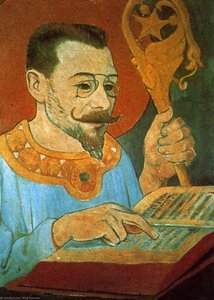
Paul Sérusier’s Colour Wheel: A Pioneer of Abstract Impressionism
The shimmering hues of autumn – crimson, ochre, amber, russet – served as the catalyst for Paul Sérusier's groundbreaking exploration into colour harmony. Born in Paris in 1864 and steeped in the burgeoning artistic fervor of his time, Sérusier embarked on a journey to transcend representational art, driven by an unwavering belief in the expressive potential of pure pigment. This quest culminated in “Colour Wheel,” a deceptively simple composition that nonetheless encapsulates the essence of his revolutionary approach to painting – a cornerstone of the Nabi movement and arguably one of the earliest examples of abstract art.
The Nabi Influence: Seeking Harmony Beyond Reality
Sérusier’s artistic trajectory was profoundly shaped by his association with Pierre Bonnard, Maurice Denis, and Édouard Vuillard—the core members of Les Nabis (“The Prophets”), a group dedicated to rejecting academic conventions and embracing spiritual contemplation. Influenced by Japanese prints and Cézanne's geometric explorations, the Nabis sought inspiration in the intangible realm of emotion and intuition, prioritizing color over meticulous detail. “Colour Wheel” embodies this ethos perfectly; it abandons photographic accuracy in favor of conveying an atmosphere of serene contemplation—a deliberate departure from the prevailing artistic trends of the late nineteenth century.
Cloisonnism: A Technique Rooted in Byzantine Iconography
Sérusier’s distinctive style, known as cloisonnism, owes its origins to Byzantine iconographic tradition. This technique involves dividing a canvas into rectangular panels delineated by thin black lines—a method that dramatically simplifies form and enhances color saturation. As Sérusier himself eloquently described, “The aim is to make the colours shine.” The resulting effect is akin to peering through stained glass windows, capturing not merely what is seen but also how it feels – an immersive experience designed to evoke a profound emotional response. This meticulous process demanded considerable patience and precision, reflecting the artist’s unwavering commitment to achieving artistic excellence.
Symbolism: Capturing Inner Landscapes
Beyond its technical prowess, “Colour Wheel” resonates with symbolic significance. The circular arrangement of colors—red, yellow, blue, green, purple, orange, pink—represents a visual distillation of cosmological concepts prevalent in medieval thought. Each hue embodies specific qualities – passion, intellect, serenity – inviting viewers to contemplate the interconnectedness of existence and the beauty inherent in simplicity. Sérusier’s intention was not merely to depict a landscape but to translate its essence into an internalized experience, mirroring the Nabis' broader preoccupation with spiritual illumination.
A Legacy of Innovation: Inspiring Future Generations
“Colour Wheel” stands as a testament to Sérusier’s visionary audacity—a bold assertion that art could transcend representation and communicate directly with the human soul. Its influence extends far beyond the Nabi movement, inspiring subsequent artists who sought to liberate painting from the constraints of realism. Today, reproductions of this iconic artwork continue to captivate audiences worldwide, serving as a poignant reminder of Sérusier’s enduring contribution to the history of art and his unwavering belief in the transformative power of color.
- Artist: Paul Sérusier
- Birth Year: 1864
- Death Year: 1927
- Medium: Oil on Wood Panel
- Size: 41 x 32 cm
Provenance: Donation from Mr Dominique Denis. Former Maurice Denis collection.
Musée de Pont-Aven
问答详情
保罗·塞吕西耶 的《Colour Wheel》 是人像、风景还是方形构图?
"Colour Wheel" 的画幅格式为 Portrait。这对于规划复制品的摆放位置非常有用。
保罗·塞吕西耶 的《Colour Wheel》 的观众来自哪里?
"Colour Wheel" 拥有专属的 统计数据 页面。该页面通过国家和语言维度的细分,展示了该作品及艺术家其他作品的每月访问量趋势图。
在哪里可以找到关于“Colour Wheel”的指南?
针对 保罗·塞吕西耶 的《Colour Wheel》,我们提供了一个 指南 页面:这是一份可打印的艺术品资料页,专为学生及课堂教学使用而设计。