
由我们的艺术家按需定制,为您提供您所选尺寸及画框的布面手工油画。 ( 切换至版画销售渠道 切换至数字图像销售渠道)





























从与原作比例一致的预设尺寸中进行选择。

您可以输入自定义尺寸,以适配特定的画框或空间。如果所选尺寸与原图比例不符,我们将通过裁剪作品或添加手绘元素来扩展画面。数字样稿将在制作开始前发送给您确认。
请注意,屏幕预览无法准确反映实际的裁剪或扩展效果,只有样稿才能真实呈现最终的构图。
虽然我们提供定制尺寸服务,但为了保留原作比例,建议您从预设列表中选择尺寸。

Study of an Apple
复制品尺寸
Paul Cézanne's Study of an Apple isn’t merely a depiction of fruit; it’s a profound meditation on perception, form, and the very essence of seeing. Completed in 1885 during a pivotal period in his artistic evolution, this watercolor offers a glimpse into the mind of a revolutionary artist grappling with how to represent the world around him – a world he felt was fundamentally misunderstood by conventional art. It’s a deceptively simple composition—a solitary apple resting on a table, its reflection mirroring itself below—yet within that stillness lies an explosion of artistic intent and a key to understanding Cézanne's lasting influence.
Cézanne’s approach in this work marks a decisive shift away from the fleeting impressions of Impressionism. While he admired the Impressionists’ ability to capture light and atmosphere, he felt they lacked a fundamental grasp of underlying structure. He sought to build his paintings not on what was seen at a single moment, but on the enduring forms that lay beneath the surface. The apple itself becomes less an object of immediate visual pleasure and more a study in geometric planes—a series of overlapping cylinders, cones, and spheres – rendered with meticulous care. This emphasis on structure anticipates the principles of Cubism, which would later emerge as a direct consequence of Cézanne’s explorations.
Cézanne's masterful use of watercolor is integral to the painting’s delicate and luminous quality. Unlike oil paints, which dry quickly and allow for precise blending, watercolor offers a more fluid and unpredictable medium. He expertly manipulated the paint’s transparency, layering washes of color to build up complex fields of tone and texture. Notice how he uses subtle shifts in hue – from pale yellows and greens to deeper reds and browns – to suggest volume and depth. The soft edges and hazy atmosphere contribute to a sense of intimacy and immediacy, inviting the viewer into the artist’s studio and his process of observation.
The watercolor technique also allows for an extraordinary level of detail, particularly in the rendering of the apple's surface. Cézanne doesn’t simply paint the apple as a solid form; he meticulously captures the play of light and shadow across its curves, creating a sense of tactile realism. The reflections on the table are equally intricate, demonstrating his keen eye for optical effects and his desire to represent how objects interact with their surroundings.
Study of an Apple is a cornerstone of Post-Impressionism – a movement that rejected the limitations of Impressionism while retaining its emphasis on color and emotion. Cézanne’s work served as a crucial bridge between the two styles, paving the way for the radical innovations of 20th-century art. His exploration of form, perspective, and color profoundly influenced artists like Picasso and Braque, who would later develop Cubism based on Cézanne's principles.
The painting’s significance extends beyond its artistic merit; it represents a fundamental shift in the way artists approached representation. Cézanne wasn’t interested in simply imitating reality; he was striving to capture the underlying essence of things – their geometric structure, their spatial relationships, and their emotional impact. This quest for a more truthful and enduring form of art continues to resonate with viewers today.
Despite its apparent simplicity, Study of an Apple is a deeply complex and emotionally resonant work. It’s a testament to Cézanne's extraordinary observation skills, his technical mastery, and his unwavering commitment to artistic innovation. The painting invites us to slow down, to look closely, and to appreciate the beauty and complexity of the everyday world. A reproduction captures this essence beautifully, offering a window into the mind of one of art history’s most influential figures.

1839 - 1906 , 法国

Discover the ethereal beauty of watercolor through an art-historical lens. Master the delicate balance of light, fluidity, and pigment to capture the luminous essence of nature, inspired by the legendary techniques of the Old Masters and Impressionist greats.

Explore the profound evolution of Cubist still life, from Cézanne's structural foundations to the fragmented brilliance of Braque and Léger. Discover how geometric abstraction redefined reality through a sophisticated lens of form, color, and modern artistic mastery.

Discover the ethereal beauty of premium watercolor reproductions and bespoke commissions at WahooArt. From museum-quality landscapes to custom AI-enhanced portraits, our master artists deliver unparalleled craftsmanship and white-glove service for discerning collectors worldwide.

Explore the structural genius of Paul Cézanne. Discover how his mastery of geometric form and color bridged Impressionism and Cubism in this definitive guide for art enthusiasts and collectors.
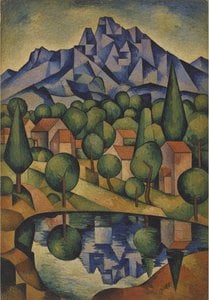
Explore the profound legacy of Paul Cézanne. Discover how his mastery of geometric forms and vibrant color bridged Impressionism and Cubism, offering timeless inspiration for fine art collectors and enthusiasts seeking to understand the foundations of modern art.


 效果预览
效果预览
 分享
分享 分享
分享
 详情
详情

 下载
下载
 相似作品
相似作品 X射线
X射线 幻灯片播放
幻灯片播放 统计数据
统计数据

 展开详情
展开详情









 玻璃选项仅适用于110厘米以下的尺寸。


