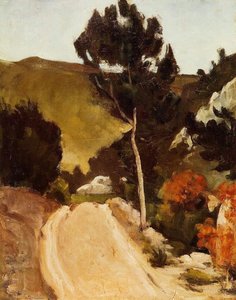
A Vision of Provence: Cézanne’s ‘Road Near Mont Sainte-Victoire’
Paul Cézanne's “Road Near Mont Sainte-Victoire,” painted in 1871, stands as a cornerstone of Post-Impressionism and arguably the genesis of Cubism. More than just a depiction of a Provençal landscape—a region deeply ingrained in Cézanne’s artistic sensibilities—it represents a radical departure from Impressionistic fleetingness, embracing instead a deliberate simplification of form and an unwavering focus on underlying structure. This painting isn't merely observed; it’s wrestled with onto the canvas, embodying Cézanne’s relentless pursuit of capturing not just what is seen but how it *feels*.
- Subject Matter: The scene portrays a winding road traversing rolling hills beneath a cerulean sky punctuated by wisps of cloud. Scattered sheep graze peacefully along its edges, grounding the composition in the tangible realities of rural life. Dominating the horizon is Mont Sainte-Victoire, Cézanne’s beloved mountain—a subject he revisited obsessively throughout his career, transforming it into an emblem of artistic contemplation.
- Style: Cézanne eschewed Impressionism's emphasis on optical illusion and atmospheric effects, opting instead for a style characterized by geometric abstraction and tonal modulation. He meticulously rendered the contours of objects—the road, the trees, Mont Sainte-Victoire—using overlapping planes of color that suggest depth without resorting to traditional perspective.
- Technique: Cézanne employed a technique known as “alla prima,” meaning "at first sight," applying paint directly onto the canvas in successive layers. This method allowed him to capture the immediacy of observation and to build up form gradually, emphasizing solidity and permanence. The artist’s brushstrokes are visible—bold, decisive marks that contribute to the painting's textural richness.
Historical Context: Bridging Impressionism and Modern Art
Painted during Cézanne’s formative years, “Road Near Mont Sainte-Victoire” arrived on the artistic scene amidst a fervent debate about the future of painting. Impressionists like Monet and Renoir championed capturing fleeting moments of light and color—a reaction against academic conventions that prioritized idealized representations. Cézanne responded by rejecting this approach, asserting instead that art should strive to represent “the truth of things,” as he famously declared. This conviction fueled his experimentation with form and perspective, paving the way for subsequent artistic movements like Cubism, spearheaded by Picasso and Braque—artists who would dismantle Cézanne’s simplified forms into geometric fragments, furthering his revolutionary vision.
Symbolic Resonance: Mont Sainte-Victoire as Meditation
Mont Sainte-Victoire holds profound symbolic significance for Cézanne. Beyond its visual beauty, the mountain represented a locus of spiritual contemplation and artistic obsession—a challenge to capture not just its appearance but also its essence. Cézanne repeatedly depicted Mont Sainte-Victoire in various compositions, transforming it into an archetype of permanence amidst the ephemeral nature of existence. The road itself symbolizes the journey of artistic exploration—the constant striving for greater understanding and representation.
Emotional Impact: Tranquility and Artistic Resolve
“Road Near Mont Sainte-Victoire” exudes a palpable sense of serenity, mirroring Cézanne’s own inner state during this period. Yet, beneath the surface tranquility lies an underlying conviction—a determination to confront artistic challenges head-on and to forge a new path for painting. The painting invites viewers into Cézanne's world, encouraging them to contemplate the beauty of nature alongside the artist’s unwavering commitment to his craft. It remains a testament to Cézanne’s enduring legacy as one of the most influential figures in modern art—a masterpiece that continues to inspire artists and collectors alike.






 购买版画
购买版画 分享
分享 分享
分享
 详情
详情

 下载
下载
 相似作品
相似作品 X射线检测
X射线检测 幻灯片播放
幻灯片播放

 展开详情
展开详情