A Quiet Resonance: Exploring Cézanne’s “Cottages”
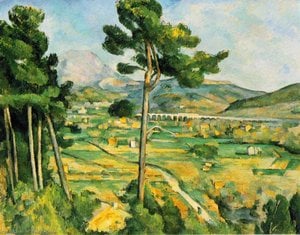
Paul Cézanne's "Cottages," painted circa 1885, isn’t merely a depiction of rural France; it’s an embodiment of Cézanne’s revolutionary approach to painting—a cornerstone of Post-Impressionism and a precursor to Cubism. This watercolor captures a serene hillside scene dominated by two modest cottages nestled amongst rolling hills, bathed in diffused sunlight. The artist eschews traditional perspective, favoring instead a fragmented geometry that anticipates Picasso and Braque's groundbreaking explorations into form and space. Cézanne’s meticulous observation of nature is transformed into an abstracted representation, prioritizing the underlying structure of the landscape over its immediate visual appearance.
- Style: Post-Impressionism – Cézanne deliberately distanced himself from Impressionist concerns with fleeting light effects, opting instead for a more enduring exploration of form and color.
- Technique: Cézanne employed a characteristic technique known as “alla prima,” applying paint directly onto the canvas without preliminary sketches or underlayers. This method allowed him to capture the immediacy of his perception and imbue the painting with palpable energy.
- Color Palette: The muted hues—primarily ochres, browns, greens, and blues—reflect Cézanne’s fascination with earthy tones and contribute to the overall sense of tranquility. However, subtle variations in color create depth and luminosity, hinting at Cézanne's masterful manipulation of pigment.
Historical Context: Cézanne’s Artistic Journey
Cézanne’s artistic development unfolded against a backdrop of intellectual ferment—the burgeoning Symbolist movement alongside the increasingly influential theories of Gestalt psychology. Influenced by Japanese prints and the writings of Nietzsche, Cézanne sought to express inner emotions and psychological states through visual imagery. He was initially dismissed by critics who deemed his work unfinished and lacking in conventional beauty, yet he persevered in his pursuit of artistic truth—a conviction that would ultimately earn him recognition as one of the most important artists of the late 19th century. The painting’s quiet stillness speaks to Cézanne's desire to distill the essence of experience into a timeless form.
- Influence: Cézanne’s work profoundly impacted subsequent generations of artists, paving the way for Cubism and establishing a new paradigm for representing reality.
- Reaction Against Impressionism: Cézanne deliberately rejected Impressionist techniques—such as capturing transient atmospheric conditions—believing that they obscured the underlying structure of objects.
- Philosophical Roots: His artistic vision was underpinned by Nietzsche’s concept of “eternal recurrence”—the belief that life repeats itself infinitely, prompting Cézanne to explore themes of permanence and repetition within his compositions.
Symbolism & Emotional Resonance
Beyond its formal innovations, "Cottages" possesses a subtle symbolic richness. The cottages themselves represent simplicity, rural life, and perhaps even the artist’s yearning for connection with nature—themes that resonated deeply with Cézanne's personal sensibilities. The placement of the figures—a chair positioned near one of the houses—suggests contemplation and observation, inviting viewers to engage in a dialogue with the artwork itself. The painting evokes feelings of peace, solitude, and contemplative beauty—qualities that continue to captivate audiences today. It’s a testament to Cézanne's ability to transform ordinary subjects into vehicles for profound emotional expression.
Consider commissioning a high-quality reproduction of “Cottages” to bring Cézanne’s vision into your home and experience the enduring power of his artistic legacy.