A Window into Emotion: Decoding Picasso’s ‘Lovers’
Pablo Picasso's “Lovers,” painted in 1919, stands as a cornerstone of Cubist art and a poignant exploration of human connection. More than just a portrait, it’s a visual distillation of feeling—a testament to Picasso’s masterful manipulation of form and color to convey profound psychological depth. Created during the height of his experimentation with stylistic innovation, this artwork exemplifies Picasso's groundbreaking approach to representing reality, rejecting traditional perspective in favor of fragmented planes that simultaneously depict multiple viewpoints.
- Subject Matter: The painting depicts two figures—a man and a woman—positioned close together, their bodies intertwined in an intimate embrace. This deliberate juxtaposition emphasizes the complexities of relationships and the desire for closeness amidst perceived separation.
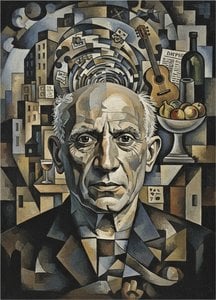
- Style & Technique: Picasso’s signature Cubist style is immediately apparent. Instead of striving for realistic representation, he dissects figures into geometric shapes—cubes, cylinders, and cones—assembling them in an unconventional manner that disrupts conventional spatial illusion. The artist utilizes a muted palette dominated by earthy tones – ochre, brown, and gray – reflecting the somber mood of the scene.
African Influences & Symbolic Resonance
Picasso’s artistic journey was profoundly impacted by his exposure to African tribal art during his travels in Morocco. The stylized figures and simplified forms found in these sculptures served as inspiration for “Lovers,” contributing to its distinctive aesthetic. Specifically, Picasso drew parallels between the frontal gaze of African masks and the directness of the lovers' eyes—a deliberate choice intended to convey a sense of immediacy and emotional intensity. The woman’s veil symbolizes concealment and perhaps unspoken emotions, adding another layer of symbolic significance to the composition.
Historical Context: The Dawn of Modern Art
“Lovers” emerged during a period of seismic change in European art history—the birth of Cubism. Challenging the conventions of Impressionism and Post-Impressionism, Picasso alongside Georges Braque spearheaded this revolutionary movement, rejecting traditional artistic traditions to forge new paths toward visual expression. This artwork represents a decisive break from academic painting, signaling a move towards abstraction and prioritizing emotional impact over meticulous detail. It’s considered one of the earliest examples of Cubist art, marking a pivotal moment in the development of 20th-century aesthetics.
Emotional Impact & Artistic Legacy
Despite its seemingly simple depiction, “Lovers” possesses an undeniable power to evoke emotion. The compressed space and fragmented forms create a sense of unease and tension, mirroring the unspoken anxieties inherent in intimate relationships. Picasso’s masterful use of color—particularly the subtle hues that underscore the melancholic atmosphere—further enhances this emotional resonance. More than just a beautiful image, “Lovers” remains an enduring symbol of human desire and vulnerability—a testament to Picasso's genius and his lasting contribution to the canon of modern art. Its influence can be seen in countless subsequent artworks exploring themes of intimacy and psychological complexity.
常见问题与解答
在“The Lovers”中,融合了怎样的心境与情感?
《毕加索 的《The Lovers》》所传达的意境为Romantic,其情感基调为Melancholic。
"The Lovers" 的主题与 毕加索 常有的创作主题有何关联?
在毕加索已记录的主题——african primitivism, geometric abstraction, love, intimacy, human connection, symbolic representation, emotional depth, exploring form——之中,"The Lovers" 则将焦点转向了romanticism, african influence, emotional intensity, cubist style, relationship dynamics, geometric composition, mediterranean landscape。
建议将“The Lovers”打印成多大的尺寸?
建议将“The Lovers”打印为 Large 尺寸。其他尺寸亦可按相同比例进行制作。