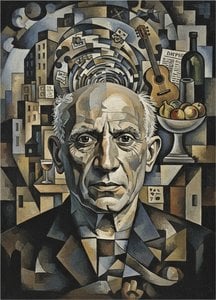
A Fragmented Reflection: Analyzing Picasso’s “Self-Portrait 6”
Pablo Picasso's "Self-Portrait 6," created circa 1937, stands as a pivotal moment in the artist’s oeuvre and embodies the core tenets of Cubism—a stylistic revolution that irrevocably altered the landscape of Western art. Captured in muted greenish hues, the painting presents an unsettling depiction of the artist's visage, characterized by deliberate distortions and a gaze directed outwards, seemingly confronting the viewer with an unspoken vulnerability. This isn’t merely a likeness; it’s a dissection of identity itself, rendered through geometric planes that challenge traditional notions of representation.
- Style & Technique: Picasso's masterful application of Cubist principles—specifically Analytical Cubism—is immediately apparent. The canvas is divided into interlocking planes of color and form, rejecting illusionistic depth in favor of a fractured perspective. This technique prioritizes conveying multiple viewpoints simultaneously, forcing the eye to actively reconstruct the image rather than passively accepting it as presented.
- Historical Context: Painted during the tumultuous period surrounding World War II, “Self-Portrait 6” reflects Picasso’s engagement with the anxieties of his time. The artwork's unsettling aesthetic aligns with the broader artistic movement exploring psychological complexities and confronting societal pressures—a response to the horrors unfolding across Europe.
Decoding Symbolism: Beyond Appearance
The greenish tint dominating the portrait isn’t accidental; it evokes feelings of melancholy and unease, mirroring Picasso's own preoccupation with mortality. The fragmented gaze suggests a profound introspection—a questioning of selfhood amidst external turmoil. Furthermore, the simplified facial features – reduced to geometric shapes – serve as a deliberate rejection of idealized beauty, prioritizing psychological truth over aesthetic perfection. This stylistic choice underscores Picasso’s desire to portray not just what he saw but how he *felt*, transforming the portrait into an emblem of existential contemplation.
- Geometric Distortion: The fractured planes and angular lines symbolize the artist's struggle to reconcile his inner world with the realities of the outside world—a visual representation of psychological fragmentation.
- Color Palette: The subdued greenish tones contribute to the painting’s emotional resonance, conveying a sense of sorrow and introspection. Picasso deliberately eschewed vibrant hues, opting for colors that amplify the mood rather than distracting from it.
Emotional Impact & Artistic Legacy
“Self-Portrait 6” transcends mere visual representation; it’s an emotionally charged exploration of the artist's psyche. Picasso’s bold stylistic innovation cemented his position as a pioneer of Modern Art, influencing generations of artists who followed him. Its enduring appeal lies in its ability to provoke contemplation about identity, perception, and the human condition—themes that continue to resonate with audiences today. As exemplified by artists like Ambreen Butt Hussain and Scottie Wilson, Picasso’s influence extends far beyond his own time, inspiring contemporary creatives to push boundaries and challenge conventions. Exploring reproductions of this masterpiece offers a window into the artistic spirit of its era and celebrates Picasso's profound contribution to art history.
常见问题与解答
毕加索 的《Self-portrait 6》 的色彩是鲜艳还是柔和?
毕加索 的《Self-portrait 6》 的色彩饱和度为 Subtle Color,色彩强度为 Balanced。
我可以在不同的光线下查看毕加索 的《Self-portrait 6》吗?
您可以在作品的 X射线透视 页面上逐层探索 “Self-portrait 6”;该交互式查看器的设计灵感源自修复师使用的光源台,通过十一层光学读数呈现图像细节。
毕加索 的《Self-portrait 6》 传达了怎样的心境与情感?
在“Self-portrait 6”中,Dramatic 的氛围伴随着 Melancholic 的情感。


 实景预览
实景预览
 分享
分享 分享
分享
 详情
详情 指南
指南

 下载作品
下载作品
 相似作品
相似作品 X射线
X射线 幻灯片播放
幻灯片播放 问答
问答
 统计数据
统计数据
 展开全文
展开全文
 切换至版画销售渠道





































 玻璃选项仅适用于110厘米以下的尺寸。