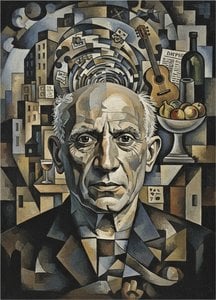
A Study in Gray and Angular Emotion
Pablo Picasso's “Self-Portrait 5,” created circa 1907, stands as a pivotal moment in the artist’s artistic trajectory—a testament to his burgeoning embrace of Cubism and an unflinching exploration of inner turmoil. Unlike earlier portraits imbued with meticulous realism, this piece abandons conventional perspective and embraces a deliberately fractured aesthetic, prioritizing emotional resonance over accurate representation.
- Composition: The portrait’s asymmetrical arrangement immediately draws the eye, emphasizing the dominance of the head and shoulders while simultaneously disrupting any sense of balanced visual harmony. Picasso skillfully employs angular lines to delineate facial features, creating a dynamic interplay between solidity and instability.
- Color Palette: Stripped down to a monochrome scheme dominated by shades of gray, black, and white, the color palette underscores the painting’s austere mood. This deliberate restriction amplifies the expressive power of the line work and contributes to an overall feeling of profound seriousness.
- Technique: Executed with rapid, gestural charcoal strokes—a hallmark of Picasso's style—the artwork conveys a palpable immediacy. The visible marks of the drawing medium lend texture and physicality to the image, mirroring the artist’s emotional intensity.
Deconstructing Form: Cubist Principles Embodied
“Self-Portrait 5” exemplifies Picasso's pioneering approach to Cubism—a revolutionary movement that sought to depict subjects from multiple viewpoints simultaneously. The artist dismantles the face into geometric planes and shapes—triangles, squares, and rectangles—representing distinct perspectives rather than attempting to capture a single unified image.
- Shapes: These fragmented forms aren’t merely decorative; they actively challenge traditional notions of representation, forcing viewers to confront the complexities of perception.
- Perspective & Depth: Rather than creating illusionistic depth, Picasso utilizes overlapping shapes and varying line weights to suggest spatial relationships—a subtle yet decisive departure from Renaissance conventions.
Symbolism Beyond Appearance
More than just a depiction of the artist’s physical likeness, “Self-Portrait 5” delves into psychological depths. The intense gaze directs inward, inviting contemplation on themes of self-awareness and vulnerability. The angular lines and fragmented composition evoke feelings of anxiety and alienation—mirroring Picasso's own struggles during this formative period.
A Legacy of Expression
"Self-Portrait 5" remains a profoundly evocative artwork—a cornerstone of Picasso’s oeuvre and an enduring symbol of artistic innovation. Its raw emotion, combined with its masterful technique, continues to captivate audiences today, cementing Picasso's place as one of the most influential figures in modern art.
常见问题与解答
"Self-portrait 5" 属于哪种艺术风格?
毕加索 的《Self-portrait 5》 所属的艺术流派为 Cubist Expressionism。这一分类将该作品置于相关艺术家及艺术作品的语境之中。
考虑到其色彩搭配,建议将 毕加索 的《Self-portrait 5》 悬挂在哪个房间?
毕加索 的《Self-portrait 5》 的 Neutrals 色调与其推荐的布置空间——Living Room 完美契合。
Cubist Expressionism 流派的作品 "Self-portrait 5" 源自哪个国家?
《Self-portrait 5》由出生于 西班牙 的 毕加索 在 Cubist Expressionism 运动背景下创作而成。艺术家的原籍地使这部作品与 西班牙 艺术家所实践的 Cubist Expressionism 风格紧密相连。