


x


 Abstract Expressionism
 2003
2003 28.0 x 22.0 cm
从与原作比例一致的预设尺寸中进行选择。

您可以输入自定义尺寸,以适配特定的画框或空间。如果您选择的尺寸与原图比例不符,我们将对作品进行裁剪,或通过镜像填充/纯色填充边缘的方式来扩展图像。在开始制作之前,我们会向您发送一份数字效果图供您确认。
请注意,屏幕上的预览并不能反映实际的裁剪或扩展效果。只有效果图才能准确展示最终的构图。
虽然我们提供定制尺寸,但为了保持原图比例,我们建议您从预设列表中选择尺寸。

Study
复制品尺寸


Nick Mauss’s work isn't merely painting; it’s a deliberate excavation, a slow unveiling of layered anxieties and forgotten histories. Born in New York City in 1980, his artistic lineage is complex – rooted in German and Irish heritage, yet carrying within it the echoes of a distant Jewish ancestry traced back to Switzerland. This confluence of influences—the pragmatic solidity of European roots intertwined with the restless energy of American identity—forms the bedrock of his uniquely unsettling aesthetic. Mauss’s trajectory wasn't a straightforward ascent; he initially wrestled with crippling anxiety, delaying his artistic pursuits until his mid-twenties when, fueled by a desire to perform and a supportive network, he began honing his craft in the vibrant comedy scene of Boston.
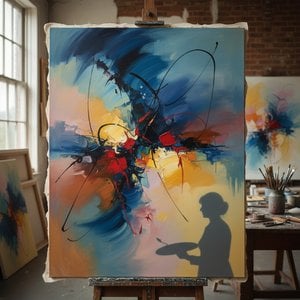
Early performances at open mic nights proved pivotal. The experience, though fraught with initial apprehension, ultimately forged a resilience and a willingness to confront vulnerability – qualities that would later become central to his artistic process. This early struggle for self-expression is subtly reflected in his work, particularly in pieces like “Study” (2003), a chaotic explosion of brushstrokes and layered colors that feels less like a finished image and more like the raw, unfiltered expression of an internal landscape grappling with turbulence. The painting’s dynamism speaks to this initial period of self-discovery, capturing the energy of a mind in constant flux.
Mauss's artistic vision quickly expanded beyond traditional painting, leading him to embrace a diverse range of media. He began experimenting with reverse-painted mirrored glass, creating shimmering surfaces that refract and distort reality – a technique he continues to utilize today. This shift reflects a deliberate rejection of easy categorization, mirroring his approach to history itself. As he himself describes, his work “folds together and expands the intimate space of the page with its spatial and performative implications,” blurring the boundaries between art forms and challenging conventional notions of representation. This is evident in pieces like "Untitled" (2003), a layered digital portrait that blends surrealism and abstraction, utilizing textured bark-like backgrounds to evoke a sense of unease and intrigue – a deliberate strategy for drawing the viewer into an unsettling narrative.
His exploration extends beyond painting, incorporating ceramics, textiles, sculpture, performance, and writing. This multifaceted approach isn’t simply decorative; it's a strategic deployment of different materials and techniques to amplify specific themes and ideas. The inclusion of performance, for instance, adds an element of immediacy and engagement, inviting the viewer to become active participants in the unfolding narrative.
Mauss’s work is deeply informed by a fascination with forgotten histories and obscured narratives. He actively seeks out connections between contemporary art production and broader historical contexts, often re-examining museum collections or archives through experimental exhibitions. This approach isn't merely academic; it’s a critical intervention, challenging established hierarchies and offering alternative perspectives on the past. His 2020 exhibition at Kunsthalle Basel, “Bizarre Silks, Private Imaginings and Narrative Facts, etc.”, exemplifies this strategy, utilizing his diverse media to explore themes of memory, identity, and the construction of narratives.
This commitment to historical resonance has garnered significant recognition from leading institutions. His work has been featured in exhibitions at the Whitney Museum of American Art, FRAC Champagne-Ardenne, Musée d’Art Moderne de Paris, and numerous galleries worldwide. His inclusion in the 2012 Whitney Biennial solidified his position as a key figure in contemporary art, while ongoing collaborations with artists like Ken Okiishi continue to push the boundaries of artistic practice.
Today, Nick Mauss remains a vital and evolving artist. His work continues to explore themes of anxiety, memory, and the complexities of identity, often through unsettling yet captivating imagery. His ongoing engagement with diverse media—from mirrored glass to performance—demonstrates a restless curiosity and a commitment to challenging conventional artistic boundaries. The influence of his early struggles with anxiety is still palpable in his work, but it’s now tempered by a profound sense of resilience and a willingness to confront the darker aspects of human experience. Mauss's legacy lies not just in the finished artworks themselves, but in their capacity to provoke reflection, unsettling viewers and prompting them to question the narratives they hold dear.

1980 -

Explore the evolution of abstract painting with WahooArt. Discover key artists, historical context & investment insights. Find museum-quality reproductions and expert appraisal services.

Explore the groundbreaking abstract expressionism of Morris Louis, a pioneer of Color Field painting. Discover his innovative techniques, influential series & lasting legacy in post-war American art. Learn more at WahooArt.
Explore the captivating world of Beatrice Parsons, a pioneering British abstract expressionist. Discover her journey from garden watercolors to evocative color field paintings and learn about her place within art history.

Explore the fascinating intersection of art & emotion! Discover how color, form, and texture convey feelings in masterpieces. Expert analysis for collectors & enthusiasts.

Explore the profound world of Clyfford Still's Abstract Expressionism with WahooArt. Discover his unique style, existential themes & investment potential. Expert analysis for discerning collectors.


第一时间获取最新的艺术新闻、独家优惠及装饰灵感。
向我们介绍您的项目需求,我们的艺术专家将为您提供 3 个个性化的艺术品推荐。
由我们的专家为您精选 3 款心仪之作 —— 完全免费!
 定制手绘复刻品
 分享
分享 分享
分享
 详情
详情

 下载
下载
 相似作品
相似作品 X射线
X射线 幻灯片播放
幻灯片播放 展开详情
展开详情






































 玻璃选项仅适用于110厘米以下的尺寸。


