
博物馆级艺术微喷或帆布版画,制作高效,并提供多种饰面选择。 ( 订购纯手工绘制画作 切换至数字图像销售渠道)





























您可以从与原作比例一致的预设尺寸中进行选择。

请输入您所需的宽度和高度,以适配您的画框或墙面。由于印刷品只能进行裁剪,无法超出原图尺寸,因此若比例不一致,画面的一部分将会被裁切。在正式印刷之前,我们会为您发送一份数字效果图供您确认。本页面显示的图片并非最终裁剪后的效果——只有效果图才能展示真实的裁剪情况。
Plafond
复刻品尺寸
Nicholas Roemerich's "Plafond," painted in 1913, is more than just a depiction of the night sky; it’s a profound meditation on humanity’s place within the vastness of the cosmos. This remarkable work, brimming with intricate detail and imbued with a spiritual sensibility, exemplifies Roerich’s unique artistic vision – one that seamlessly blended scientific observation with deeply held philosophical and religious beliefs. The painting immediately draws the eye to its central focus: a luminous circle dominated by a youthful figure, often interpreted as an angelic child or nascent human spirit, surrounded by a swirling tapestry of stars and planets.
Roerich was deeply influenced by both Russian Orthodox spirituality and his extensive travels – particularly to Central Asia and Tibet – where he encountered ancient symbols and beliefs related to the cosmos. “Plafond” reflects this influence through its use of vibrant, almost iridescent colors, achieved through a technique known as ‘verlona,’ which Roerich developed himself. This method involved layering thin glazes of paint, creating an ethereal glow that seems to emanate from within the canvas. The meticulous detail in depicting constellations and planets demonstrates his dedication to scientific accuracy, reflecting his belief that art should be informed by knowledge.
The painting’s texture is rich and tactile, achieved through multiple layers of paint built up over time. This technique not only adds depth but also contributes to the overall sense of wonder and awe evoked by the scene. The brushwork is precise yet fluid, conveying both a scientific understanding of celestial mechanics and an emotional connection to the beauty of the universe.
"Plafond" was created during a period of significant intellectual and spiritual ferment in early 20th-century Russia. Roerich’s work aligns with broader trends of interest in esoteric knowledge, comparative religion, and the search for universal truths. The painting's symbolism is rich with layers of meaning, referencing ancient myths, religious iconography, and philosophical concepts related to creation, humanity’s destiny, and the interconnectedness of all things. The title itself, “Plafond,” suggests a ceiling or dome – a traditional symbol of heaven or the cosmos – further emphasizing the painting's spiritual dimension.
Painted in 1913, just before World War I dramatically reshaped Europe, "Plafond" represents a moment of relative peace and optimism within Roerich’s artistic trajectory. It stands as a testament to his enduring belief in humanity’s potential for harmony and understanding.
"Plafond" possesses a powerful emotional impact, inviting viewers to contemplate their place in the universe and to connect with something larger than themselves. The painting's luminous quality and evocative imagery create a sense of serenity and wonder, while its complex symbolism encourages deeper reflection. Nicholas Roerich’s work continues to resonate today, demonstrating his mastery of technique, his profound spiritual vision, and his enduring legacy as one of the 20th century’s most important artists.
尼古拉·罗斯里赫 的《Plafond》 将 night sky, celestial bodies, angel figure, nicholas roerich, cosmic wonder, symbolic art, russian artist 与 Ethereal 的氛围完美融合。
尼古拉·罗斯里赫 的《Plafond》 的建议用途为 Statement,同时也适用于其他场景。


1874 - 1947 , 俄罗斯

Elevate your design projects with WahooArt's premium canvas prints and hand-painted reproductions. From Giclée excellence to bespoke oil commissions, we provide professional decorators with museum-quality, affordable art solutions delivered worldwide with a 100% satisfaction guarantee.

探索 WahooArt.com 高品质艺术海报打印服务。我们专注于博物馆级色彩还原与精准的尺寸定制,为精英收藏家与室内设计师提供理想的装饰方案。凭借二十余年的专业工艺、全球免费配送及100%满意保证,让每一件精美艺术品都能完美融入您的私人空间,成就卓越审美格调。

Master the nuances of Giclée printing with our expert guide. Discover how pigment-based inks and museum-grade substrates create fade-resistant, high-fidelity art reproductions designed for discerning collectors seeking unparalleled quality and longevity.
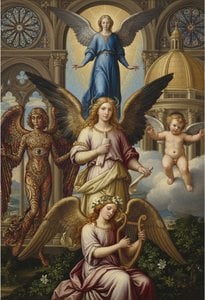
Explore the profound beauty of angelic figures in art history. From Renaissance masterpieces to celestial symbolism, our expert guide offers a sophisticated journey through the divine imagery of the Old Masters for discerning collectors and art enthusiasts.


 实景预览
实景预览
 分享
分享 分享
分享
 详情
详情 指南
指南

 下载作品
下载作品
 相似作品
相似作品 X射线
X射线 幻灯片播放
幻灯片播放 Q&A
Q&A 统计数据
统计数据

 展开全文
展开全文









 玻璃选项仅适用于110厘米以下的尺寸。


