
由我们的艺术家按需定制,为您提供您所选尺寸及画框的布面手工油画。 ( 切换至版画销售渠道 切换至数字图像销售渠道)
您可以从与原作比例一致的预设尺寸中进行选择。

您可以输入自定义尺寸,以适配特定的画框或空间。如果所选尺寸与原图比例不符,我们将通过裁剪作品或添加手绘元素来扩展画面。数字样稿将在制作开始前发送给您确认。
请注意,屏幕预览无法准确反映实际的裁剪或扩展效果,只有样稿才能真实呈现最终的构图。
虽然我们提供定制尺寸服务,但为了保留原作比例,建议您从预设列表中选择尺寸。

Landscape
复刻品尺寸说明

In the quiet, contemplative atmosphere of late Edo-period Japan, a profound artistic dialogue was unfolding between the ancient traditions of China and the burgeoning sensibilities of the Japanese literati. At the heart of this movement stood Nakabayashi Chikkei, an artist whose brushstrokes served as a vital bridge between eras. Born in Nagoya in 1801, Chikkei entered a world where art was not merely a display of technical skill, but a pursuit of intellectual depth and poetic resonance. As the son of the renowned nanga master Nakabayashi Chikutō, Chikkei’s very existence was steeped in the refined aesthetics of the literati tradition, a lineage that would profoundly shape his creative soul.
Chikkei’s early years were defined by a rigorous and meticulous training process. Following the established customs of nanga education, he spent much of his youth engaged in the disciplined practice of copying the works of masters. This was far more than simple imitation; it was a spiritual absorption of the rhythmic complexities and tonal subtleties found in Chinese landscape painting. Through this method, he internalized the essence of the Yuan Dynasty masters, particularly the minimalist elegance and evocative use of space characteristic of artists like Wu Zhen and Ni Zan. This foundation allowed him to develop a nuanced understanding of ink techniques that would later define his mature style.
While Chikkei remained deeply rooted in the nanga tradition, his artistic journey was marked by an extraordinary breadth of exploration. He did not confine himself to a single school; instead, he sought to expand the boundaries of his visual language by studying diverse Japanese traditions. His curiosity led him to engage with the Maruyama Shijo and Yamato-e schools, as well as the Nanbin style. This eclectic education infused his work with a unique sense of realism, particularly in his ability to render the delicate textures of nature.
This stylistic synthesis is perhaps most evident when observing his treatment of flora and fauna. While many of his contemporaries focused solely on the abstract spiritualism of landscapes, Chikkei demonstrated a remarkable capacity for shinkeizu—naturalistic views. In his floral compositions, one can witness a breathtaking attention to detail, where the soft petals of roses or the intricate feathers of a sparrow are rendered with a freshness that feels almost tactile. He possessed the rare ability to balance the rugged, strangely-shaped rocks typical of the Chinese bunjinga style with a delicate, lifelike precision that suggested a deep, personal connection to the physical world.
As the Edo period transitioned into an era of increasing social change and Western influence, Chikkei’s work remained a steadfast testament to the enduring power of the ink wash tradition. His landscapes, often featuring serene mountains and cascading waterfalls, captured a sense of timelessness that transcended the political shifts of his age. He was not merely a painter of scenery, but a poet of the landscape, using subtle tonal gradations to create atmospheres that felt both physically present and spiritually distant.
The historical significance of Nakabayashi Chikkei lies in his role as a custodian of the nanga spirit during a period of profound transformation. Through his mastery of ink and color, he ensured that the intellectual and philosophical underpinnings of the literati movement continued to flourish. His legacy is found in the balance he achieved between the scholarly weight of Chinese tradition and the observant, naturalistic beauty of Japanese art, leaving behind a body of work that continues to resonate with those seeking harmony within the natural world.

1816 - 1867

Embark on a profound journey through the soul of Chinese calligraphy. Explore the historical mastery of ink, brush, and script, from ancient Zhuanshu to elegant running script, and discover how this timeless art form reflects the enduring spirit of classical East Asian aesthetics.
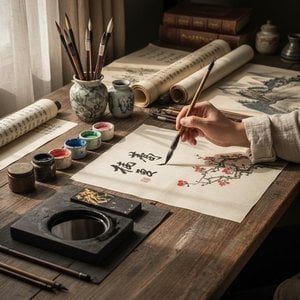
Embark on a sophisticated exploration of ink wash painting and Sumi-e. Uncover the profound historical lineages, Zen philosophies, and technical mastery behind this timeless medium in our authoritative guide for fine art enthusiasts.


 实景预览
实景预览
 发送
发送 分享
分享
 详情
详情 指南
指南

 下载图片
下载图片
 相似作品
相似作品 X射线
X射线 幻灯片播放
幻灯片播放 统计数据
统计数据


 阅读全文
阅读全文






































 玻璃选项仅适用于110厘米以下的尺寸。


