A Surrealist Echo: Exploring Max Ernst’s “Untitled (8351)”
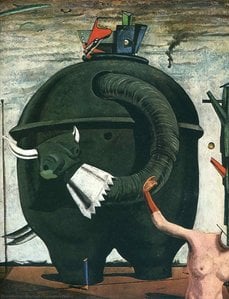
The canvas holds an unsettling beauty—a landscape rendered in hues of ochre and bruised violet, dominated by a colossal sculpture that commands immediate attention. This is Max Ernst’s “Untitled (8351),” a cornerstone of Surrealist art produced in 1927 during the height of Weimar Germany's artistic ferment. It’s not merely a painting; it’s an invitation into a realm where logic yields to dream, and familiar forms twist into grotesque distortions.
- Subject Matter: The sculpture itself is amorphous—a towering monolith devoid of discernible features—yet undeniably imposing. Scattered around its base are smaller figures, some recognizable as birds, others rendered in abstract shapes that defy categorization. These elements coalesce to form a desolate tableau reminiscent of arid deserts or windswept plains.
- Style: Ernst’s approach aligns perfectly with the Surrealist movement's rejection of rational representation. Influenced by Sigmund Freud’s psychoanalytic theories, he sought to tap into the subconscious mind and express primal emotions—fear, anxiety, desire—without resorting to conventional artistic conventions.
Technique: Automatism and Collage – Embracing Chance
Ernst pioneered a revolutionary technique known as automatism—a process of spontaneous drawing or painting undertaken without conscious control. He believed that bypassing rational thought allowed access to deeper levels of creativity, liberating the artist from self-censorship and fostering unexpected visual discoveries. To achieve this effect, Ernst combined collage techniques with meticulous brushwork. Fragments of printed matter—photographs, maps, newspaper clippings—were meticulously adhered to the canvas, creating a textured surface that mirrored the fragmented nature of the subconscious.
- Materials: Ernst utilized oil paints mixed with turpentine and linseed oil on linen canvas. The collage elements included paper scraps sourced from various publications, adding layers of visual complexity and referencing anxieties surrounding political instability and cultural fragmentation prevalent in Weimar Germany.
Historical Context: Weimar’s Artistic Crisis and the Rise of Surrealism
“Untitled (8351)” emerged during a period of profound societal upheaval in Germany. The aftermath of World War I left the nation reeling from economic hardship, political polarization, and social disillusionment. Amidst this crisis, Surrealist artists—including Ernst, André Breton, Joan Miró, René Magritte—challenged prevailing artistic dogma and championed experimentation as a means of confronting existential anxieties. They sought to liberate art from the constraints of reason and explore the uncharted territories of human consciousness.
Symbolism: Desert Landscapes and Fragmented Forms – Reflections of Inner Turmoil
The desolate landscape depicted in “Untitled (8351)” serves as a powerful metaphor for inner turmoil—a representation of psychological emptiness and vulnerability. The colossal sculpture embodies the overwhelming presence of repressed desires and anxieties, while the scattered figures symbolize fragmented identities and shattered perceptions. Ernst’s masterful use of color—the muted violet conveying melancholy and uncertainty—further amplifies the painting's emotional impact.
Emotional Impact: An Invitation to Contemplate the Unconscious
Ultimately, “Untitled (8351)” compels viewers to confront uncomfortable truths about themselves and their relationship with reality. It’s a disconcerting yet profoundly rewarding experience—a reminder that beauty can reside in dissonance and that art possesses the capacity to illuminate hidden dimensions of human psychology. Like many Surrealist masterpieces, it continues to resonate today as an emblem of artistic innovation and a testament to the enduring power of imagination.



 效果预览
效果预览
 购买手绘画作
 分享
分享 分享
分享
 详情
详情

 下载
下载
 相似作品
相似作品 X射线
X射线 幻灯片播放
幻灯片播放
 展开详情
展开详情






































 玻璃选项仅适用于110厘米以下的尺寸。