
 PaintingBaroque
 190719th Century
 20.0 x 17.0 cm
 Rhode Island School of Design Museum of Art
博物馆级艺术微喷或帆布版画,制作高效,并提供多种饰面选择。 ( 订购此收藏品的纯手工复刻画作 切换至数字图像销售渠道)





























您可以从与原作比例一致的预设尺寸中进行选择。

您可以输入自定义尺寸,以适配特定的画框或空间。如果您选择的尺寸与原图比例不符,我们将对作品进行裁剪,或通过镜像填充/纯色填充边缘的方式来扩展图像。在开始制作之前,我们会向您发送一份数字效果图供您确认。
请注意,屏幕上的预览并不能反映实际的裁剪或扩展效果。只有效果图才能准确展示最终的构图。
虽然我们提供定制尺寸,但为了保持原图比例,我们建议您从预设列表中选择尺寸。

Le Lion
复刻品尺寸说明

In the heart of Central Europe, where the dramatic landscapes of Bohemia meet the spiritual fervor of the Counter-Reformation, the name Matthias Bernard Braun resonates with the weight of stone and the fluidity of motion. Born in 1684 in the small Tyrolean village of Sautens, near Innsbruck, Braun was a sculptor whose hands possessed the rare ability to breathe life into cold minerals. His early years were shaped by the rugged, pious atmosphere of the Stams monastery region, where he began his apprenticeship under the esteemed Andreas Tamash. This formative period in Tyrol provided him with a foundational mastery of stone carving, yet it was only through his subsequent wanderings that his true artistic soul began to emerge from the mountain mists.
The trajectory of Braun’s life changed irrevocably when he embarked on a transformative journey through the great cradles of Italian art. At a young age, he traversed the vibrant landscapes of Venice, Bologna, and Rome, immersing himself in the pulsating energy of the High Baroque. Here, the shadows of Michelangelo Buonarroti and the theatrical, swirling dynamism of Gian Lorenzo Bernini became his silent mentors. He did not merely observe these masters; he absorbed their essence—the way light dances across a furrowed brow, the way drapery seems to catch an invisible wind, and the profound emotional tension held within a single, poised gesture. This Venetian-inflected sensibility, characterized by a certain rhythmic grace and intense psychological depth, would become the hallmark of his later masterpieces.
While his roots were Austrian, Braun’s destiny was inextricably linked to the cobblestones of Prague. Arriving in the Bohemian capital around 1708, he found a city ripe with architectural ambition and religious devotion. His ascent was accelerated by the patronage of the influential Count František Antonín Špork, a nobleman whose vision for monumental art provided Braun with the canvas necessary to execute his most ambitious dreams. It was during this era that Braun established himself as a central figure in the Prague Sculptors' Guild, transforming the city’s skyline and its most sacred landmarks with works of unparalleled expressive power.
Perhaps no location serves as a more profound testament to his genius than Kuks. Under the commission of Count Špork, Braun orchestrated a sculptural program that remains one of the pinnacles of Baroque achievement. In the natural setting of Bethlehem, he sculpted the Virtues and Vices, a series of figures that transcend mere decoration to become profound allegories of human morality. These works are not static; they are caught in a state of perpetual becoming, their limbs twisting with an organic vitality that seems to defy the very medium of sandstone. His ability to weave complex theological narratives into the physical movement of stone allowed him to bridge the gap between the earthly and the divine.
Beyond the hospital at Kuks, Braun’s influence draped itself across the most iconic artery of Prague: the Charles Bridge. His contributions to this historic span, including the hauntingly beautiful Dream of St. Luitgarde and the commanding presence of St. Ives, brought a new level of dramatic intensity to the riverfront. To walk past these statues is to witness a masterclass in the use of light and shadow—a technique where deep undercuts create dark recesses that contrast sharply with polished surfaces, forcing the viewer’s eye to follow the undulating rhythm of the composition.
The legacy of Matthias Bernard Braun is not merely found in the museums that house his smaller works, but in the very atmosphere of Central European Baroque architecture. He was a bridge between the traditions of the Alps and the sophisticated theatricality of Italy, synthesizing these influences into a uniquely Bohemian style. His work represents the zenith of the late Baroque period, a time when art sought to overwhelm the senses and stir the soul through sheer technical virtuosity and emotional honesty.
Even as the tides of art history shifted toward Neoclassicism, Braun’s ability to capture the "drama of movement in space" ensured his permanence in the canon of great sculptors. His life remains a testament to the power of artistic migration—how a young apprentice from a Tyrolean village could, through study and patronage, reshape the cultural identity of an entire region. Today, we look upon his rugged, expressive stone figures not just as relics of the 18th century, but as enduring symbols of human passion captured in eternal, unyielding form.

1684 - 1738 , Austria
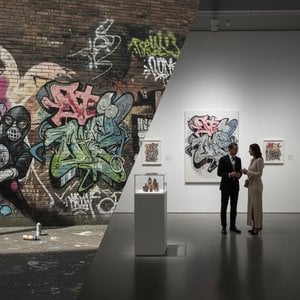
Explore the captivating journey of street art from urban walls to prestigious galleries. Discover how contemporary graffiti has evolved into a high-end collectible movement, redefining modern interior design and global art culture.


 实景预览
实景预览
 发送
发送 分享
分享
 详情
详情 指南
指南

 下载图片
下载图片
 相似作品
相似作品 X射线
X射线 幻灯片播放
幻灯片播放 统计数据
统计数据 阅读全文
阅读全文









 玻璃选项仅适用于110厘米以下的尺寸。


