
购买高分辨率增强版数字图像,其品质远超在线预览。
每一份文件都由我们的内部专家使用先进工具与专业的后期润色技术精心打造。我们确保每一张图像都具备卓越的清晰度、精准的色彩还原度以及细腻的细节表现。
最终文件将在 72 小时内通过电子邮件交付,并针对专业、编辑及印刷用途进行了优化。其品质与顶级设计工作室、出版社和画廊所信赖的标准完全一致。
选择 WahooArt.com,您获得的不仅仅是一张图像——您收到的是经过专业级增强、精雕细琢的数字艺术作品,并享有满意保证。以下是您的订单中自动包含的所有内容:

您的高分辨率数字图像文件将在下单后 72 小时内通过电子邮件发送给您 —— 即可立即使用。

您的艺术品经过专业优化,结合先进的 AI 技术与人工修饰,确保呈现极致的细节、清晰度与色彩准确度。

不小心删除了文件或找不到了?没关系——我们将随时为您免费重发。

即刻拥有您的艺术作品,无需支付任何关税、税费或运费——数字下载始终免税。

我们通过专业工具与色彩管理技术,确保您的数字图像尽可能真实地还原原作色彩。

如果您对所购数字图像不满意,我们将在100天内为您进行修改或提供100%的全额退款——无需任何理由。

不满意?在收到数字文件后的100天内,您可以申请全额退款——无需任何理由。

购买 3 张图片可享 10% 折扣 - 购买 5 张可享 15% 折扣 - 购买 10+ 张可享 20% 折扣。非常适合创意项目、画廊和机构使用。

In the golden age of Victorian landscape painting, few artists captured the ephemeral dance of light and atmosphere with as much soul as Matthew Ridley Corbet. Born on May 20, 1850, in the quiet village of South Willingham, Lincolnshire, Corbet’s origins were rooted in a world of classical scholarship and religious tradition. As the son of the Reverend Andrew Corbet, his early life was shaped by the disciplined intellect of Cheltenham College, yet his heart was destined for the vibrant, sun-drenched vistas of the Mediterranean. This tension between his structured English upbringing and his burgeoning passion for the natural world would eventually define his unique contribution to the nineteenth-century art canon.
Corbet’s formal artistic journey began within the prestigious halls of the Slade School of Art, where he studied under Alexander Davis Cooper, and later at the Royal Academy Schools under the legendary Frederic Leighton. These institutions provided him with a rigorous foundation in neoclassical technique, yet it was his departure for Italy in 1880 that truly ignited his creative spirit. In the warmth of the Italian sun, Corbet moved beyond the rigid boundaries of academic realism to embrace a more fluid, expressive way of seeing. It was during this transformative period that he formed a profound and lasting bond with the painter Giovanni Costa. This partnership became a cornerstone of his development, as together they explored the rugged beauty of Tuscany and Umbria, seeking to capture the very essence of the landscape.
The true metamorphosis of Corbet’s style occurred through his immersion in the Macchiaioli movement. Often referred to as the "splashed" painters, this group of Italian innovators sought to reject the stale conventions of academic painting in favor of direct observation and the emotive power of light. Influenced by Costa, Corbet began to master the art of the macchia—the use of distinct patches or "spots" of color to define form and atmosphere. His brushwork grew looser and more spontaneous, allowing him to render the fleeting moments of a sunset or the hazy shimmer of heat over an Italian valley with unprecedented vitality.
His canvases became windows into a world of luminous color palettes and soft, atmospheric textures. This evolution is perhaps most evident in his ability to blend Romanticism with a burgeoning Impressionistic sensibility. While his compositions often retained a sense of classical grandeur and structural integrity, the surface of his paintings pulsed with life. He did not merely paint a mountain or a field; he painted the way light clung to the stone and the way shadows stretched across the grass at dusk. This mastery of light allowed him to evoke deep emotional responses, transporting the viewer from the grey skies of England to the idyllic, sun-soaked landscapes of the Mediterranean.
Throughout his career, Corbet exhibited extensively across Europe, earning a reputation as a premier chronicler of the Italian countryside. His oeuvre contains several landmarks of Victorian landscape art that continue to captivate collectors and historians alike:
Though his life was tragically short, ending in 1902, Matthew Ridley Corbet left an indelible mark on the trajectory of landscape painting. He served as a vital bridge between the structured traditions of the Royal Academy and the experimental freedom of the modern era. By integrating the classical training of his English heritage with the revolutionary light-centric techniques of the Italian Macchiaioli, he created a body of work that remains a testament to the enduring power of nature and the transformative beauty of light.
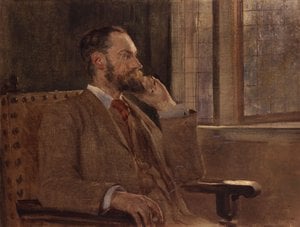
1850 - 1902


 效果预览
效果预览
 切换至版画销售渠道
 分享
分享 分享
分享
 详情
详情

 下载
下载
 相似作品
相似作品 X射线
X射线 幻灯片播放
幻灯片播放 统计数据
统计数据
 展开详情
展开详情


