


x

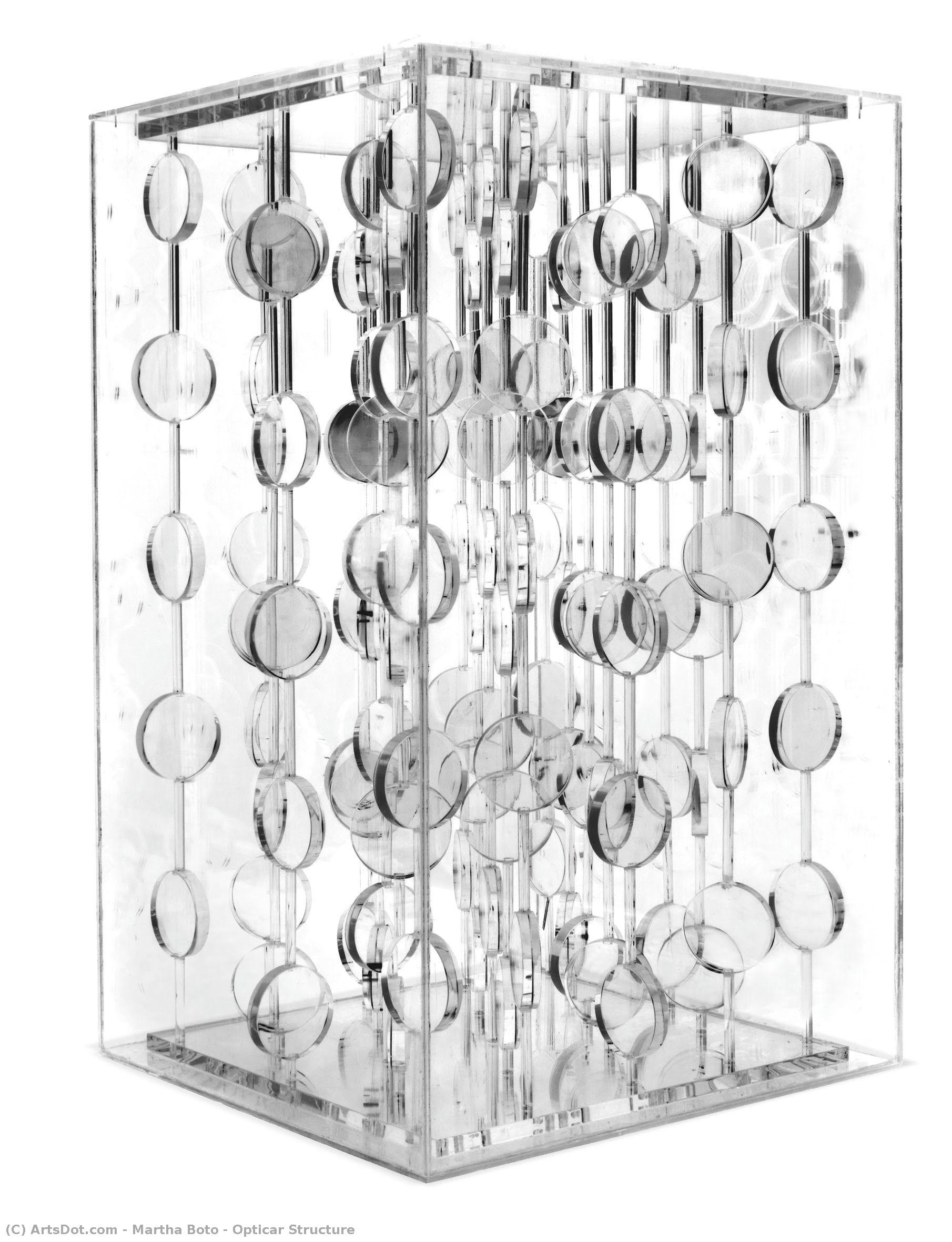
 1962
1962 87.0 x 52.0 cm
 布宜诺斯艾利斯现代艺术博物馆
从与原作比例一致的预设尺寸中进行选择。

您可以输入自定义尺寸,以适配特定的画框或空间。如果您选择的尺寸与原图比例不符,我们将对作品进行裁剪,或通过镜像填充/纯色填充边缘的方式来扩展图像。在开始制作之前,我们会向您发送一份数字效果图供您确认。
请注意,屏幕上的预览并不能反映实际的裁剪或扩展效果。只有效果图才能准确展示最终的构图。
虽然我们提供定制尺寸,但为了保持原图比例,我们建议您从预设列表中选择尺寸。

Opticar Structure
复制品尺寸

Martha Boto (1925-2004) was a highly influential Argentinian artist renowned for her pioneering work in kinetic and programmed art. Born in Buenos Aires, Argentina, she demonstrated an early aptitude for visual arts. In 1944, Boto formally began her artistic training at the Escuela Superior de Bellas Artes, where she honed her skills in drawing and painting.
Boto’s initial artistic explorations centered around geometric abstraction. During the 1950s, she held several solo exhibitions showcasing these early works. However, a pivotal shift occurred in 1956 when she joined the “Arte Nuevo” group – a collective dedicated to concrete art. This association spurred her experimentation with innovative materials like plexiglass, light, and mirrors.
Boto was among the first artists in Buenos Aires to integrate movement as a fundamental element within her sculptural creations. In 1957, alongside her husband and artistic collaborator, Gregorio Vardanega, she co-founded “Artistas no figurativos de la argentina,” further solidifying her commitment to non-figurative art.
In 1959, Boto relocated to Paris with Vardanega, a move that proved crucial for her international recognition. The influential gallerist Denise René championed Boto’s work, providing her with opportunities to exhibit alongside leading figures in the kinetic art movement. She also participated in the inaugural Biennale de Paris.
During her time in Paris, Boto increasingly incorporated industrial materials – notably electric motors – into her sculptures. This integration of technology allowed for dynamic, moving artworks that challenged traditional notions of sculpture. Her work explored the interplay between light, space, and motion, creating immersive visual experiences.
Martha Boto’s contributions to kinetic and programmed art are widely celebrated. She is recognized as a key figure in Latin American modernism and a pioneer who expanded the boundaries of sculptural practice. Her innovative use of materials, incorporation of movement, and exploration of perceptual phenomena continue to inspire artists today. Her work remains a testament to the power of experimentation and the enduring appeal of abstract art.

1925 - 2004 , Argentina


第一时间获取最新的艺术新闻、独家优惠及装饰灵感。
向我们介绍您的项目需求,我们的艺术专家将为您提供 3 个个性化的艺术品推荐。
由我们的专家为您精选 3 款心仪之作 —— 完全免费!
 定制手绘复刻品
 分享
分享 分享
分享
 详情
详情

 下载
下载
 相似作品
相似作品 X射线
X射线 幻灯片播放
幻灯片播放 展开详情
展开详情






































 玻璃选项仅适用于110厘米以下的尺寸。


