Exploring the Resonance of Absence: Mark Rothko’s Untitled (1953)
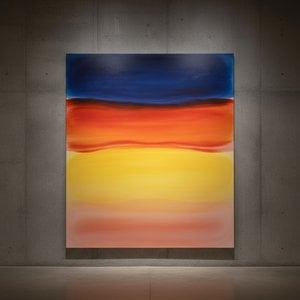
Mark Rothko's "Untitled" stands as a cornerstone of Abstract Expressionism, embodying not merely visual aesthetics but profound explorations of emotion and spirituality. Painted in 1953 during his prolific period in New York City, this monumental canvas transcends mere color; it invites contemplation on themes of loss, vulnerability, and the elusive nature of human experience—themes deeply rooted in Rothko’s personal history and informing his artistic vision. The painting's deceptively simple composition – two rectangular blocks of cadmium yellow and crimson – immediately commands attention, yet its impact is far more complex than its surface appearance suggests.
A Palette Born from Displacement
Rothko’s formative years instilled within him a sensitivity to suffering that would permeate his entire oeuvre. Growing up in Dvinsk, Latvia, amidst the anxieties surrounding Jewish life under Tsarist rule and the looming threat of pogroms, he witnessed firsthand the fragility of existence. This early exposure profoundly shaped his artistic sensibilities, propelling him toward abstraction as a means of conveying intangible feelings—a deliberate rejection of representational art’s attempt to capture external reality. The subsequent move to Portland, Oregon, marked another significant transition, bringing with it the challenges of cultural assimilation and the heartbreaking loss of his father. These experiences solidified Rothko's preoccupation with mortality and trauma, anxieties that find expression in the monumental scale and luminous hues of works like “Untitled.”
Technique and Texture: Layers of Emotion
Rothko’s distinctive technique—known as "color field painting"—involved applying thin layers of pigment onto canvas to create expansive fields of color. Unlike traditional brushstrokes, Rothko eschewed visible marks, prioritizing instead the subtle interplay of hues and their gradual blending. The artist meticulously prepared his canvases with gesso, creating a smooth surface that allowed for an almost ethereal diffusion of color. As the paint dried, it developed a characteristic matte sheen, enhancing the painting’s textural quality and contributing to its hypnotic effect. This deliberate process aimed not to depict a scene but to evoke a feeling—a sensation akin to encountering pure emotion itself. The subtle fading of the crimson pigment adds another layer of complexity, hinting at time's passage and suggesting that the artwork retains an aura of immediacy despite its age.
Symbolism Within Simplicity: Color as Spiritual Language
The choice of yellow and crimson is deliberately symbolic. Yellow represents enlightenment and optimism—a beacon of hope amidst darkness—while crimson embodies passion, sacrifice, and primal emotion. Rothko’s intention wasn't to convey literal narratives but rather to tap into universal human experiences. The rectangular blocks themselves can be interpreted as representing the boundaries between consciousness and unconsciousness, mirroring the artist’s own quest for spiritual understanding. Critics have noted that Rothko’s paintings resemble stained glass windows, suggesting a desire to illuminate the viewer’s inner landscape and inspire contemplation on profound questions of existence.
Emotional Impact: An Invitation to Contemplation
Ultimately, “Untitled” achieves its remarkable emotional impact through its masterful manipulation of color and texture. The painting invites viewers into a meditative state, encouraging them to surrender to the sensory experience without striving for intellectual comprehension. Its quiet grandeur fosters introspection—a confrontation with one’s own mortality and an appreciation for the beauty inherent in vulnerability. Rothko's aim was not to offer answers but to pose questions, prompting contemplation on the fundamental mysteries of life and death. Reproductions of this iconic artwork continue to resonate with audiences worldwide, serving as a testament to its enduring power to evoke emotion and inspire artistic vision.
问答详情
马克·罗斯科 的《Untitled》 是什么类型的艺术品?
马克·罗斯科 的《Untitled》 被归类为 WallArt。该类别描述了原作的艺术形式。
马克·罗斯科 的《Untitled》 是否保存在艺术家的原籍国?
不——该作品目前存放于海外。马克·罗斯科出生于拉脱维亚,而原作《Untitled》则由位于西班牙的一家博物馆收藏。
在马克·罗斯科的创作生涯中,"Untitled"处于怎样的地位?
"Untitled" 与 马克·罗斯科 的其他作品一样,都体现了 Abstract Expressionism 风格以及其一贯的主题:color theory, existentialism, formal abstraction, emotional impact, rothko’s legacy。
马克·罗斯科 的《Untitled》 的版权情况是如何界定的?
"Untitled" 的版权状态 —— 仍受版权保护 —— 取决于艺术家于 1970 年逝世这一事实。
"Untitled" 是 马克·罗斯科 最受欢迎的作品之一吗?
马克·罗斯科 的《Untitled》 的知名度处于 Iconic 水平。这一分类反映了该作品被广泛认可的程度。
马克·罗斯科 的《Untitled》 传达了怎样的心境与情感?
《马克·罗斯科 的《Untitled》》所传达的意境为Serene,其情感基调为Reflective。
马克·罗斯科 的《Untitled》 的色彩构图是如何构建的?
马克·罗斯科 的《Untitled》 的色彩分析记录了一种 Gentle 的对比与 Strong Color Unity 的和谐。
我该如何获取马克·罗斯科 的《Untitled》的数字文件?
“Untitled”可通过 高分辨率数字图像下载 获取,您直接在 本页 即可购买。