The Weight of Absence: Exploring Mark Rothko’s “Seated Nude”
Mark Rothko's "Seated Nuge" stands as a testament to the artist's unwavering commitment to conveying profound emotional resonance through minimalist abstraction. Painted sometime between 1953 and 1954, this deceptively simple canvas embodies the core tenets of Color Field painting—a movement that revolutionized American art in the mid-century—and invites viewers into an introspective dialogue about vulnerability and contemplation. The artwork’s power resides not in representational detail but in its ability to evoke a visceral response rooted in color and form, mirroring Rothko's lifelong preoccupation with exploring the human condition.
- Subject Matter: At first glance, “Seated Nude” presents a solitary figure—a woman draped in muted hues—seated upon a chair. The deliberate lack of explicit anatomical rendering underscores Rothko’s intention to transcend mere depiction and delve into psychological states. Rather than portraying the body as an object of observation, he seeks to capture its essence, its inherent stillness and quietude.
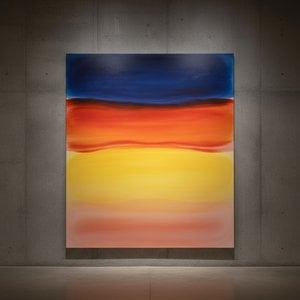
- Style & Technique: Rothko's signature technique—the layering of rectangular blocks of color—is evident throughout the composition. These blocks are applied in thin washes, creating a hazy, atmospheric effect that diffuses light and softens edges. The subtle gradations within each rectangle contribute to an illusion of depth and movement, despite the apparent simplicity of the form.
Historical Context: Color Field Painting and Existential Anxiety
The emergence of Color Field painting coincided with a period of significant intellectual ferment in postwar America. Philosophers like Jean-Paul Sartre and Albert Camus wrestled with questions of freedom, responsibility, and the absurdity of existence—themes that deeply impacted artists seeking to express these anxieties on canvas. Rothko’s work aligns perfectly with this existential sensibility, reflecting a desire to confront fundamental human concerns without resorting to narrative or figurative imagery. The painting speaks to the pervasive feeling of displacement experienced by many individuals following World War II, mirroring Rothko's own formative years marked by emigration and loss.
Symbolism & Emotional Impact: Color as Language
Rothko’s masterful use of color is paramount to understanding “Seated Nude.” The dominant hues—ranging from dusky reds and oranges to muted blues—are deliberately chosen not for their visual vibrancy but for their capacity to evoke emotional states. Critics have interpreted these colors as representing feelings of sorrow, longing, and spiritual yearning – emotions that Rothko himself acknowledged as central to his artistic vision. The rectangular blocks themselves can be seen as symbols of containment and solitude, mirroring the woman’s posture and reinforcing the painting's contemplative mood.
Conclusion: An Invitation to Reflection
“Seated Nude” transcends mere visual beauty; it offers a profound invitation to introspection. By stripping away representational detail and focusing solely on color and form, Rothko compels viewers to confront their own emotions and contemplate the complexities of human experience. Its enduring appeal lies in its ability to resonate with audiences across generations—a testament to Rothko’s genius in transforming abstract pigment into a vehicle for conveying universal truths about vulnerability, stillness, and the search for meaning.
问答详情
马克·罗斯科 是否还有其他别名或曾用名?
马克·罗斯科 也被称为 马库斯·雅各夫列维奇·罗斯科维茨 (俄语全名), Markus Yakovlevich Rothkowitz (英文音译)。
我能查看马克·罗斯科 的《Seated Nude》的X光影像吗?
您可以在作品的 X射线检测 页面上逐层探索 “Seated Nude”;该交互式查看器的设计灵感源自修复师使用的光源台,通过十一层光学读数呈现图像细节。
马克·罗斯科 的《Seated Nude》 的构图以什么颜色为主导?
Espresso (#38271b) 是 马克·罗斯科 的《Seated Nude》 的主导色。