x
 Acrylic On CanvasWallArtAbstract Expressionism
 1948
1948 135.0 x 118.0 cm




























从与原作比例一致的预设尺寸中进行选择。

您可以输入自定义尺寸,以适配特定的画框或空间。如果您选择的尺寸与原图比例不符,我们将对作品进行裁剪,或通过镜像填充/纯色填充边缘的方式来扩展图像。在开始制作之前,我们会向您发送一份数字效果图供您确认。
请注意,屏幕上的预览并不能反映实际的裁剪或扩展效果。只有效果图才能准确展示最终的构图。
虽然我们提供定制尺寸,但为了保持原图比例,我们建议您从预设列表中选择尺寸。

No. 9
复制品尺寸
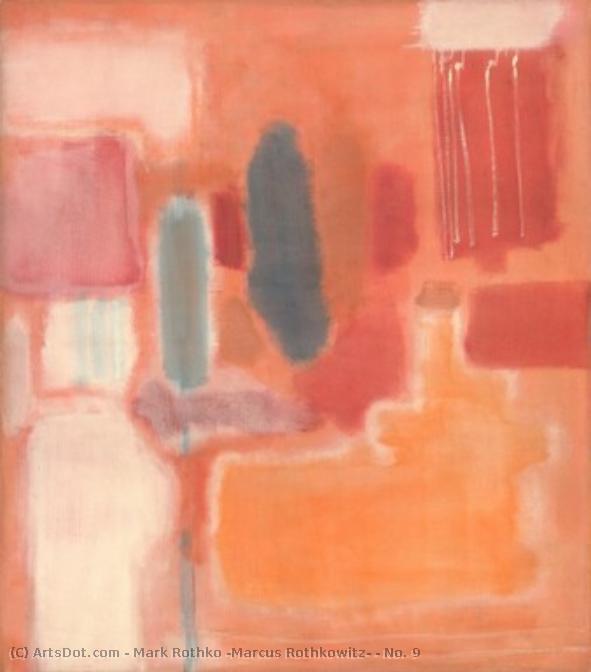
Mark Rothko's "No. 9," painted in 1948, isn’t merely a canvas splashed with color; it’s an immersion into the profound and often unsettling realm of human experience. Born Markus Yakovlevich Rothkowitz in Dvinsk, Latvia, in 1903, Rothko's early life was steeped in displacement – a constant negotiation between cultural identities shaped by pogroms and political instability. This inherent sense of otherness profoundly informed his artistic vision, driving him to explore themes of mortality, trauma, and the elusive search for meaning. “No. 9” embodies this exploration with an arresting simplicity, inviting viewers into a meditative space where color itself becomes a conduit for emotion.
At first glance, "No. 9" appears almost elemental – a collection of rectangular blocks in muted tones of ivory, slate blue, crimson red, and apricot orange. However, to reduce it to mere geometric abstraction would be a grave oversight. Rothko’s masterful technique lies in the subtle blending of these forms, creating an atmosphere of hazy depth. The edges are deliberately blurred, dissolving the boundaries between shapes and fostering a sense of ambiguity. It's not about precise representation; rather, it’s about conveying a feeling – a quiet melancholy, perhaps, or a yearning for something beyond comprehension. Notice how the slate blue streak, beginning near the center and cascading downwards, acts as a visual anchor, grounding the composition while simultaneously suggesting an inexorable flow.
Considering Rothko’s personal history – his early experiences with loss and displacement – it's not surprising that “No. 9” carries a palpable sense of grief and remembrance. The stacked shapes in the left corner, beginning with pale pink rectangles and culminating in an ivory-white rectangle extending off the bottom edge, could be interpreted as fragments of memory, stubbornly clinging to existence. The crimson red rectangle streaked with white lines evokes a feeling of blood or tears, while the overall composition suggests a landscape scarred by hardship. The repetition of forms – particularly the vertical rectangles – creates a hypnotic effect, drawing the viewer into a state of contemplation and inviting them to confront their own experiences of loss.
“No. 9” is a pivotal work in Rothko's development, marking a shift towards his signature style – large, luminous fields of color intended to evoke profound emotional responses. Painted just after his arrival in Portland and following the tragic loss of his father, it’s a testament to the artist’s ability to transform personal sorrow into universal themes. The painting’s enduring power lies not in its representational qualities but in its capacity to connect with viewers on an intuitive level, prompting introspection and offering a glimpse into the depths of human emotion. WahooArt offers meticulously crafted hand-painted reproductions that faithfully capture the essence of this iconic piece, allowing you to experience Rothko's vision firsthand.


1903 - 1970 , 拉脱维亚
Explore the profound emotional depth of Mark Rothko's abstract expressionism. Discover the history, techniques & lasting impact of this pivotal Color Field painter. Expert insights for collectors and art enthusiasts.

Explore the vibrant world of Gene Davis and the Washington Color School. Discover his iconic stripe paintings, innovative techniques, and lasting impact on American abstract art. A deep dive for collectors & enthusiasts.

Explore 10 iconic paintings with captivating 'mushroom' tones! Discover Van Gogh, Monet & Rembrandt’s masterpieces—earthy palettes, rich history & artistic techniques. Find museum-quality art reproductions and curated decor ideas at

Explore the profound world of Color Field painting with WahooArt. Discover key artists like Rothko & Newman, its philosophical roots, and lasting impact on modern art. Expert insights for collectors.

Explore the evolution of geometric abstraction from Cubism to contemporary art. Discover key artists like Malevich & Mondrian, investment insights, and expert collecting advice at WahooArt.


第一时间获取最新的艺术新闻、独家优惠及装饰灵感。
向我们介绍您的项目需求,我们的艺术专家将为您提供 3 个个性化的艺术品推荐。
由我们的专家为您精选 3 款心仪之作 —— 完全免费!

 定制手绘复刻品
 分享
分享 分享
分享
 详情
详情

 下载
下载
 相似作品
相似作品 X射线检测
X射线检测 幻灯片播放
幻灯片播放 展开详情
展开详情









 玻璃选项仅适用于110厘米以下的尺寸。