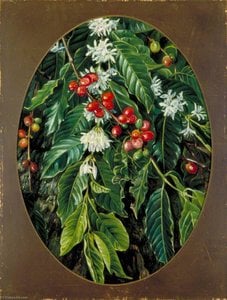
A Victorian Vision of Tropical Majesty: Marianne North’s “The Preanger Mountains, Java”
Marianne North (1830–1890) wasn't merely an artist; she was a pioneer—a woman who defied societal expectations and embarked on extraordinary expeditions to document the breathtaking beauty of the natural world. Her legacy resides not just in her stunning paintings but also in her unwavering determination to pursue scientific curiosity alongside artistic expression, establishing herself as one of Britain’s foremost botanists and visual artists of her era. “The Preanger Mountains, Java,” completed around 1876, exemplifies this remarkable blend of observation and artistry—a captivating glimpse into a pivotal moment in Victorian exploration and botanical science.
A Landscape Steeped in Symbolism
North's depiction transcends a simple topographical representation; it’s infused with symbolic resonance reflecting the prevailing Victorian fascination with exotic landscapes and the burgeoning field of biogeography. The towering Preanger Mountains, rising majestically from the verdant valleys below, symbolize resilience and grandeur—qualities deeply admired during a period marked by imperial ambition and scientific discovery. More subtly, the snow-capped peaks hint at aspirations for purity and transcendence, mirroring the Victorian yearning for spiritual contemplation amidst the dynamism of the natural world. The artist’s meticulous attention to detail – from the delicate textures of mosses and ferns to the subtle gradations of color in the sky – underscores this profound engagement with both visual beauty and intellectual inquiry.
Technique and Impressionistic Style
Executed in oil on board, “The Preanger Mountains” showcases North's mastery of impressionistic technique. Unlike academic painting’s emphasis on precise realism, North prioritized capturing fleeting moments of light and atmosphere—a stylistic choice that aligns perfectly with the burgeoning influence of Impressionism on British art. Visible brushstrokes contribute to a sense of movement and immediacy, conveying not just what the eye sees but also how it feels. The artist skillfully employs layering techniques, blending colors to create luminous hues and enhancing tonal variations – methods honed through years of painstaking botanical observation and artistic experimentation. This deliberate approach elevates the painting beyond mere depiction, transforming it into an emotive response to the grandeur of Java’s mountainous terrain.
Historical Context: Victorian Exploration and Botanical Art
“The Preanger Mountains” emerged during a period of intense scientific exploration fueled by imperial expansion and underpinned by Darwinian theory. Marianne North's expeditions to Southeast Asia—particularly Java—were driven by a desire to collect specimens for Kew Gardens’ Herbarium, furthering the advancement of botanical knowledge and challenging conventional artistic conventions. Simultaneously, Impressionism was gaining traction in Europe, rejecting traditional academic styles in favor of capturing subjective experience and prioritizing color and light over meticulous detail. North's work embodies this convergence of scientific ambition and artistic innovation—a testament to her pioneering spirit and her unwavering commitment to documenting the wonders of the natural world through a uniquely expressive medium.
Emotional Resonance: Tranquility Amidst Adventure
Despite its depiction of challenging terrain, “The Preanger Mountains” exudes an aura of serene tranquility. The muted palette – dominated by greens and blues – fosters a sense of calm contemplation, inviting viewers to immerse themselves in the beauty of Java’s untouched wilderness. The absence of human figures reinforces this impression of unspoiled nature—a deliberate artistic choice that underscores North's reverence for the natural world and her conviction that art could inspire awe and wonder. Ultimately, “The Preanger Mountains” remains a powerful reminder of Victorian idealism – a celebration of scientific discovery intertwined with an appreciation for sublime beauty.
问答详情
建议将 "The Preanger Mountains, Java" 的 Panoramic 格式作品陈列在什么位置?
凭借其Panoramic的形态,建议将《The Preanger Mountains, Java》复制品用于装饰Living Room。
"The Preanger Mountains, Java" 是否收藏于其创作者的本国?
不——该作品目前存放于海外。艺术家的出生国是英国,而收藏原作的博物馆位于美国。
玛丽安·诺思 的《The Preanger Mountains, Java》 传达了怎样的心境与情感?
在“The Preanger Mountains, Java”中,Serene 的氛围伴随着 Tranquil 的情感。
玛丽安·诺思 的《The Preanger Mountains, Java》 描绘了什么内容?
玛丽安·诺思 的《The Preanger Mountains, Java》 描绘了:mountain landscape, tropical flora, botanical art, victorian era, floral painting, landscape detail, marianne north。
"The Preanger Mountains, Java" 是否不受版权保护?
玛丽安·诺思 的《The Preanger Mountains, Java》 属于 属于公有领域 —— 其版权已过期。此版权状态决定了该作品图像的复制方式。
如何购买 玛丽安·诺思 的《The Preanger Mountains, Java》 的版画?
您可以在 本页 直接订购 玛丽安·诺思 的《The Preanger Mountains, Java》 的版画:采用棉质帆布或档案级画布纸制作的艺术版画。
原件"The Preanger Mountains, Java"的尺寸是多少?
"The Preanger Mountains, Java" 原作尺寸为 12 x 35 cm。在选择复制品尺寸时,参考原作尺寸会非常有帮助。
“The Preanger Mountains, Java”代表了玛丽安·诺思艺术生涯的哪个阶段?
“The Preanger Mountains, Java”属于玛丽安·诺思艺术生涯中的Mature Period时期。这一分类将该作品与艺术家的创作发展历程联系在一起。