
 Arts & Crafts
 50.0 x 40.0 cm
由我们的艺术家按需定制,为您提供您所选尺寸及画框的布面手工油画。 ( 切换至版画销售渠道 切换至数字图像销售渠道)





























从与原作比例一致的预设尺寸中进行选择。

您可以输入自定义尺寸,以适配特定的画框或空间。如果所选尺寸与原图比例不符,我们将通过裁剪作品或添加手绘元素来扩展画面。数字样稿将在制作开始前发送给您确认。
请注意,屏幕预览无法准确反映实际的裁剪或扩展效果,只有样稿才能真实呈现最终的构图。
虽然我们提供定制尺寸服务,但为了保留原作比例,建议您从预设列表中选择尺寸。

What's for Pudding Today
复制品尺寸

In the soft, dappled light of the late Victorian and Edwardian eras, the work of Margaret Gere (1878–1965) emerged as a testament to the beauty found in stillness. Born in Leamington Spa, Warwickshire, Gere was an artist whose brush captured more than just pigment on canvas; she captured the very essence of a vanishing age. Her paintings, characterized by a remarkable sensitivity to detail and an understated Arts & Crafts aesthetic, offer intimate glimpses into domestic life and portraits imbued with a profound, quiet dignity. While her name may not have commanded the widespread fame of her contemporaries during her lifetime, her oeuvre remains a vital window into the serene landscapes and soulful character studies of her era.
Gere’s artistic journey was deeply intertwined with both familial mentorship and prestigious academic rigor. Her early training began at the Birmingham School of Art, where she studied under her brother, the esteemed painter Charles March Gere. This foundational period allowed her to absorb the principles of craftsmanship and decorative integrity that were central to the Birmingham Group of Artist-Craftsmen. Seeking to expand her horizons beyond the English Midlands, she traveled to Florence in 1900 to study Italian painting, a move that undoubtedly enriched her understanding of color and classical composition. By 1905, she had enrolled at the legendary Slade School of Fine Art in London, studying under masters such as William Holman Hunt and Frederic Leighton. It was within these hallowed halls that she forged lasting connections with notable figures like Virginia Woolf, placing her at the very heart of a burgeoning intellectual and artistic renaissance.
The technical prowess of Margaret Gere is evident in the diverse range of media she employed to bring her visions to life. While many of her most enduring works are executed in oil on canvas, she demonstrated a masterful command of tempera, a medium that lent a unique texture and luminous depth to her more symbolic compositions. Her ability to manipulate light and color allowed her to navigate between the heavy, symbolic weight of religious narratives and the delicate, ephemeral qualities of everyday life.
Her catalogue of work is marked by several standout achievements that showcase her versatility:
The soul of Margaret Gere’s work is inextricably linked to the Arts & Crafts movement. Influenced by the philosophies of William Morris and Gustav Stickley, she embraced an aesthetic that prioritized natural materials, decorative embellishment, and a profound respect for the integrity of the handmade. This reverence for craftsmanship is mirrored in her meticulous observation of nature and her commitment to realistic yet idealized subject matter. Furthermore, the influence of Pre-Raphaelite masters like John Everett Millais and Dante Gabriel Rossetti can be felt in her exploration of symbolism and her pursuit of a certain poetic truth within her portraits.
Throughout her career, Gere was not only a creator but also an educator and a participant in the wider art world. She exhibited her works at the prestigious New English Art Club and held solo exhibitions at notable venues such as the Cotswold Gallery and the Beaux Arts Gallery. Her life as an artist was one of continuous engagement with the evolving landscape of British art, from the traditionalist roots of her training to the modern social circles she inhabited in London. Today, her paintings serve as a poignant bridge to the past, inviting contemporary viewers to pause and find solace in the timeless elegance and quiet strength of her vision.
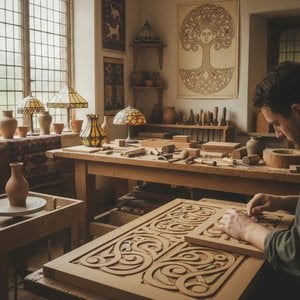
Explore the profound beauty of the Arts and Crafts Movement. Discover how the legacy of William Morris and handcrafted artistry offers a timeless antidote to mass production, inspiring soulful, luxury interiors through organic integrity and masterful craftsmanship.


 效果预览
效果预览
 分享
分享 分享
分享
 详情
详情 指南
指南

 下载
下载
 相似作品
相似作品 X射线
X射线 幻灯片播放
幻灯片播放 统计数据
统计数据 展开详情
展开详情









 玻璃选项仅适用于110厘米以下的尺寸。


