
 PrintWallArtDadaism
 1968Late Medieval
 34.0 x 23.0 cm
由我们的艺术家按需定制,为您提供您所选尺寸及画框的布面手工油画。 ( 切换至版画销售渠道 切换至数字图像销售渠道)





























从与原作比例一致的预设尺寸中进行选择。

您可以输入自定义尺寸,以适配特定的画框或空间。如果所选尺寸与原图比例不符,我们将通过裁剪作品或添加手绘元素来扩展画面。数字样稿将在制作开始前发送给您确认。
请注意,屏幕预览无法准确反映实际的裁剪或扩展效果,只有样稿才能真实呈现最终的构图。
虽然我们提供定制尺寸服务,但为了保留原作比例,建议您从预设列表中选择尺寸。

Selected Details after Cranach
复制品尺寸
Marcel Duchamp’s “Selected Details after Cranach and Relâche,” created in 1968, isn't a painting in the traditional sense; it’s an etching and aquatint—a subtle yet profound meditation on representation, appropriation, and the very nature of art itself. This deceptively simple work, measuring just 34 x 23 centimeters, invites prolonged contemplation, revealing layers of intellectual engagement that echo Duchamp's revolutionary spirit and his deep respect for the German Renaissance master Lucas Cranach the Elder.
The image depicts two nude figures—a man and a woman—standing in a stark, almost clinical arrangement. They are rendered with an astonishing economy of line; the forms emerge not through detailed shading or vibrant color, but through precise, unwavering black ink on pristine white paper. This minimalist approach immediately establishes a sense of detachment, pulling the viewer away from the immediate sensuality of the subject matter and into a realm of conceptual inquiry. The figures are positioned side-by-side, their gazes averted, creating an atmosphere of quiet contemplation—or perhaps, unsettling ambiguity. The composition is remarkably centered, emphasizing the duality presented before us.
Duchamp’s choice to work in etching and aquatint speaks volumes about his artistic intentions. Etching involves using acid to create lines on a metal plate, while aquatint employs dust to produce tonal variations. This combination allows for both sharp detail and subtle gradations of gray—essential elements in conveying the figures' forms with such understated elegance. Crucially, Duchamp’s process deliberately departs from traditional representation. He doesn’t attempt to faithfully reproduce Cranach’s style; instead, he uses the etching technique as a vehicle for exploring his own ideas about perception and the illusion of reality.
The reference to Lucas Cranach is deliberate and complex. Cranach was a prolific painter of mythological and allegorical scenes, often depicting nude figures in dynamic poses. Duchamp’s work isn't a direct copy but rather an “after” – a selection of details, a distillation of Cranach’s approach. He seems to be interrogating the very act of representation, questioning how we perceive and interpret images, particularly those rooted in classical tradition.
Beyond its formal qualities, “Selected Details after Cranach and Relâche” is laden with symbolic weight. The nude figures themselves are open to interpretation—they could represent lovers, companions, or simply two individuals engaged in a silent exchange. The averted gazes suggest a lack of connection, perhaps reflecting the inherent limitations of representation itself. Duchamp’s inclusion of “Relâche,” a term he used to describe his approach to art as a kind of ‘release,’ hints at a desire to dismantle traditional notions of artistic value and challenge viewers to actively participate in the creation of meaning.
The work's starkness—the black ink against white paper—evokes a sense of vulnerability, stripping away any superficial ornamentation. It’s a deliberate act of reduction, forcing us to confront the essential elements of the image and consider what remains when everything else is removed. The reference to “Cranach” adds another layer of complexity, suggesting a dialogue between past and present, tradition and innovation.
“Selected Details after Cranach and Relâche” stands as a pivotal work in Duchamp’s oeuvre and a cornerstone of conceptual art. It exemplifies his relentless questioning of artistic conventions and his willingness to challenge the very definition of what constitutes “art.” The piece's enduring appeal lies not only in its formal beauty but also in its profound intellectual depth—a testament to Duchamp’s genius as both an artist and a thinker. Reproductions, like this one, offer a chance to engage with this complex and rewarding work, inviting us to contemplate the relationship between image, representation, and our own perceptions of reality.


1887 - 1968 , 法国

Explore the profound elegance of minimalist art. Discover how the precision of a single line transforms simple geometry into timeless masterpieces for the discerning collector seeking sophistication and depth in fine art acquisitions.

Explore the radical world of Dadaism with our expert-led deep dive. From Duchamp's readymades to the aesthetics of chaos, uncover how this anti-art movement redefined modern creativity and paved the way for Surrealism. A must-read for art students and history enthusiasts alike.
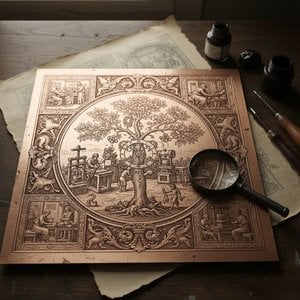
Explore the intricate world of etching and intaglio printmaking. Discover how masters use acid and metal to create profound textures and lines, from Romanticism to modern era, through an expert lens of art history and technical mastery.


 效果预览
效果预览
 分享
分享 分享
分享
 详情
详情 指南
指南

 下载
下载
 相似作品
相似作品 X射线
X射线 幻灯片播放
幻灯片播放 统计数据
统计数据 展开详情
展开详情









 玻璃选项仅适用于110厘米以下的尺寸。


