
 Acrylic On CanvasWallArtExpressionism
 1968
1968 34.0 x 23.0 cm
博物馆级艺术微喷或帆布版画,制作高效,并提供多种饰面选择。 ( 购买手绘画作 切换至数字图像销售渠道)





























从与原作比例一致的预设尺寸中进行选择。

您可以输入自定义尺寸,以适配特定的画框或空间。如果您选择的尺寸与原图比例不符,我们将对作品进行裁剪,或通过镜像填充/纯色填充边缘的方式来扩展图像。在开始制作之前,我们会向您发送一份数字效果图供您确认。
请注意,屏幕上的预览并不能反映实际的裁剪或扩展效果。只有效果图才能准确展示最终的构图。
虽然我们提供定制尺寸,但为了保持原图比例,我们建议您从预设列表中选择尺寸。

Selected Details after Courbet
复制品尺寸
Marcel Duchamp’s “Selected Details after Courbet,” created in 1968, is a deceptively simple etching that speaks volumes about the artist's evolving aesthetic sensibilities. Produced during his later period—a departure from the groundbreaking readymades of his early career—this artwork exemplifies Duchamp’s fascination with distilling artistic essence into fundamental forms, mirroring the spirit of Expressionism.
The drawing’s core is a seated female figure, positioned centrally on the paper. Her posture exudes a serene stillness, yet carries an undeniable ambiguity—a characteristic of Duchamp's deliberate avoidance of explicit narrative. Two birds are subtly integrated into the scene: one perched gracefully near the upper right corner and another nestled at the lower left edge. This juxtaposition emphasizes the interplay between human presence and the natural world, reflecting Courbet’s own exploration of landscape and figure.
Duchamp employs loose, gestural lines—primarily hatching and crosshatching—to define the contours of the woman and birds. These lines aren't meticulously rendered; rather, they prioritize textural variation and convey a sense of spontaneity. The technique deliberately eschews realism, focusing instead on capturing the essence of form through expressive mark-making – a significant shift from his earlier explorations.
"Selected Details after Courbet" transcends mere visual representation. The presence of birds—often associated with freedom and observation—suggests a deeper contemplation of existence. Duchamp’s stylistic choice invites viewers to consider the artwork not just as an image, but as a conduit for introspection and emotional resonance. It embodies his belief that art should provoke thought rather than simply imitate reality.
This drawing builds upon Duchamp’s pioneering work with Dadaism and readymades—particularly “Fountain”—demonstrating a continuing commitment to challenging artistic conventions. As evidenced by the title itself, it acknowledges Courbet's influence while simultaneously asserting Duchamp’s independent artistic voice. The artwork resides in the Philadelphia Museum of Art, alongside other celebrated pieces from Duchamp’s oeuvre, cementing his place as one of the most transformative figures in 20th-century art.


1887 - 1968 , 法国

Explore the profound artistry of graphite drawing. Discover professional techniques for mastering depth, texture, and detail through a lens of art history, from classical sketches to modern masterpieces. Elevate your understanding of the pencil medium with our expert guide.
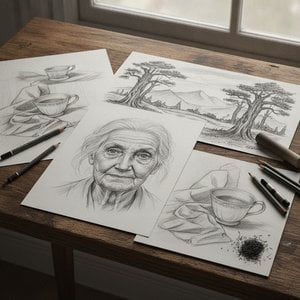
Explore the profound elegance of pencil and charcoal sketching. Discover how masters use line, shadow, and chiaroscuro to capture light and texture, bridging the gap between preparatory studies and timeless fine art masterpieces.

Elevate your artistic practice with this expert guide to mastering the line. Discover advanced techniques in graphite, charcoal, and contour drawing designed for art students seeking technical precision and expressive depth in their fine art studies.


 效果预览
效果预览
 分享
分享 分享
分享
 详情
详情 指南
指南

 下载
下载
 相似作品
相似作品 X射线
X射线 幻灯片播放
幻灯片播放 统计数据
统计数据 展开详情
展开详情









 玻璃选项仅适用于110厘米以下的尺寸。


