
x


 Acrylic On CanvasWallArtSurrealism
 1963Modern
 37.0 x 58.0 cm




























从与原作比例一致的预设尺寸中进行选择。

您可以输入自定义尺寸,以适配特定的画框或空间。如果您选择的尺寸与原图比例不符,我们将对作品进行裁剪,或通过镜像填充/纯色填充边缘的方式来扩展图像。在开始制作之前,我们会向您发送一份数字效果图供您确认。
请注意,屏幕上的预览并不能反映实际的裁剪或扩展效果。只有效果图才能准确展示最终的构图。
虽然我们提供定制尺寸,但为了保持原图比例,我们建议您从预设列表中选择尺寸。

The Jacob's Dream (8)
复制品尺寸
Marc Chagall’s “The Jacob’s Dream” (1963) isn’t merely a painting; it’s an immersion into a deeply personal mythology, a vibrant tapestry woven from the threads of Jewish folklore, biblical narrative, and the artist's own lifelong spiritual quest. This masterpiece, rendered in gouache, oil, and pastel on paper, captures a pivotal moment – Jacob’s encounter with divine messengers while journeying to his new home in Haran – transforming a foundational story into a dreamscape brimming with symbolic richness. The painting immediately draws the viewer in with its arresting color palette: deep purples and blues dominate the nocturnal scene, punctuated by bursts of fiery red, representing Jacob himself and the ascending angels. It’s a world both familiar and profoundly strange, echoing the artist's own unique vision.
At the heart of “The Jacob’s Dream” lies the iconic ladder, a motif that recurs throughout Chagall’s oeuvre. Here, it doesn’t simply represent a physical ascent; it embodies a spiritual journey, a bridge between the earthly and divine realms. The ladder, rooted firmly in the earth, reaches upwards towards the heavens, carrying angels who are both messengers and witnesses to this extraordinary event. The presence of seven angels circling the ladder reinforces its connection to the Hebrew alphabet, adding another layer of symbolic depth. Notably, Jacob’s open eye – a recurring feature in Chagall's depictions of dreams – suggests an active participation in this encounter, a recognition of the sacred unfolding before him. The inclusion of Isaac and Jesus on either side of the ladder further emphasizes the painting’s theological significance, linking ancient prophecy with Christian faith.
To understand “The Jacob’s Dream,” one must consider its origins in Chagall’s childhood home of Vitebsk. The town, a melting pot of Russian Orthodox and Jewish cultures, profoundly shaped the artist’s aesthetic sensibility. The influence of this diverse environment is evident in the painting's composition – the swirling figures, the vibrant colors, and the sense of movement all evoke the energy and spirit of Vitebsk. Chagall frequently depicted his hometown, often imbuing it with fantastical elements drawn from Jewish folklore and religious stories. This particular scene, rooted in Genesis 28:14-15, is a testament to how deeply personal and emotionally resonant these memories were for him.
Chagall’s masterful use of color and line creates an atmosphere of both wonder and unease. The dreamlike quality of the scene – the elongated figures, the distorted perspective, the fantastical elements – invites viewers to suspend their disbelief and enter into Jacob’s subjective experience. The painting isn't a literal depiction of the biblical story; it’s a distillation of its essence, filtered through Chagall’s unique artistic vision. It speaks not just to the narrative of Jacob’s dream but also to the universal human longing for connection with something greater than oneself – a yearning that resonates powerfully across cultures and generations. “The Jacob’s Dream” remains a profoundly moving testament to the power of art to capture the complexities of faith, memory, and the enduring mysteries of the human spirit.


1887 - 1985 , 白俄罗斯

Embark on a sophisticated journey through the surrealist movement. Discover how masters like Dalí and Ernst blurred the lines between dreams and reality through innovative techniques, exploring the profound impact of the subconscious on fine art history with expert authority.
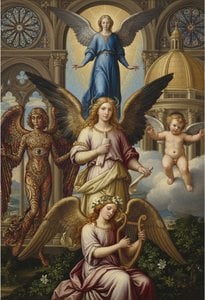
Explore the profound beauty of angelic figures in art history. From Renaissance masterpieces to celestial symbolism, our expert guide offers a sophisticated journey through the divine imagery of the Old Masters for discerning collectors and art enthusiasts.

Embark on a journey through the subconscious with our expert guide to Surrealism. Discover the profound symbolism of masters like Dalí and Ernst, exploring how dreamlike imagery reshaped art history and continues to inspire collectors and enthusiasts worldwide.


第一时间获取最新的艺术新闻、独家优惠及装饰灵感。
向我们介绍您的项目需求,我们的艺术专家将为您提供 3 个个性化的艺术品推荐。
由我们的专家为您精选 3 款心仪之作 —— 完全免费!


 效果预览
效果预览
 购买手绘画作
 分享
分享 分享
分享
 详情
详情

 下载
下载
 相似作品
相似作品 X射线
X射线 幻灯片播放
幻灯片播放 展开详情
展开详情









 玻璃选项仅适用于110厘米以下的尺寸。


