
博物馆级艺术微喷或帆布版画,制作高效,并提供多种饰面选择。 ( 订购此收藏品的纯手工复刻画作 切换至数字图像销售渠道)





























您可以从与原作比例一致的预设尺寸中进行选择。

请输入您所需的宽度和高度,以适配您的画框或墙面。由于印刷品只能进行裁剪,无法超出原图尺寸,因此若比例不一致,画面的一部分将会被裁切。在正式印刷之前,我们会为您发送一份数字效果图供您确认。本页面显示的图片并非最终裁剪后的效果——只有效果图才能展示真实的裁剪情况。
The Fiddler
复刻品尺寸说明
Marc Chagall's "The Fiddler," painted in 1914 during his formative years in Paris, isn’t merely a depiction of a man playing an instrument; it’s a shimmering portal into a world steeped in folklore, memory, and the quiet beauty of rural life. This oil on canvas, currently residing within the Kunstsammlung Nordrhein-Westfalen in Düsseldorf, embodies the artist's unique synthesis of influences – a potent blend of Cubism’s fractured perspectives, the vibrant hues of Fauvism, and the deeply personal symbolism rooted in his Jewish heritage.
The scene unfolds with an immediate sense of dreamlike tranquility. A solitary fiddler, rendered with bold, almost childlike strokes, stands before a modest dwelling, its snow-dusted roof hinting at a harsh winter landscape. His face, etched with a gentle melancholy and framed by a flowing red coat, is instantly recognizable – a figure both familiar and profoundly enigmatic. Around him, the composition isn’t concerned with strict realism; instead, Chagall employs Cubist principles to deconstruct forms into geometric shapes, layering planes and creating an intriguing sense of spatial ambiguity. The figures observing from afar are rendered in muted tones, almost dissolving into the background, suggesting a community witnessing this solitary moment.
Chagall’s embrace of Cubism is evident not as a rigid adherence to its tenets but rather as a means to express his inner vision. The fragmented forms, tilted perspectives, and overlapping planes aren't simply stylistic choices; they mirror the artist’s desire to capture fleeting memories and emotional states. Crucially, however, “The Fiddler” transcends mere Cubist experimentation. It’s deeply intertwined with Chagall’s personal iconography – a vocabulary of symbols drawn from his childhood in Vitebsk, Belarus, a region where Jewish culture thrived alongside Orthodox Christianity.
The fiddle itself is a potent symbol, representing not just music but also storytelling, tradition, and the preservation of cultural memory. The red coat, a recurring motif in Chagall’s work, often signifies passion, vitality, or even sacrifice. The presence of the boy – presumably the fiddler's son – adds another layer of meaning, evoking themes of lineage, continuity, and the passing down of heritage. Furthermore, the snow-covered house suggests both hardship and resilience—a testament to the enduring spirit of a rural community.
Painted in the wake of World War I, “The Fiddler” reflects a period of profound artistic upheaval. Chagall was grappling with new ideas and experimenting with different styles, seeking to forge his own distinct voice amidst the revolutionary currents sweeping through the art world. This work demonstrates his early exploration of abstraction while retaining a strong connection to representational imagery and deeply personal symbolism. It’s a pivotal piece in understanding his artistic trajectory – a bridge between his formative years in Vitebsk and his later, more overtly expressive works.
The influence of artists like Pablo Picasso and Henri Matisse is undeniable, yet Chagall skillfully integrates these influences into his own unique style. His use of bold colors—particularly the vibrant red against the muted blues and whites—creates a dynamic visual impact, drawing the viewer’s eye through the composition. The painting's emotional resonance stems from its ability to evoke a sense of nostalgia, solitude, and the quiet dignity of everyday life. It is a testament to Chagall’s extraordinary talent for transforming personal memories into universal symbols.
Art enthusiasts now have the opportunity to bring the magic of “The Fiddler” into their homes through meticulously crafted oil painting reproductions offered by WahooArt.com and similar platforms. These reproductions strive to capture not only the visual details of the original but also its emotional essence – the dreamlike quality, the vibrant colors, and the profound sense of human connection. By owning a reproduction of “The Fiddler,” one gains access to a timeless masterpiece that continues to resonate with viewers across generations.
For further exploration into Marc Chagall’s life and work, we encourage you to visit WahooArt.com or the Stedel museum for a deeper understanding of this extraordinary artist.
马尔克·夏加尔 的《The Fiddler》 的色彩呈现出 Balanced Soft 的饱和度与 Balanced 的强度。
若要预览 马尔克·夏加尔 的《The Fiddler》 复制品的详情,请打开该作品的 预览 页面。
马尔克·夏加尔 的《The Fiddler》 的 X射线检测 页面是一个交互式查看器,您可以通过它逐层滑动浏览作品图像的十一层光学图层,其中还包含 X 光风格的视图。


1887 - 1985 , 白俄罗斯

Master the complexities of Cubism with our expert guide for collectors. Explore the revolutionary forms of Picasso, distinguish between Analytical and Synthetic styles, and learn to integrate these profound geometric aesthetics into your private art collection.

Embark on a journey through the revolutionary world of Cubism. Discover how masters like Picasso redefined perspective through Analytical and Synthetic techniques in this expert-led guide for art enthusiasts and collectors.
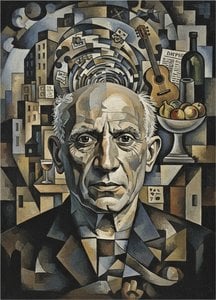
Explore the profound evolution of Cubism through an expert analysis of Pablo Picasso's revolutionary works. From Analytical to Synthetic Cubism, discover the techniques that redefined modern art and learn how to curate these iconic masterpieces for your private collection.


 实景预览
实景预览
 发送
发送 分享
分享
 详情
详情 指南
指南

 下载图片
下载图片
 相似作品
相似作品 X射线
X射线 幻灯片播放
幻灯片播放 统计数据
统计数据

 阅读全文
阅读全文









 玻璃选项仅适用于110厘米以下的尺寸。


