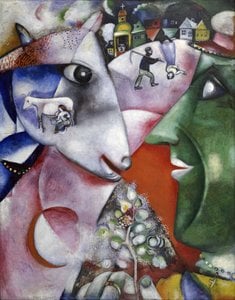
The Dance: A Surrealist Symphony of Color and Emotion
Marc Chagall’s “The Dance” stands as a cornerstone of surrealist art, embodying the artist's singular vision—a harmonious fusion of dreamlike fantasy and tangible reality. Executed in 1951, this oil on canvas masterpiece transcends mere depiction; it invites contemplation and evokes profound feelings about human connection and transcendence. Its enduring appeal lies not only in its visual beauty but also in the intricate layers of symbolism woven into its composition.
Composition and Symbolism: Gravity Defying Grace
At first glance, “The Dance” presents a joyous tableau of figures engaged in movement—a celebration of communal experience. However, astute observation reveals a rich tapestry of symbols that elevate the painting beyond a simple visual narrative. Dominating the canvas is a vibrant yellow hue, establishing an atmosphere charged with optimism and imbued with the ethereal quality characteristic of surrealism. The dancers themselves appear to defy gravity, hovering effortlessly above the ground—a deliberate gesture signifying liberation from earthly constraints and embracing spiritual aspiration. Notably, one figure holds aloft a bouquet of flowers, symbolizing fertility, beauty, and remembrance, while another rests upon the shoulders of his companion, representing interdependence and support.
Artistic Influences: Matisse’s Legacy and Surrealist Roots
Chagall's artistic journey was profoundly shaped by movements like Expressionism and Cubism, yet he ultimately found his voice within the embrace of Surrealism—a movement championed by luminaries such as Henri Matisse. Chagall’s distinctive style, marked by fantastical imagery and bold color palettes, reflects a deep fascination with the subconscious mind and its capacity to generate visions unbound by logic. “The Dance” draws inspiration from Matisse's seminal work "The Dance" (1909-1910), mirroring their shared commitment to spontaneity and conveying the essence of human movement—a testament to Matisse’s influence on Chagall’s artistic sensibilities.
Context in 20th Century Art: Avant-Garde Innovation
“The Dance” occupies a pivotal position within the broader context of 20th-century Western painting, which witnessed an explosion of experimental creativity and challenged conventional aesthetic standards. Alongside fellow Surrealist artists like Giorgio de Chirico and Salvador Dalí, Chagall spearheaded this transformative movement—a reaction against rationalism and realism—and championed new artistic approaches that prioritized emotion and imagination. The Museum of Dartmoor Life in Devon, South West England, houses a remarkable collection of artworks reflecting the region’s cultural heritage; while “The Dance” isn't featured prominently within its galleries, it exemplifies the spirit of innovation that defined this era of artistic exploration.
Conclusion: An Enduring Masterpiece
Marc Chagall’s “The Dance” remains an unforgettable achievement in surrealist art—a captivating portrayal of human joy and spiritual yearning. Its luminous colors, intricate symbolism, and masterful technique continue to inspire artists and connoisseurs alike. As a symbol of artistic boldness and visionary imagination, "The Dance" secures its place as one of the most celebrated paintings of the 20th century.



 效果预览
效果预览
 购买手绘画作
 分享
分享 分享
分享
 详情
详情

 下载
下载
 相似作品
相似作品 X射线
X射线 幻灯片播放
幻灯片播放

 展开详情
展开详情






































 玻璃选项仅适用于110厘米以下的尺寸。