博物馆级艺术微喷或帆布版画,制作高效,并提供多种饰面选择。 ( 订购纯手工绘制画作 切换至数字图像销售渠道)





























您可以从与原作比例一致的预设尺寸中进行选择。

请输入您所需的宽度和高度,以适配您的画框或墙面。由于印刷品只能进行裁剪,无法超出原图尺寸,因此若比例不一致,画面的一部分将会被裁切。在正式印刷之前,我们会为您发送一份数字效果图供您确认。本页面显示的图片并非最终裁剪后的效果——只有效果图才能展示真实的裁剪情况。
Russian village
复刻品尺寸
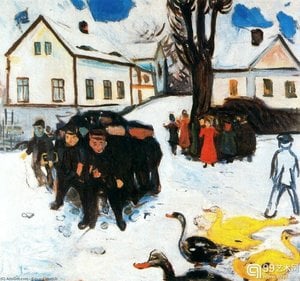
In the quiet, monochromatic depths of Marc Chagall’s “Russian Village,” we encounter a world that exists at the intersection of memory and myth. Completed in 1929 during his period of Parisian exile, this oil on canvas masterpiece serves as a profound distillation of the artist's connection to his Vitebsk homeland. Rather than a literal depiction of a landscape, the painting functions as a dreamscape, where the wintry Russian countryside is rendered with an ethereal quality that defies rational explanation. The absence of color does not diminish the work; instead, it strips away the distractions of the physical world, leaving behind a skeletal, hauntingly beautiful vision of a life etched in frost and nostalgia.
The composition invites the viewer to wander through a stylized, snow-covered landscape where reality feels delightfully unmoored. A horse-drawn carriage, a quintessential symbol of rural tradition, moves across the left side of the canvas, traversing over rooftops and buildings as if gravity were merely a suggestion. This sense of spatial ambiguity is a hallmark of the Naïve Art movement, a style Chagall embraced to recapture the uninhibited spirit of childhood and folklore. By rejecting the rigid academic conventions of perspective and anatomical precision, Chagall creates a flattened, layered world where buildings overlap in a charmingly chaotic arrangement, suggesting a village that is as much a mental construct as it is a physical place.
Every element within this wintry scene carries a weight of quiet symbolism. The presence of two clocks—one positioned in the upper right and another in the lower left—serves as a poignant reminder of the passage of time, perhaps suggesting that this village is a moment frozen eternally in the artist's mind. The figures scattered throughout the landscape, including a man riding atop the carriage and others standing near the center, add a pulse of everyday life to the stillness of the snow. These simplified, geometric forms contribute to the painting's primitive charm, evoking a sense of timelessness that resonates deeply with those who find beauty in simplicity.
Technically, the work is a masterclass in using texture and tone to evoke atmosphere. Through the application of oil pigments, Chagall creates a tactile experience where snowy surfaces appear rough and uneven, contrasting with the smoother, more solid feel of the village structures. The lighting is diffused and even, casting minimal shadows and enveloping the entire scene in a soft, melancholic glow. For the collector or interior designer, this piece offers a sophisticated monochromatic palette that brings a sense of calm, quiet beauty and intellectual depth to any space. It is not merely a painting of a place, but an invitation to inhabit a memory, making it a profound addition to any collection dedicated to the transformative power of the human imagination.
针对 Living Room,建议将 马尔克·夏加尔 的《Russian village》 打印为 Medium。
马尔克·夏加尔 的《Russian village》 所传达的情感基调为 Melancholic,这概括了作品所表达的情绪。
马尔克·夏加尔 的《Russian village》 推荐用于 Accent,理想的摆放空间为 Living Room。结合使用场景与空间布局,可以更好地确定复制品的陈列位置。


1887 - 1985 , 白俄罗斯

Explore 25 iconic Marc Chagall masterpieces. Discover the dreamlike stories behind his colors on WahooArt.com.

Immerse yourself in the vibrant world of German Expressionism with our curated guide to Franz Marc's top 25 masterpieces. Explore the spiritual energy and symbolic colors of The Blue Rider movement. Find museum-quality art reproductions for your decor. Discover all masterpieces on WahooArt.com
Explore the profound grandeur of Russian art, from sacred Orthodox icons to Imperial Romanov splendor. Discover a curated guide to historical masterpieces, perfect for elite collectors and discerning interior designers seeking timeless elegance and cultural depth.

 实景预览
实景预览
 分享
分享 分享
分享
 详情
详情 指南
指南

 下载作品
下载作品
 相似作品
相似作品 X射线
X射线 幻灯片播放
幻灯片播放 问答
问答 统计数据
统计数据

 展开全文
展开全文









 玻璃选项仅适用于110厘米以下的尺寸。