
博物馆级艺术微喷或帆布版画,制作高效,并提供多种饰面选择。 ( 购买手绘画作 切换至数字图像销售渠道)





























从与原作比例一致的预设尺寸中进行选择。

您可以输入自定义尺寸,以适配特定的画框或空间。如果您选择的尺寸与原图比例不符,我们将对作品进行裁剪,或通过镜像填充/纯色填充边缘的方式来扩展图像。在开始制作之前,我们会向您发送一份数字效果图供您确认。
请注意,屏幕上的预览并不能反映实际的裁剪或扩展效果。只有效果图才能准确展示最终的构图。
虽然我们提供定制尺寸,但为了保持原图比例,我们建议您从预设列表中选择尺寸。

Pliushkin's village
复制品尺寸
Marc Chagall’s “Pliushkin’s Village,” created in 1923, isn't merely a depiction of a Russian countryside; it’s an embodiment of Chagall’s singular artistic vision—a distillation of his childhood memories and infused with the vibrant spirit of Vitebsk. This sketch-like etching captures a moment frozen in time, prioritizing emotional resonance over meticulous realism. The artwork immediately draws the eye with its tilted perspective, subtly disrupting our expectations of spatial accuracy and contributing to an overall feeling of whimsical disorientation.
Chagall’s style is undeniably rooted in Naïve Art (Primitivism), a movement that championed unfiltered emotion and spontaneous gesture. However, it transcends simple categorization thanks to the influence of Cubism—particularly evident in the simplified geometric forms representing buildings—and a deep engagement with Jewish folklore traditions. The artist eschewed academic conventions, favoring loose lines and hatching techniques to convey texture and volume. Charcoal and pencil were skillfully employed on tracing paper, resulting in an ethereal quality that captures the essence of Chagall’s artistic impulse.
Despite its dreamlike atmosphere, “Pliushkin’s Village” utilizes a predominantly monochrome palette—primarily shades of black, grey, and white. This deliberate restriction amplifies the artwork's expressive power, focusing attention on line and form rather than coloristic detail. The composition is layered and dynamic, with buildings stacked unevenly and the ground sloping dramatically. Figures populate the scene in a scattered arrangement, seemingly adrift amidst the landscape—a visual metaphor for Chagall’s exploration of memory and imagination.
The village itself is more than just a setting; it represents Vitebsk – Chagall’s birthplace – a town defined by its confluence of Orthodox Christianity and Jewish culture. This duality finds visual expression in the artwork through recurring motifs like flying figures, symbolizing aspiration and transcendence, and stylized animals—a nod to Jewish folklore—adding layers of symbolic meaning. While there's no explicit narrative storyline, “Pliushkin’s Village” speaks volumes about Chagall’s preoccupation with personal experience and his ability to transform observation into profound emotional statement.
“Pliushkin’s Village,” executed in 1923, exemplifies Chagall's unwavering commitment to artistic freedom. It stands as a testament to the power of imagination and the enduring beauty of Naïve Art—a captivating glimpse into the artist’s inner world and his profound connection to the landscapes and traditions of his formative years. Its ethereal quality continues to inspire collectors and interior designers alike, cementing Chagall's place among the most influential artists of the 20th century.


1887 - 1985 , 白俄罗斯

Discover the enchanting world of Naive Art. Explore the profound beauty of self-taught masters like Henri Rousseau through an art-history lens, uncovering how simple forms and vibrant colors create timeless, soulful masterpieces for the discerning collector.
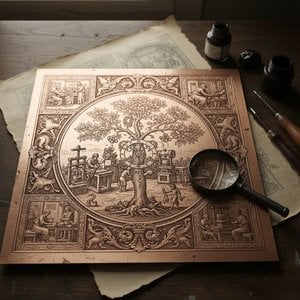
Explore the intricate world of etching and intaglio printmaking. Discover how masters use acid and metal to create profound textures and lines, from Romanticism to modern era, through an expert lens of art history and technical mastery.


 效果预览
效果预览
 分享
分享 分享
分享
 详情
详情

 下载
下载
 相似作品
相似作品 X射线
X射线 幻灯片播放
幻灯片播放 统计数据
统计数据

 展开详情
展开详情









 玻璃选项仅适用于110厘米以下的尺寸。


