The Genesis of a Masterpiece: Marc Chagall’s ‘King David’ (1963)
Marc Chagall, born Moishe Shagal in 1887 in Liozna, Belarus, wasn't merely a painter; he was a poet of color, a weaver of dreams, and a chronicler of memory. His life, spanning nearly a century, mirrored the tumultuous currents of the 20th century, yet his art remained steadfastly rooted in a deeply personal vision—one infused with the folklore of his Hasidic Jewish upbringing and an unwavering belief in the power of imagination. Vitebsk itself was more than just a birthplace; it became the emotional core of his artistic universe, a recurring motif populated by flying figures, whimsical animals, and the vibrant hues of remembered landscapes. The town’s unique blend of cultures—Russian Orthodox churches alongside bustling Jewish marketplaces—forged an aesthetic sensibility that would defy easy categorization throughout his long career. ‘King David,’ painted in 1963, exemplifies this deeply personal approach, a testament to Chagall's ability to translate profound spiritual and cultural themes into a visually arresting and emotionally resonant work.

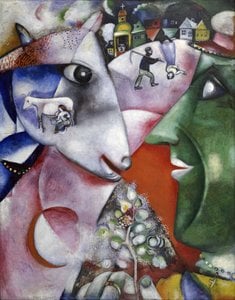
(Image: King David, 1963 - Marc Chagall - WikiArt.org)
A Vision in Naïve Art and Biblical Weight
This monumental oil on canvas, measuring 179.8 x 98 cm, is a prime example of what critics have termed Chagall’s “Naïve Art” or “Primitivism.” Rejecting the conventions of academic realism, Chagall employed bold colors, simplified forms, and a dreamlike quality to convey his deeply felt emotions and spiritual experiences. The painting eschews precise detail in favor of expressive lines and symbolic imagery—a deliberate choice that allows the viewer to connect with the work on an intuitive level. The grayscale lithograph version (referenced in WahooArt’s database) highlights this, emphasizing the dramatic scale and expressive lines, evoking a sense of biblical weight and solemnity.
Symbolism and Narrative: A Dance of Figures
At the heart of ‘King David’ stands the iconic figure of the biblical monarch himself. Dressed in a vibrant red robe—a color often associated with royalty and divine power—he plays his lyre, a symbol of music, poetry, and kingship. However, the scene is far from static. A ghostly woman, seemingly emerging from the shadows, stands beside him, her presence adding an element of mystery and perhaps representing David’s past or a spiritual guide. Several other figures populate the composition: one holding what appears to be a bird—a recurring motif in Chagall's work often symbolizing freedom and aspiration—and others engaged in conversation or seemingly lost in contemplation. The background features a stylized townscape beneath a crescent moon, further enhancing the painting’s dreamlike atmosphere and connecting it to the biblical narrative of David’s reign.
Historical Context and Artistic Legacy
Created in 1963, during a period of significant personal reflection for Chagall, ‘King David’ reflects his lifelong fascination with Jewish history, mythology, and spirituality. It builds upon the earlier 'King David (II Samuel, VI, 4 5)' lithograph from 1956, demonstrating a continued exploration of this iconic biblical figure. The painting draws inspiration from the Book of Samuel, but Chagall’s interpretation transcends mere illustration; he imbues the scene with his own unique vision and emotional intensity. Chagall's work, including pieces like ‘King David,’ has been celebrated for its ability to bridge the gap between religious faith and artistic expression, making it a cornerstone of 20th-century art. The painting’s enduring appeal lies in its capacity to evoke a sense of wonder, mystery, and profound emotional resonance—a testament to Chagall's genius as both an artist and a poet of color.



 效果预览
效果预览
 购买手绘画作
 分享
分享 分享
分享
 详情
详情

 下载
下载
 相似作品
相似作品 X射线
X射线 幻灯片播放
幻灯片播放


 展开详情
展开详情






































 玻璃选项仅适用于110厘米以下的尺寸。