
 Mixed MediaWallArtContemporary Art
 1996Contemporary
 32.0 x 168.0 cm
 Fundación Universidad de las Américas Puebla
购买高分辨率增强版数字图像,其品质远超在线预览。
每一份文件都由我们的内部专家使用先进工具与专业的后期润色技术精心打造。我们确保每一张图像都具备卓越的清晰度、精准的色彩还原度以及细腻的细节表现。
最终文件将在 72 小时内通过电子邮件交付,并针对专业、编辑及印刷用途进行了优化。其品质与顶级设计工作室、出版社和画廊所信赖的标准完全一致。
选择 WahooArt.com,您获得的不仅仅是一张图像——您收到的是经过专业级增强、精雕细琢的数字艺术作品,并享有满意保证。以下是您的订单中自动包含的所有内容:

您的高分辨率数字图像文件将在下单后 72 小时内通过电子邮件发送给您 —— 即可立即使用。

您的艺术品经过专业优化,结合先进的 AI 技术与人工修饰,确保呈现极致的细节、清晰度与色彩准确度。

不小心删除了文件或找不到了?没关系——我们将随时为您免费重发。

即刻拥有您的艺术作品,无需支付任何关税、税费或运费——数字下载始终免税。

我们通过专业工具与色彩管理技术,确保您的数字图像尽可能真实地还原原作色彩。

如果您对所购数字图像不满意,我们将在100天内为您进行修改或提供100%的全额退款——无需任何理由。

不满意?在收到数字文件后的100天内,您可以申请全额退款——无需任何理由。

购买 3 张图片可享 10% 折扣 - 购买 5 张可享 15% 折扣 - 购买 10+ 张可享 20% 折扣。非常适合创意项目、画廊和机构使用。
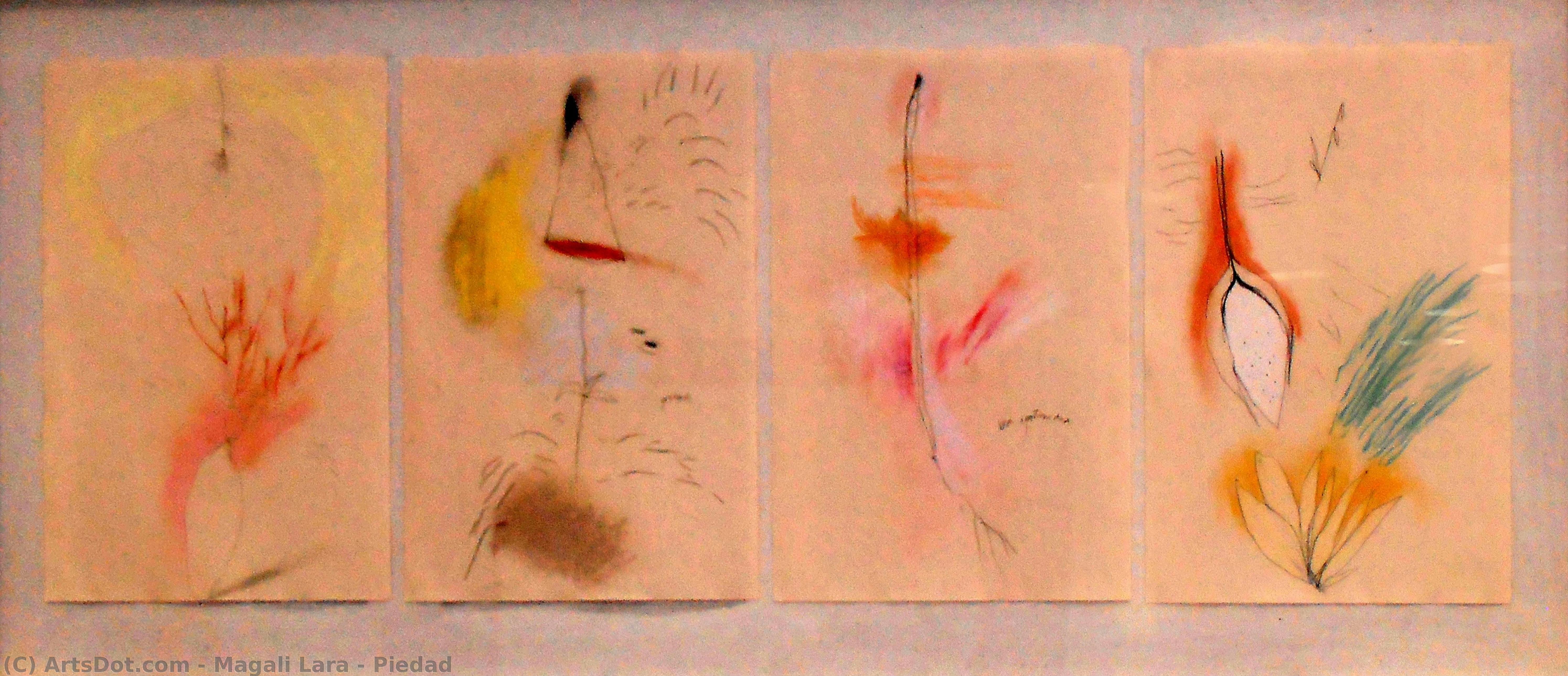
In the delicate interplay of color and form found within Piedad, we encounter the profound intimacy that defines the work of Mexican contemporary master Magali Lara. Created in 1996, this expansive piece—stretching an impressive 168 centimeters in width—functions less like a static image and more like a living, breathing landscape of memory and sensation. At first glance, the eye is drawn to a vibrant choreography of elements: colorful birds that seem to flutter across a vast, ethereal space, interspersed with the subtle, haunting presence of human figures. It is a composition that captures a fleeting moment of grace, where the natural world and human vulnerability exist in a fragile, beautiful equilibrium.
The technique employed in Piedad reflects Lara’s mastery over mixed media and printmaking, utilizing a sophisticated layering of materials that creates a rich, tactile depth. The artist employs a palette of white, orange, green, yellow, and black, set against a luminous background that allows each stroke to resonate with clarity. There is a rhythmic quality to the way the birds are distributed across the canvas—some clustered in the upper reaches, others drifting toward the lower periphery—creating a sense of movement that guides the viewer through an emotional journey. This fluid arrangement mimics the organic growth of rhizomes or the delicate unfolding of petals, a hallmark of Lara’s ability to bridge the gap between abstract gesture and representational beauty.
To understand Piedad is to delve into the symbolic language of Magali Lara, an artist renowned for her contributions to feminist art. The title itself, meaning "Piety" or "Pity," evokes themes of compassion, devotion, and the shared weight of human experience. Within this work, the juxtaposition of delicate flora and fauna with the human form suggests a deep interconnectedness between the self and the environment. The birds may serve as messengers of the soul or symbols of freedom, yet their placement alongside figures in a state of quiet contemplation invites us to reflect on our own place within the cycles of life and loss.
Lara’s work often explores the tension between the monumental and the precarious, a theme that is palpable in this composition. The sheer scale of the piece provides a sense of grandeur, yet the fine, almost skeletal lines and the ephemeral nature of the subjects remind us of life's fragility. For the collector or the interior designer, this duality makes Piedad an extraordinary centerpiece; it possesses the strength to anchor a large architectural space while maintaining a poetic softness that invites quiet, prolonged observation.
Integrating a high-quality reproduction of Piedad into a curated interior offers more than mere decoration; it introduces a narrative of profound emotional depth. For those seeking to create a sanctuary of reflection, this artwork provides a focal point that stimulates both the intellect and the spirit. The way the light interacts with the perceived textures of the printmaking process can transform the atmosphere of a room, lending an air of sophisticated contemporary elegance.
Whether placed in a minimalist gallery setting or a warm, textured living space, Piedad acts as a window into the complex inner world of Magali Lara. It is a piece that rewards the attentive viewer, revealing new layers of meaning with every glance—a testament to the enduring power of Mexican contemporary art to move, inspire, and haunt the modern imagination.
Jackson Pollock, born January 28, 1912, in Cody, Wyoming, and tragically dying August 11, 1956, near Springs, Long Island, remains one of the most iconic and profoundly influential figures in 20th-century art. His journey from a quiet boy in rural America to a globally recognized artist is a testament to his relentless experimentation, his willingness to challenge artistic conventions, and his profound impact on the development of abstract expressionism. Pollock’s work wasn't simply about creating images; it was about embodying process, emotion, and the very act of painting itself.
The youngest of five children in a family rooted in Iowa farming traditions, Jackson Pollock’s early life instilled within him a deep connection to the land and a pragmatic approach to life. His father, LeRoy Pollock, was a surveyor, and his mother, Stella May McClure, possessed a strong Presbyterian faith. Despite moving frequently throughout his childhood – from Wyoming to California and Arizona – Pollock found himself drawn to New York City in 1930, enrolling at the prestigious Art Students League under the guidance of Thomas Hart Benton. Benton’s emphasis on narrative painting and American themes initially influenced Pollock, but he quickly moved beyond this style, seeking a more direct and personal approach to artmaking.
Pollock’s most revolutionary contribution to art arrived in 1947 with the development of what would become known as “drip painting.” Rejecting traditional easel-and-brush techniques, he began working on canvases laid flat on the floor of his studio. Using thinned enamel paints and a variety of tools – sticks, brushes, even syringes – he flung, dripped, poured, and splattered paint onto the surface, creating complex, layered compositions. This process wasn’t about meticulously controlling every brushstroke; it was about allowing the materials to dictate the outcome, embracing chance and spontaneity. As Pollock himself famously stated, “When I am in my painting, I’m not aware of what I’m doing.”
Pollock’s career was tragically short, but during his lifetime he achieved significant recognition. Key works like “Number 17A” (1948), “One: Number 31, 1950,” and “Mural on Indian Red Ground” (1950) became instantly iconic, captivating critics and collectors alike. His paintings were exhibited at MoMA in New York City and the Tate Gallery in London, solidifying his place as a leading figure in the burgeoning abstract expressionist movement.
Jackson Pollock’s untimely death in a car accident in 1956 cut short a brilliant career, but his legacy continues to resonate today. His innovative techniques, his fearless experimentation, and his commitment to expressing the raw energy of the creative process have cemented his place as one of the most important artists of the 20th century. His work remains a powerful reminder of the transformative potential of art and the enduring power of individual expression. The Pollock-Krasner House and Studio in Springs, Long Island, now serves as a museum dedicated to preserving and interpreting his life and work, ensuring that this revolutionary artist’s vision continues to inspire.

1956 - , Mexico

 效果预览
效果预览
 切换至版画销售渠道
 分享
分享 分享
分享
 详情
详情

 下载
下载
 相似作品
相似作品 X射线
X射线 幻灯片播放
幻灯片播放 统计数据
统计数据 展开详情
展开详情


![Abstract Composition [triptych] — Vaclav Vytlacil, Abstract Expressionism](/media/artworks/images-thumb/08/3c/083c0675045645fd42d4e6c6d63f1ced.jpg)


