
由我们的艺术家按需定制,为您提供您所选尺寸及画框的布面手工油画。 ( 切换至版画销售渠道 切换至数字图像销售渠道)





























您可以从与原作比例一致的预设尺寸中进行选择。

请输入您需要的宽度和高度,以适配您的画框或墙面。由于作品为手工绘制,若您选择不同的尺寸比例,艺术家可能会在画面边缘多画一些或稍作裁剪 —— 由您决定。在开始绘画之前,我们会为您发送一份数字效果图供您确认。本页面上展示的图片并非最终实物 —— 只有效果图才能反映真实结果。
The Last Supper
复刻品尺寸说明
Step closer to the table. There is a particular tension held within this room, a weight that seems to press against the very air between the figures. In this depiction of the biblical event, we find Christ at the center of a long, horizontal arrangement, his presence anchoring a scene of sudden, sharp movement. The light enters from a window on the right, casting deep shadows that pull the faces of the disciples into relief. It is a quiet sort of drama. You can almost hear the hushed whispers and the clatter of bread being moved as the news of betrayal ripples through the group. De Vos has captured that precise second where the announcement has been made, but the full weight of the consequence has not yet settled.
The composition relies on a careful arrangement of bodies to guide your eye. While many of the apostles are caught in mid-conversation or looking toward Christ with startled expressions, one figure is set apart. Judas sits directly in front of Jesus, turning his face away, physically attempting to evade the gaze of the man he intends to betray. This subtle movement creates a psychological pull that keeps you anchored to the center of the table.
Observe the way the oil interacts with the wooden panel. There is a certain luster here, a pearl-like quality in the skin tones and the heavy folds of the drapery that speaks to the Northern Mannerist tradition. The palette is grounded in warm, earthy tones—ochres, deep reds, and browns—which lend the room an opulent, almost heavy atmosphere. This warmth is contrasted by the sharp, directional light that defines the architectural details of the setting, suggesting a space that is both Roman and Byzantine in its grandeur.
The technique allows for a meticulous attention to texture. You can see the weight of the fabrics and the rougher surfaces of the objects resting upon the table. These elements are not merely decorative; they ground the spiritual narrative in a tangible, physical reality. The bread and wine, central to the Eucharist, are rendered with a clarity that makes them feel present in the room with us. Through this careful layering of light and shadow, the artist achieves a sense of depth that brings the figures forward, making the betrayal feel less like a distant historical event and more like a lived, breathing moment.
"The Last Supper" 的色彩基调由以 Rosy Brown (#a69c83) 为主的 Earthy 色系构成。
Maarten De Vos 的《The Last Supper》 的知名度处于 Recognized 水平。这一分类反映了该作品被广泛认可的程度。
考虑到其Earthy的色调,建议将“The Last Supper”布置于Restaurant中。

Maerten de Vos, born in the bustling artistic hub of Antwerp in 1532, emerged from a family deeply rooted in the city’s painting tradition. His father, Pieter de Vos, originally hailing from Leiden, had established himself as a respected painter after an apprenticeship with Jeroom Scuelens. Young Maerten, alongside his brother Pieter, initially received his foundational training within their father's workshop, absorbing the techniques and sensibilities of the mid-16th century Flemish school. While speculation suggests a possible tutelage under the prominent Frans Floris—the leading history painter of the time—documentary evidence remains elusive. This early period undoubtedly instilled in him a solid understanding of composition, draftsmanship, and the prevailing artistic currents of Antwerp.
As was common for ambitious Flemish artists seeking to broaden their horizons, Maerten de Vos embarked on an extended journey to Italy between 1550 and 1558. This transformative experience proved pivotal in shaping his artistic style. He likely sojourned in major centers like Rome, Florence, and Venice, immersing himself in the masterpieces of the Italian Renaissance and Mannerism. The vibrant colors and dynamic compositions of Venetian painters—particularly Paolo Veronese and Jacopo Tintoretto—left an indelible mark on his work. Carlo Ridolfi, a 17th-century art biographer, even claimed that de Vos studied directly under Tintoretto in Venice, though this assertion requires careful consideration. Regardless, the influence is palpable: a newfound richness of hue, a heightened sense of drama, and a more fluid approach to form characterize his paintings following his return to Antwerp.
Upon his return to Antwerp in 1558, de Vos quickly integrated into the city’s artistic community, joining the Guild of Saint Luke. He married Joanna le Boucq, a woman from Valenciennes, and together they raised a large family. The art world of Antwerp was competitive; Frans Floris dominated the scene with his expansive workshop. De Vos initially faced challenges securing commissions but proved fortunate in 1564 when he received patronage from Gillis Hooftman, a wealthy merchant who commissioned several significant works. However, it was the tumultuous period following the Beeldenstorm of the 1560s—the wave of iconoclasm that swept through the Netherlands—that truly propelled de Vos to prominence. Floris, deeply shaken by the destruction of his art, retreated from active painting, creating a void in the market for history paintings. De Vos skillfully stepped into this breach, becoming one of the leading figures in the Spanish Netherlands.
De Vos distinguished himself as a prolific painter of history and allegorical scenes, often imbued with moral or religious themes. His work reflects both his earlier Flemish training and the Italian influences he absorbed during his travels. He was particularly adept at depicting complex narratives filled with numerous figures, showcasing his mastery of composition and anatomical detail. In 1570, he received a prestigious commission to decorate the palatine chapel of William, Duke of Brunswick-Lüneburg in Celle, Germany—a project that involved creating a Lutheran scheme of decoration. This demonstrates his adaptability and willingness to cater to diverse religious patrons. Later in his career, as Antwerp experienced a resurgence of Catholic fervor, de Vos became a leading producer of altarpieces, effectively paving the way for the rise of Peter Paul Rubens.
Maerten de Vos’s impact extended beyond his own paintings. He was an exceptionally prolific draftsman, creating hundreds of designs that were widely circulated through Antwerp printing workshops. These prints served as models for tapestries, stained glass windows, and other decorative arts, disseminating his style throughout Europe and the Spanish colonies. His influence can be seen in the works of numerous artists who followed him. He left a lasting legacy not only as a skilled painter but also as an important innovator in printmaking and a key figure in the transition from Mannerism to Baroque art in the Netherlands. He died in Antwerp on December 4, 1603, leaving behind a rich artistic heritage that continues to captivate and inspire.

1532 - 1603
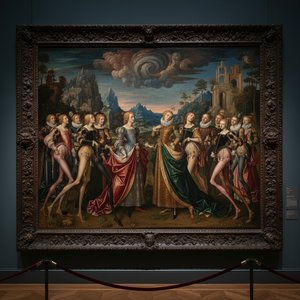
Explore the dramatic evolution of Northern Mannerism. Discover how masters like Bosch and Grünewald transitioned from Renaissance harmony to profound, elegant distortion through an expert analysis of symbolism, emotional intensity, and artistic innovation.


 实景预览
实景预览
 发送
发送 分享
分享
 详情
详情 指南
指南

 下载图片
下载图片
 相似作品
相似作品 X射线
X射线 幻灯片播放
幻灯片播放 统计数据
统计数据


 阅读全文
阅读全文









 玻璃选项仅适用于110厘米以下的尺寸。


