
博物馆级艺术微喷或帆布版画,制作高效,并提供多种饰面选择。 ( 订购此收藏品的纯手工复刻画作 切换至数字图像销售渠道)





























您可以从与原作比例一致的预设尺寸中进行选择。

您可以输入自定义尺寸,以适配特定的画框或空间。如果您选择的尺寸与原图比例不符,我们将对作品进行裁剪,或通过镜像填充/纯色填充边缘的方式来扩展图像。在开始制作之前,我们会向您发送一份数字效果图供您确认。
请注意,屏幕上的预览并不能反映实际的裁剪或扩展效果。只有效果图才能准确展示最终的构图。
虽然我们提供定制尺寸,但为了保持原图比例,我们建议您从预设列表中选择尺寸。

I quanta
复刻品尺寸说明
Lucio Fontana's "I quanta," a captivating work from 1960, isn’t merely a painting; it’s an invitation to reconsider the very nature of art and its relationship to space. Born in Rosario, Argentina, in 1899, and later establishing himself as a pivotal figure in Italian avant-garde circles, Fontana relentlessly pursued radical innovations throughout his career. “I quanta,” with its vibrant red slices cutting through a seemingly monochrome background, embodies this spirit perfectly. The photograph presented here offers a close-up glimpse into this dynamic composition, revealing the meticulous layering of color and texture that defines Fontana’s unique approach. The scattered shapes aren't haphazard; they possess an intentional rhythm, drawing the eye across the canvas and creating a sense of controlled chaos – a hallmark of his Spatialism.
Fontana’s work is inextricably linked to the movement he founded, Spatialism. Emerging in the mid-1940s, Spatialism rejected the traditional constraints of painting – its two-dimensional surface, its reliance on illusion and representation. Instead, Fontana sought to liberate art from these limitations, proposing that it should exist as a dynamic interaction between the picture plane and the surrounding space. His signature technique—the “cut” or “slash”—became the central gesture of this philosophy. These incisions weren’t simply decorative; they were acts of revelation, exposing the void behind the canvas and suggesting an infinite depth. "I quanta" exemplifies this perfectly, with the red slices acting as portals into a perceived space beyond the physical boundaries of the artwork.
The execution of “I quanta” is both precise and intuitively expressive. The monochrome background, likely applied with meticulous care, provides a stark contrast to the bold red shapes. Fontana’s use of color was often considered reductive – he favored simple hues like black, white, and red – but within this restraint lay immense potential for visual impact. The cuts themselves are clean and deliberate, suggesting a controlled energy. It's important to note that Fontana frequently lined the reverse of his canvases with black gauze, creating an illusion of depth and shimmering light when viewed in darkened settings. This layering of materials—paint, canvas, and gauze—contributes significantly to the artwork’s overall effect, transforming it into a complex interplay of surfaces and voids.
The symbolism embedded within “I quanta” is open to interpretation, reflecting Fontana's broader philosophical concerns. The red slices can be seen as representing fragments of a whole, suggesting a desire to break down established forms and reveal underlying structures. Some scholars have linked the work to concepts of quantum physics – hence the title "I quanta" (meaning “the quanta” or smallest units of energy) – interpreting the cuts as symbolic representations of these fundamental particles. More broadly, the piece evokes a sense of mystery and exploration, inviting viewers to contemplate the relationship between perception, space, and reality. The act of cutting itself can be viewed as an attempt to pierce through illusion and access something more profound—a visual metaphor for the search for the infinite.
WahooArt offers meticulously crafted hand-painted reproductions of Lucio Fontana’s “I quanta,” allowing you to experience the power and beauty of this seminal work in your own space. Each reproduction is created by skilled artists using traditional techniques, ensuring an authentic representation of Fontana's vision. Explore our collection today and bring a piece of art history into your home.

1899 - 1968 , 阿根廷

Journey through Wassily Kandinsky's 25 most iconic abstract paintings. Explore his revolutionary use of color, form & spiritual expressionism. Find museum-quality Kandinsky reproductions and elevate your home decor with WahooArt.com. Discover all masterpieces on WahooArt.com!
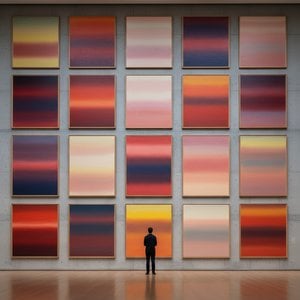
探索马克·罗斯科25幅杰作,感受抽象表现主义的色彩力量与深刻情感。从经典色域绘画到无题系列,了解艺术史上的大师及其作品背后的故事。WahooArt.com提供博物馆级高质量复制品,为您的家居装饰带来艺术灵感!立即探索完整收藏。
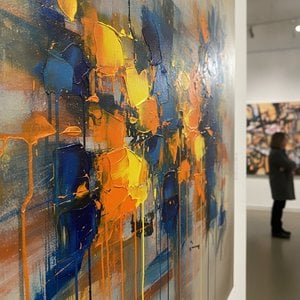
Master the high-impact world of contemporary abstraction. Discover how bold colors, textures, and modern movements like Abstract Expressionism can transform your space with premium, high-energy art curated for the design-conscious professional.

探索抽象表现主义的十幅经典杰作!波洛克、罗斯科等大师作品,揭秘艺术史上的重要瞬间。WahooArt.com为您呈现高品质艺术品复制和精选家居装饰方案,感受现代艺术的力量与魅力。立即浏览全系列!

探索几何抽象艺术的十大杰作!康定斯基、蒙德里安等大师作品,色彩构成与非具象之美。WahooArt.com提供博物馆级艺术复制品,为您的家居带来现代艺术灵感。立即在线探索完整系列!


 实景预览
实景预览
 发送
发送 分享
分享
 详情
详情 指南
指南

 下载图片
下载图片
 相似作品
相似作品 X射线
X射线 幻灯片播放
幻灯片播放 统计数据
统计数据

 阅读全文
阅读全文









 玻璃选项仅适用于110厘米以下的尺寸。


