
切换至版画销售渠道 切换至版画销售渠道购买手绘画作 购买手绘画作 分享分享
详情详情 加入收藏 加入收藏 下载下载 相似作品相似作品 幻灯片播放幻灯片播放 统计数据统计数据

Bowl

A striking brown ceramic bowl with intricate blue accents showcases the masterful craftsmanship of Lucie Cousturier, offering a unique piece of artistic history for your collection.

Lucie Cousturier (1876-1925): French Neo-Impressionist painter & writer. Explore vibrant landscapes, insightful writings on West Africa, and her pioneering voice against colonialism.

购买高分辨率增强版数字图像,其品质远超在线预览。

每一份文件都由我们的内部专家使用先进工具与专业的后期润色技术精心打造。我们确保每一张图像都具备卓越的清晰度、精准的色彩还原度以及细腻的细节表现。

最终文件将在 72 小时内通过电子邮件交付,并针对专业、编辑及印刷用途进行了优化。其品质与顶级设计工作室、出版社和画廊所信赖的标准完全一致。

数字图像

下载高分辨率文件,用于个人展示、打印及创意项目。 (切换至版画销售渠道 切换至版画销售渠道购买手绘画作 购买手绘画作)

最终价格

$ 24.90

每份数字图像订单均包含

专业数字图像交付,品质保障

选择 WahooArt.com,您获得的不仅仅是一张图像——您收到的是经过专业级增强、精雕细琢的数字艺术作品,并享有满意保证。以下是您的订单中自动包含的所有内容:

shipping_icon
邮件快速送达

您的高分辨率数字图像文件将在下单后 72 小时内通过电子邮件发送给您 —— 即可立即使用。

canvas_icon
AI 增强型数字文件

您的艺术品经过专业优化,结合先进的 AI 技术与人工修饰,确保呈现极致的细节、清晰度与色彩准确度。

insurance_icon
终身免费重发服务

不小心删除了文件或找不到了?没关系——我们将随时为您免费重发。

tax_icon
无需进口费用,始终如一

即刻拥有您的艺术作品,无需支付任何关税、税费或运费——数字下载始终免税。

color_icon
色彩精准保证

我们通过专业工具与色彩管理技术,确保您的数字图像尽可能真实地还原原作色彩。

return_icon
100天满意保证

如果您对所购数字图像不满意,我们将在100天内为您进行修改或提供100%的全额退款——无需任何理由。

guarantee_icon
100% 退款保证

不满意?在收到数字文件后的100天内,您可以申请全额退款——无需任何理由。

discount_icon
批量订单优惠

购买 3 张图片可享 10% 折扣 - 购买 5 张可享 15% 折扣 - 购买 10+ 张可享 20% 折扣。非常适合创意项目、画廊和机构使用。

作品概览

  • Artist: Lucie Cousturier
  • Year: 1977
  • Notable elements or techniques: Blue accents, intricate craftsmanship
  • Medium: Ceramic
  • Title: Bowl

The Soul of Earth and Form

In the quiet intersection of utility and fine art lies this exquisite ceramic bowl, a piece that breathes with the rhythmic pulse of mid-century mastery. Created in 1977, this work serves as a profound testament to the enduring legacy of the Vienna School of Arts and Crafts, specifically channeling the spirit of Lucie Rie’s transformative influence on modern pottery. The bowl is not merely a vessel but a sculptural dialogue between the raw, elemental nature of clay and the sophisticated refinement of contemporary design. Its deep, earthy brown tones provide a grounding foundation, while the delicate blue accents dance across the surface like sudden strokes of twilight across a landscape, inviting the viewer to contemplate the balance between stability and movement.

The craftsmanship displayed in this piece evokes a sense of timelessness, reminiscent of the Asian pottery traditions that have long inspired the world's most celebrated ceramicists. Each curve of the bowl’s silhouette suggests a deliberate, meditative process, where the potter’s hands have coaxed life from the kiln's heat. The texture and color palette are masterfully balanced; the richness of the brown glaze offers a warm, tactile depth that feels both ancient and avant-garde. For the discerning collector or interior designer, this piece acts as a focal point of organic elegance, capable of anchoring a minimalist modern space or adding a layer of sophisticated warmth to a classical setting.

A Legacy of Craftsmanship and Aesthetic Grace

To behold this bowl is to connect with a lineage of artistic excellence that spans generations. The influence of the Vienna School—a movement defined by its seamless integration of functional objects into the fabric of beautiful living—is palpable in every detail. This work captures the essence of an era where the boundaries between decorative arts and high art were dissolved, replaced by a shared reverence for material integrity and formal precision. The blue accents are not merely decorative; they serve as rhythmic interruptions to the solid form, creating a visual tension that keeps the eye wandering across its surface, discovering new nuances in the glaze with every glance.

Beyond its physical presence, the bowl carries an emotional resonance of tranquility and permanence. In an age of fleeting digital imagery, there is something deeply restorative about the weight and substance of well-crafted ceramics. It embodies a sense of "wabi-sabi"—the beauty found in the imperfect, the natural, and the enduring. Whether displayed as a solitary masterpiece on a pedestal or integrated into a curated collection of fine stoneware, this reproduction offers an opportunity to bring a piece of art history into the contemporary home, providing an atmosphere of cultured serenity and unparalleled aesthetic distinction.

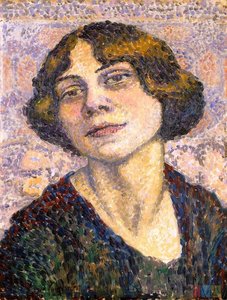
艺术家简介

A Parisian Life Intertwined with Art and Activism

Lucie Cousturier, born Lucie Brû in Paris on December 19, 1876, was a woman of remarkable breadth—a painter whose canvases shimmered with the light of Neo-Impressionism, and a writer who dared to challenge colonial perspectives. Her life unfolded against a backdrop of artistic ferment and social change, a period where traditional boundaries were being questioned and new forms of expression were emerging. Born into privilege – her father, Léon Casimir Brû, owned a successful doll factory – Lucie benefited from opportunities for education and artistic development that were unavailable to many women of her time. From the age of fourteen, she demonstrated a keen interest in painting, an inclination nurtured by exposure to the vibrant art scene of Belle Époque Paris. This early passion led her to study under luminaries like Paul Signac and Henri-Edmond Cross, pivotal figures in the Neo-Impressionist movement, and fostered a close artistic kinship with Georges Seurat himself. These influences would profoundly shape her aesthetic sensibilities and technical approach, laying the foundation for a career that seamlessly blended artistic innovation with social consciousness.

The Embrace of Pointillism and Evolving Style

Cousturier’s early work is deeply rooted in Neo-Impressionism, a technique characterized by the meticulous application of small, distinct dots of pure color intended to optically blend in the viewer's eye. This method, championed by Seurat and Signac, allowed for an extraordinary luminosity and vibrancy, qualities that Cousturier masterfully embraced in her landscapes and still lifes. However, she wasn’t merely a follower; her style evolved over time, subtly incorporating elements of Fauvism – a movement known for its bold, non-naturalistic colors and expressive brushstrokes. This transition is evident in her outdoor scenes, which became increasingly dynamic and infused with warmth. She frequently depicted the serene beauty of landscapes, intimate still lifes often featuring flowers and vases, and insightful portraits that offered glimpses into the personalities of her subjects. Her 1919 self-portrait stands as a compelling testament to her artistic vision and inner life, revealing a woman confident in her craft and keenly aware of her place within the evolving art world. By 1907, Cousturier had achieved a remarkable level of technical skill and color mastery, establishing herself as a significant voice within the Neo-Impressionist circle.

A Journey into the Heart of Colonial Africa

The trajectory of Lucie Cousturier’s life took an unexpected turn following World War I. Granted a mission by the French Minister of Colonies, she embarked on a journey to French West Africa in October 1921, returning in April 1922. This wasn't simply a voyage of exploration; it was a deliberate attempt to understand family life and the role of women within the colonial context. Her experiences during this period proved transformative, prompting her to meticulously document her observations in a detailed journal. These writings formed the basis for two groundbreaking books: *Mes inconnus chez eux: mon ami Fatou* (My Strangers in Their Home: My Friend Fatou) and *Mes inconnus chez eux: mon ami Soumaré* (My Strangers in Their Home: My Friend Soumaré), published posthumously in 1925. Cousturier’s accounts offered a refreshingly unprejudiced perspective on colonial relationships, emphasizing her genuine friendships with African women and acknowledging the complexities of her own position within the colonial hierarchy. She was unafraid to critique both the structural injustices of colonialism and the patriarchal attitudes prevalent in local societies, making her work a pioneering contribution to anti-colonial thought.

Legacy of Art and Advocacy

Upon returning to France, Cousturier dedicated herself to the cause of racial emancipation, contributing articles to *Le Paria*, a newspaper that served as a platform for advocating the rights of people of color. This commitment to social justice underscored her belief in the power of art not only to reflect reality but also to challenge it. In 1923, she was honored with an exhibition showcasing her work alongside that of Paul Signac in Brussels, further solidifying her reputation within artistic circles. Sadly, Lucie Cousturier’s life was cut short by illness; she died in Paris on June 16, 1925, at the age of forty-eight. Writer René Maran poignantly described her as “two eyes and a heart,” recognizing her profound empathy and insightful observations. While much of her artwork remains in private collections, her writings continue to be studied for their unique perspective on colonialism and race relations, and her art is experiencing a renewed appreciation for its vibrant colors and expressive style.
  • Early Exhibitions: Began exhibiting at the Salon des Artistes Indépendants in 1901.
  • Literary Works: Author of *Mes inconnus chez eux: mon ami Fatou* and *Mes inconnus chez eux: mon ami Soumaré*.
  • Social Activism: Contributed to *Le Paria*, advocating for racial emancipation.
Lucie Cousturier’s legacy extends beyond her artistic achievements. She was a woman who dared to look beyond the conventions of her time, embracing both aesthetic innovation and social responsibility. Her life serves as an inspiration—a testament to the power of art to illuminate, challenge, and ultimately, contribute to a more just and equitable world. Her work remains a vital reminder that artistic expression can be a powerful force for change.
Lucie Cousturier

Lucie Cousturier

1876 - 1925 , France

基本信息

  • Artistic Movement Or Style: Neo-Impressionism, Fauvism
  • Artists Or Movements Influenced By This Artist: Early Colonial Studies
  • Artists Who Influenced This Artist:
    • Paul Signac
    • Henri-Edmond Cross
    • Georges Seurat
  • Date Of Birth: Dec 19, 1876
  • Date Of Death: Jun 16, 1925
  • Full Name: Lucie Cousturier
  • Nationality: French
  • Notable Artworks:
    • Flowers & Statuette
    • Bowl
    • Golden Vase
  • Place Of Birth: Paris, France