
x


 Acrylic On CanvasWallArtExpressionist Portrait
 1916
1916 165.0 x 96.0 cm
 巴伐利亚国家绘画馆




























从与原作比例一致的预设尺寸中进行选择。

您可以输入自定义尺寸,以适配特定的画框或空间。如果您选择的尺寸与原图比例不符,我们将对作品进行裁剪,或通过镜像填充/纯色填充边缘的方式来扩展图像。在开始制作之前,我们会向您发送一份数字效果图供您确认。
请注意,屏幕上的预览并不能反映实际的裁剪或扩展效果。只有效果图才能准确展示最终的构图。
虽然我们提供定制尺寸,但为了保持原图比例,我们建议您从预设列表中选择尺寸。

Thomas and Wilhelmine
复制品尺寸
Lovis Corinth's "Thomas and Wilhelmine," painted in 1916, isn’t merely a portrait; it’s a poignant distillation of childhood innocence captured within the burgeoning complexities of early 20th-century Europe. The painting depicts two young siblings – Thomas and Wilhelmine – standing side by side, their postures radiating a quiet intimacy that belies the turbulent era in which it was created. Corinth, a master of capturing fleeting moments and intense emotion, eschews traditional formality for a remarkably candid portrayal, inviting us into a private world of familial connection.
The scene unfolds within what appears to be a modest interior – a glimpse of a wooden chair, a partially visible chest of drawers, and a window offering a soft, diffused light. Corinth’s masterful use of chiaroscuro—the dramatic contrast between light and shadow—draws our attention immediately to the children themselves. Their faces, rendered with remarkable sensitivity, hold an expression of gentle curiosity and shared contentment. Wilhelmine, on the left, gazes downwards, her hand instinctively reaching for Thomas's, a gesture that speaks volumes about their bond. Thomas, positioned slightly further back, turns his head towards the viewer, creating a direct connection with the observer – a subtle invitation to share in this quiet moment.
Understanding “Thomas and Wilhelmine” requires placing it within the context of Lovis Corinth's artistic journey. Initially associated with the more rigid traditions of Munich’s Academy, Corinth quickly gravitated towards the avant-garde circles of Berlin, becoming a prominent figure in the Berlin Secession. This group challenged established norms, embracing bold colors, expressive brushwork, and a focus on depicting the realities of modern life – often with an emotional intensity that resonated deeply with viewers. His early work was influenced by Courbet’s realism, but Corinth swiftly developed his own distinctive style, characterized by vibrant hues, loose brushstrokes, and a profound empathy for his subjects.
The painting's creation coincided with a period of significant personal transformation for Corinth. Following a debilitating stroke in 1911, he experienced a shift in perspective, moving away from the grand narratives of earlier works towards smaller-scale depictions of everyday life and intimate relationships. This change is powerfully evident in “Thomas and Wilhelmine,” where the focus isn’t on elaborate composition or historical grandeur but rather on the simple beauty of childhood connection.
Beyond its immediate depiction, "Thomas and Wilhelmine" carries a rich symbolic weight. The children's youthful faces represent an unspoiled innocence – a fleeting moment before the complexities and challenges of adulthood intrude upon their lives. Their intertwined hands symbolize not only familial love but also a shared vulnerability and mutual support. Corinth’s deliberate choice to depict them in a domestic setting suggests a reverence for the sanctity of family life, particularly during a time marked by social upheaval and uncertainty.
The muted palette—dominated by earthy tones and soft blues—contributes to the painting's overall atmosphere of quiet contemplation. The light filtering through the window acts as a gentle guide, illuminating the children’s faces and highlighting their connection. Corinth masterfully uses this light to create a sense of warmth and intimacy, drawing the viewer into their world.
"Thomas and Wilhelmine" stands as a testament to Lovis Corinth's extraordinary ability to capture the essence of human emotion through his art. It’s a painting that transcends mere representation, offering instead a glimpse into the heart of familial love and the enduring beauty of childhood innocence. Reproductions of this work retain its power to evoke a sense of nostalgia and quiet contemplation, making it a cherished addition to any collection or interior space. Its timeless appeal lies in Corinth's ability to distill complex emotions into a single, unforgettable image – a tender embrace frozen in time.


1858 - 1925 , 荷兰

Transform your most cherished family moments into timeless heirlooms with WahooArt's custom hand-painted oil portraits. Enjoy up to 3 faces free in a bespoke masterpiece designed to last generations. Experience premium artistry, professional transparency, and our 100% satisfaction guarantee.

Transform scattered family photos into a single, breathtaking oil masterpiece. WahooArt specializes in hand-painted custom portraits that merge loved ones from multiple images into one timeless heirloom. Experience museum-quality artistry and a 100% satisfaction guarantee.
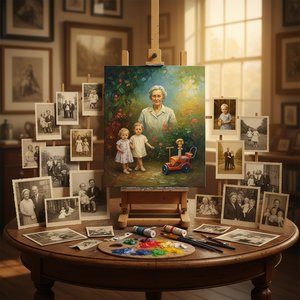
Transform scattered family photos into timeless oil masterpieces with WahooArt. Our master artists hand-paint bespoke portraits that turn precious memories into elegant, generational heirlooms. Experience premium quality, digital previews, and a 100% satisfaction guarantee.

Transform your family's history into a timeless masterpiece. WahooArt specializes in luxury, large-scale custom group portrait commissions for 10+ people. Hand-painted by master artists using traditional oil techniques to create an enduring legacy for your home or organization.


第一时间获取最新的艺术新闻、独家优惠及装饰灵感。
向我们介绍您的项目需求,我们的艺术专家将为您提供 3 个个性化的艺术品推荐。
由我们的专家为您精选 3 款心仪之作 —— 完全免费!


 效果预览
效果预览
 购买手绘画作
 分享
分享 分享
分享
 详情
详情

 下载
下载
 相似作品
相似作品 X射线
X射线 幻灯片播放
幻灯片播放 展开详情
展开详情









 玻璃选项仅适用于110厘米以下的尺寸。


