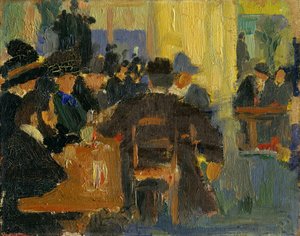
1888
1888 73.0 x 92.0 cm
购买高分辨率增强版数字图像,其品质远超在线预览。
每一份文件都由我们的内部专家使用先进工具与专业的后期润色技术精心打造。我们确保每一张图像都具备卓越的清晰度、精准的色彩还原度以及细腻的细节表现。
最终文件将在 72 小时内通过电子邮件交付,并针对专业、编辑及印刷用途进行了优化。其品质与顶级设计工作室、出版社和画廊所信赖的标准完全一致。
选择 WahooArt.com,您获得的不仅仅是一张图像——您收到的是经过专业级增强、精雕细琢的数字艺术作品,并享有满意保证。以下是您的订单中自动包含的所有内容:

您的高分辨率数字图像文件将在下单后 72 小时内通过电子邮件发送给您 —— 即可立即使用。

您的艺术品经过专业优化,结合先进的 AI 技术与人工修饰,确保呈现极致的细节、清晰度与色彩准确度。

不小心删除了文件或找不到了?没关系——我们将随时为您免费重发。

即刻拥有您的艺术作品,无需支付任何关税、税费或运费——数字下载始终免税。

我们通过专业工具与色彩管理技术,确保您的数字图像尽可能真实地还原原作色彩。

如果您对所购数字图像不满意,我们将在100天内为您进行修改或提供100%的全额退款——无需任何理由。

不满意?在收到数字文件后的100天内,您可以申请全额退款——无需任何理由。

购买 3 张图片可享 10% 折扣 - 购买 5 张可享 15% 折扣 - 购买 10+ 张可享 20% 折扣。非常适合创意项目、画廊和机构使用。

Born in Pontoise, a suburb just northwest of Paris, in 1864, Louis Hayet’s artistic journey was one shaped by both humble beginnings and an evolving engagement with the vibrant currents of late 19th-century art. His early life, marked by financial hardship and a quiet disposition, provided little indication of the distinctive visual language he would eventually develop. Yet, from his youth—as early as 1876—Hayet demonstrated a remarkable talent for drawing, a seed that blossomed through self-directed study and, crucially, a connection with the landscape painter Camille Pissarro and his son Lucien.
Initially apprenticed to his father, who worked as a travelling salesman, Hayet’s artistic pursuits were often relegated to stolen moments spent painting in the surrounding countryside. These early works—primarily watercolors—established a foundation of observation and an appreciation for the subtle shifts of light and color that would become hallmarks of his mature style. Crucially, he was introduced to the burgeoning world of Impressionism through Pissarro’s circle, absorbing influences from artists like Signac and Seurat, though ultimately forging his own unique path within this evolving artistic landscape.
Around 1887, Hayet transitioned to the techniques of Neo-Impressionism, embracing the scientific approach championed by Paul Signac and Georges Seurat. This involved meticulously applying tiny dots or strokes of pure color – a process known as pointillism – to create an image through optical mixing in the viewer’s eye. His early pointillist works, such as “Market in Pontoise,” demonstrate this technique with remarkable precision and a delicate handling of light. These paintings capture the bustling atmosphere of everyday Parisian life—market scenes, café interiors, and glimpses into the city's vibrant entertainment venues – offering a unique perspective on urban modernity.
However, Hayet’s engagement with pointillism was not purely academic. He quickly moved beyond its rigid constraints, incorporating elements of his earlier training and developing a more expressive style. He experimented with color theory, influenced by Eugène Chevreul's research into the psychology of color, creating elaborate color wheels to predict how hues would interact. This scientific approach informed his palette and technique, resulting in paintings that shimmered with subtle luminosity and an almost ethereal quality.
A significant aspect of Hayet’s career involved his work as a decorative painter, particularly for the renowned stage designer Lugné-Poe. His skills were highly sought after, and he spent decades creating elaborate sets for theatrical productions, demonstrating an understanding of color and composition that extended beyond the canvas. This experience undoubtedly influenced his approach to painting, sharpening his eye for detail and his ability to capture fleeting moments of light and atmosphere.
Furthermore, Hayet’s association with Pissarro introduced him to Paul Cézanne, a pivotal figure in modern art. While direct influence is difficult to pinpoint, the emphasis on observation, structure, and the exploration of form evident in Cézanne's work likely resonated with Hayet’s evolving artistic sensibilities.
Despite exhibiting at prominent salons like the Salon des Indépendants and Le Barc de Boutteville, Hayet largely remained a relatively obscure figure during his lifetime. His output was often sporadic, dictated by commercial demands and periods of relative inactivity. He was notably overlooked by Bénézit’s comprehensive dictionary of artists, published in 1923, reflecting the lack of recognition he received for his contributions to Neo-Impressionism.
It wasn't until the mid-20th century that Hayet’s work began to attract serious attention. Today, his paintings are recognized as a significant contribution to both Neo-Impressionism and the broader landscape of French art at the turn of the 20th century. His delicate color palettes, meticulous brushwork, and evocative depictions of Parisian life continue to captivate viewers, offering a unique window into a world of subtle beauty and quiet observation. Works like “Market in Pontoise” are now held in prestigious collections, including the Cleveland Museum of Art, ensuring that this once-forgotten painter’s legacy endures.

1864 - 1940


 效果预览
效果预览
 购买印刷品
购买印刷品 分享
分享 分享
分享
 详情
详情

 下载
下载
 相似作品
相似作品 X射线
X射线 幻灯片播放
幻灯片播放 展开详情
展开详情