
 Song Dynasty Painting
 98.0 x 56.0 cm
 中国美术学院美术馆
博物馆级艺术微喷或帆布版画,制作高效,并提供多种饰面选择。 ( 订购此收藏品的纯手工复刻画作 切换至数字图像销售渠道)
您可以从与原作比例一致的预设尺寸中进行选择。

您可以输入自定义尺寸,以适配特定的画框或空间。如果您选择的尺寸与原图比例不符,我们将对作品进行裁剪,或通过镜像填充/纯色填充边缘的方式来扩展图像。在开始制作之前,我们会向您发送一份数字效果图供您确认。
请注意,屏幕上的预览并不能反映实际的裁剪或扩展效果。只有效果图才能准确展示最终的构图。
虽然我们提供定制尺寸,但为了保持原图比例,我们建议您从预设列表中选择尺寸。

Reading in the Shade
复刻品尺寸说明

Born in Jiaozhou, Shandong province, during the late 17th century (though precise dates remain elusive), Leng Mei – also known as Jichen – stands as a pivotal figure in the development of Chinese portraiture during the Qing dynasty. His life and artistic journey are inextricably linked to the imperial court, where he honed his skills under the tutelage of Jiao Bingzhen, a renowned artist himself, and ultimately became celebrated for his exquisite depictions of court ladies—a genre that would define much of his legacy.
Leng Mei’s early life remains somewhat shrouded in mystery. He was a native of Jiaozhou, a region known for its artistic traditions, and it is believed he received his initial training within the local art scene before being formally apprenticed to Jiao Bingzhen. This association proved crucial, as Jiao Bingzhen's influence shaped Leng Mei’s approach to perspective, modeling, and overall composition – elements that would later become hallmarks of his distinctive style.
Leng Mei’s career truly blossomed within the walls of the Qing court. He began serving as an artist in the Imperial Painting Academy during the Kangxi reign, and continued to contribute significantly to various imperial projects throughout the reigns of Yongzheng and Qianlong. His involvement extended beyond mere illustration; he was frequently tasked with painting palace buildings, elaborate costumes, and, most notably, portraits of court ladies.
Unlike many of his contemporaries who emulated Western techniques – as seen in the work of Ding Guanpeng – Leng Mei remained firmly rooted in traditional Chinese aesthetics. He skillfully blended meticulous detail with a subtle understanding of color and composition, creating images that were both realistic and imbued with an ethereal quality. His portraits weren’t simply likenesses; they captured the grace, elegance, and inner lives of the women who graced the imperial court.
His work was highly valued by the Qianlong Emperor, a discerning patron known for his appreciation of refined artistry. The *Records of the Imperial Workshops* from 1743 reveal that even after Leng Mei’s death, his paintings were signed with his name by imperial decree, demonstrating the profound respect and trust he commanded within the court.
Leng Mei's artistic style is characterized by a remarkable sensitivity to detail and an understated elegance. He employed a refined technique of brushwork, utilizing subtle gradations of color to create a sense of depth and volume. His figures are rendered with a delicate grace, capturing the poise and bearing of court ladies with exceptional accuracy.
A key element of his style is his masterful use of light and shadow. He skillfully employed atmospheric perspective to create a sense of distance and space, while simultaneously highlighting the beauty and refinement of his subjects. His compositions are often balanced and harmonious, reflecting a deep understanding of traditional Chinese principles of design.
Unlike some of his contemporaries who adopted Western techniques, Leng Mei’s work retains a distinctly Chinese sensibility. His portraits are not merely representations of physical appearance; they are imbued with an emotional depth that speaks to the inner lives of the women he depicted.
Leng Mei's contributions to Chinese portraiture during the Qing dynasty were significant, establishing him as a leading figure in the genre. His refined style and meticulous attention to detail influenced generations of artists who followed, shaping the development of courtly portraiture for decades to come.
His works are now held in prestigious collections worldwide, including at The Art Institute of Chicago, where his paintings offer a captivating glimpse into the world of Qing Dynasty court life. Leng Mei’s legacy endures as a testament to the enduring power and beauty of traditional Chinese art – a reminder that even within the confines of imperial service, artistic expression could flourish with grace, subtlety, and profound emotional resonance.
Further exploration can be found at WahooArt.com and Wikipedia.

China

Embark on a scholarly journey through the alchemy of lithography. This definitive guide offers collectors profound insights into the chemical mastery of stone and ink, the medium's historical legacy, and essential expertise for acquiring rare, museum-quality prints with absolute confidence.
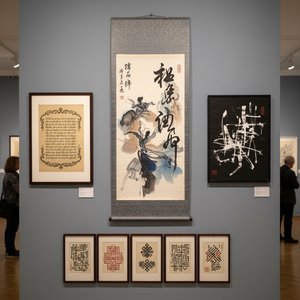
Explore the profound beauty of calligraphy art. From the fluid running script of Chinese masters to historical ink masterpieces, discover how the elegance of line transforms spaces with timeless grace and scholarly sophistication.
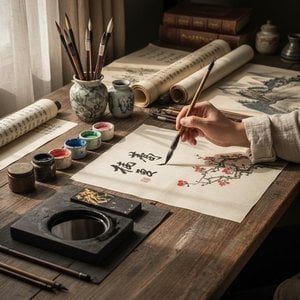
Embark on a sophisticated exploration of ink wash painting and Sumi-e. Uncover the profound historical lineages, Zen philosophies, and technical mastery behind this timeless medium in our authoritative guide for fine art enthusiasts.

Embark on a profound journey through the soul of Chinese calligraphy. Explore the historical mastery of ink, brush, and script, from ancient Zhuanshu to elegant running script, and discover how this timeless art form reflects the enduring spirit of classical East Asian aesthetics.

Discover the art of high-end Giclée and fine art reproductions. Our expert guide explores pigment-based inks, museum-grade substrates, and premium textured prints for the discerning collector seeking archival excellence and unparalleled color fidelity.


 实景预览
实景预览
 发送
发送 分享
分享
 详情
详情 指南
指南

 下载图片
下载图片
 相似作品
相似作品 X射线
X射线 幻灯片播放
幻灯片播放 统计数据
统计数据 阅读全文
阅读全文






































 玻璃选项仅适用于110厘米以下的尺寸。


![Untitled [uwaki No Sō (the Fickle Onethe Fickle One)] — 喜多川歌麿, Impressionistic Style](/media/artworks/images-thumb/46/8e/468eafb3b6da18ad90b6e962513246d1.jpg)


